

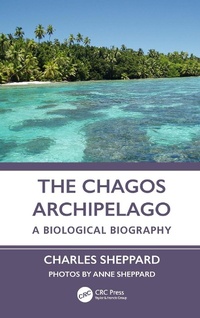
The Chagos Archipelago
A Biological Biography
1st Edition
Published on 25. April 2024
154 pages
978-1-040-01694-7 (ISBN)
Description

This book is the story of the natural history of Chagos Archipelago, and of the efforts of many to get it recognized as an important and protected wildlife reserve. Exploring its immense natural riches and biodiversity, both on islands and in the marine environment, this book addresses competing claims to its resources, its politics, and the desire of some commercial and political parties to exploit the area. It is about the fight to conserve a wonderland of biodiversity and obtain its protection from exploitation, especially of its reefs and other marine life.
This book shows the importance of the Chagos Archipelago and why so much research was done there. Rather than being a typical research book, this work presents research in a narrative form and describes the now substantial Government, UN, and legal interest in the archipelago since the UK was told to 'decolonise' it. It is also the story of our planet in miniature: the archipelago encapsulates much of the world's conservation tribulations in a way we can much more easily understand. This narrative explores the difficulties faced by the Chagos Archipelago, including displaced people, old and derelict industries (coconut in this case), the military, politics, rich and untouched ecosystems that some want to exploit, ruined habitats on land, climate change, and territorial claims. It examines how all of these factors have affected the natural history, biodiversity, and conservation of the archipelago.
With beautiful photography of the Chagos Archipelago coral reefs and islands, as well as graphs indicating their findings, this book offers professionals, researchers, academics, and students in conservation and biodiversity an insight into one of the world's most diverse ecosystems. It is also accessible for non-academic readers with an interest in climate change, biodiversity, and the importance of conservation.
This book shows the importance of the Chagos Archipelago and why so much research was done there. Rather than being a typical research book, this work presents research in a narrative form and describes the now substantial Government, UN, and legal interest in the archipelago since the UK was told to 'decolonise' it. It is also the story of our planet in miniature: the archipelago encapsulates much of the world's conservation tribulations in a way we can much more easily understand. This narrative explores the difficulties faced by the Chagos Archipelago, including displaced people, old and derelict industries (coconut in this case), the military, politics, rich and untouched ecosystems that some want to exploit, ruined habitats on land, climate change, and territorial claims. It examines how all of these factors have affected the natural history, biodiversity, and conservation of the archipelago.
With beautiful photography of the Chagos Archipelago coral reefs and islands, as well as graphs indicating their findings, this book offers professionals, researchers, academics, and students in conservation and biodiversity an insight into one of the world's most diverse ecosystems. It is also accessible for non-academic readers with an interest in climate change, biodiversity, and the importance of conservation.
Reviews / Votes
"Professor Emeritus Charles Sheppard OBE's latest (and final) book on the coral reefs and biogeography of the Chagos Islands is a highly engaging and accessible narrative, but ultimately a plea to act on climate change and human impacts on coral within a decade-or there won't be much left. Charles vividly paints the Chagos archipelago as a unique and broadly instructive microcosm of the world's conservation and governance conundrums, and an ecological reference point. There are few branches of science whose practitioners hope that the outcomes of their lifetime's research might be wrong or become irrelevant, but Charles reminds us, 'that is the case both for scientists researching climate change and its effects on natural systems, not only coral reefs'. As for Chagos and its reefs? We must retain hope, he said, or we are lost. 'After all, we know we will be dead one day but would still see a doctor tomorrow if needed. Why?'. Sadly, the first print of this book arrived at his door just days after his sudden death in 2024 not long after 'retirement'. It is a fitting final publication."Matthew Bunce FMBA, in The Marine Biologist, Issue 32, Oct 2024
More details
Edition
1. Auflage
Language
English
Place of publication
London
United Kingdom
Publishing group
Taylor & Francis Ltd
Target group
College/higher education
Professional and scholarly
Product notice
Reflowable
Illustrations
1 Tables, color; 10 Line drawings, color; 55 Halftones, color; 65 Illustrations, color
ISBN-13
978-1-040-01694-7 (9781040016947)
Copyright in bibliographic data and cover images is held by Nielsen Book Services Limited or by the publishers or by their respective licensors: all rights reserved.
Schweitzer Classification
Other editions
Additional editions
Book
04/2024
1st Edition
CRC Press
€178.44
Shipment within 10-20 days
Person
Charles Sheppard OBE was an Emeritus Professor whose work focused on coral reefs, and impacts of marine exploitation and climate change. He researched in most Indian Ocean and Caribbean countries, wrote about 250 research articles and over a dozen books, and received several awards for conservation.
Anne Sheppard has been Charles' partner and scientific colleague throughout, a biologist, taxonomist and photographer. They first visited the Chagos Archipelago in the 1970s and then, with others, built up a series of research expeditions as the richness, condition and value of Chagos became apparent. This culminated in its declaration as the world's largest no-take ocean reserve.
Photo Jon Schlayer, with permission.
Anne Sheppard has been Charles' partner and scientific colleague throughout, a biologist, taxonomist and photographer. They first visited the Chagos Archipelago in the 1970s and then, with others, built up a series of research expeditions as the richness, condition and value of Chagos became apparent. This culminated in its declaration as the world's largest no-take ocean reserve.
Photo Jon Schlayer, with permission.
Content
1. A tour of the Archipelago. Where and what is BIOT? The Capital Area. Environmental planning in Diego Garcia. The rest of the archipelago 2. Geography, origins, human use. What is so important about coral reefs anyway? 3. Natural history of the islands and human settlement. Environmental history in plantation days. Introduced plants. Seabirds. Rats and other introduced animals. Turtles. Coconut crabs. Final plantation days. Economics and the island environment 4. Restoration, rats and the persistence of the coconut. Possible restoration. Today's tiny islands. Potential value of the islands 5. Coral reefs of Chagos. The earliest scientists. The 1970s reef expeditions. Reef corals in the sunlit coral gardens. Corals at the extremes: the shallowest corals. Corals at the extremes: the deepest corals. Lasting impressions 6. Dark Ages and Enlightenment. The dark ages. Age of Enlightenment. Ship expeditions: a way to do science. Later expeditions. 2006 onwards 7. The first ocean heatwave. 'The reefs are in black and white'. Eroding reefs. Rubble. Recovery and erosion 8. Connections, and the major reef components. Stepping-stones across the ocean. Smaller reef creatures. Juvenile corals. The reef fish. Poaching. Commercial Overfishing. Anchoring on the corals - ships big and small. Sewage in Diego Garcia lagoon 9. Creation of the BIOT Marine Reserve. Deep water not yet explored. More cavalry from over the horizon 10. Climate change research. Measuring water temperatures. Measuring coral cover. Measuring sea level rise. Island erosion. Other climate change. 11. The world's conservation conundrum in one archipelago. Conservation and deniers in a changing landscape. Costs and values of conservation in Chagos. Hostility about working in Chagos. The Military era and Modern environmental and commercial problems. 12. What of the future? A poor prognosis?. Why justify it?. Politics and the future . In the End. References
