

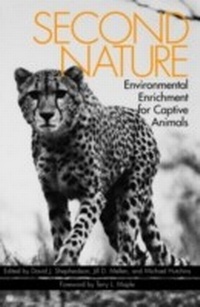
Second Nature
Environmental Enrichment for Captive Animals
1st Edition
Published on 11. January 2012
372 pages
978-1-58834-365-9 (ISBN)
Description

Growing recognition of the complexity of animals' physical, social, and psychological lives in the wild has led both zookeepers and the zoo-going public to call for higher environmental standards for animals in captivity.
Bringing together the work of animal behaviorists, zoo biologists, and psychologists, Second Nature explores a range of innovative strategies for environmental enrichment in laboratories and marine parks, as well as in zoos. From artificial fleeing-prey devices for leopards to irregular feeding schedules for whales, the practices discussed have resulted in healthier, more relaxed animals that can breed more easily and can exert some control over their environments. Moving beyond the usual studies of primates to consider the requirements of animals as diverse as reptiles, amphibians, marine mammals, small cats, hooved grazers, and bears, contributors argue that whether an animal forages in the wild or plays computer games in captivity, the satisfaction its activity provides—rather than the activity itself—determines the animal's level of physical and psychological well-being.
Second Nature also discusses the ways in which environmental enrichment can help zoo-bred animals develop the stamina and adaptability for survival in the wild, and how it can produce healthier lab animals that yield more valid test results. Providing a theoretical framework for the science of environmental enrichment in a variety of settings, the book renews and extends a humane approach to the keeping and conservation of animals.
Bringing together the work of animal behaviorists, zoo biologists, and psychologists, Second Nature explores a range of innovative strategies for environmental enrichment in laboratories and marine parks, as well as in zoos. From artificial fleeing-prey devices for leopards to irregular feeding schedules for whales, the practices discussed have resulted in healthier, more relaxed animals that can breed more easily and can exert some control over their environments. Moving beyond the usual studies of primates to consider the requirements of animals as diverse as reptiles, amphibians, marine mammals, small cats, hooved grazers, and bears, contributors argue that whether an animal forages in the wild or plays computer games in captivity, the satisfaction its activity provides—rather than the activity itself—determines the animal's level of physical and psychological well-being.
Second Nature also discusses the ways in which environmental enrichment can help zoo-bred animals develop the stamina and adaptability for survival in the wild, and how it can produce healthier lab animals that yield more valid test results. Providing a theoretical framework for the science of environmental enrichment in a variety of settings, the book renews and extends a humane approach to the keeping and conservation of animals.
More details
Other editions
Additional editions
David J. Shepherdson | Jill D. Mellen | Michael Hutchins
Second Nature
Environmental Enrichment for Captive Animals
Book
05/1999
Smithsonian Books
€22.00
Shipment within 3-4 weeks
Persons
David J. Shepherdson is program scientist at Metro Washington Park Zoo in Portland, Oregon. Jill D. Mellen is a behavioral scientist at the Walt Disney Animal Program in Orlando, Florida. Michael Hutchins is director of conservation and science for the American Zoo and Aquarium Association, based in Bethesda, Maryland.
Content
- Intro
- Title Page
- Copyright
- Contents
- List of Contributors
- Foreword
- Preface
- Acknowledgments
- 1. Introduction: Tracing the Path of Environmental Enrichment in Zoos: David J. Shepherdson
- Part One: Theoretical Bases of Environmental Enrichment
- 2. Evolution, Ecology, and Enrichment: Basic Considerations for Wild Animals in Zoos: John Seidensticker Debra L. Forthman
- 3. Environmental Enrichment and The Importance of Exploratory Behavior: Joy A. Mench
- 4. Power for Captive Animals: Contingencies and Nature: Hal Markowitz Cheryl Aday
- 5. Context, Ethics, and Environmental Enrichment in Zoos and Aquariums: Michael D. Kreger Michael Hutchins Nina Fascione
- 6. Meeting a Mammal's Psychological Needs: Basic Principles: Trevor B. Poole
- Part Two: Environmental Enrichment in Animal Conservation and Welfare
- 7. The Captive Environment and Reintroduction: The Black-Footed Ferret as a Case Study with Comments on Other Taxa: Brian Miller, Dean Biggins, Astrid Vargas, Michael Hutchins, Louis Hanebury, Jerry Godbey, Stan Anderson, Chris Wemmer, and John Oldemeier
- 8. Environmental Enrichment in a Reintroduction Program for Golden Lion Tamarins (Leontopithecus rosalia): M. InES Castro Benjamin B. Beck Devra G. Kleiman Carlos R. Ruiz-Miranda Alfred L. Rosenberger
- 9. Psychological Well-Being of Captive Nonhuman Primates: Lessons from Laboratory Studies: Carolyn M. Crockett
- 10. Zoos, Enrichment, and the Skeptical Observer: The Practical Value of Assessment: Kathleen N. Morgan, Scott W. Line, and Hal Markowitz
- 11. Determining the Causes of Stereotypic Behaviors in Zoo Carnivores: Toward Appropriate Enrichment Strategies: Kathy Carlstead
- 12. Captive Environments for Small Felids: Jill D. Mellen, Marc P. Hayes, and David J. Shepherdson
- Part Three: Environmental Enrichment in Captive Management, Husbandry, and Training
- 13. Beyond Mammals: Environmental Enrichment for Amphibians and Reptiles: Marc P. Hayes, Mark R. Jennings, and Jill D. Mellen
- 14. Toward Optimal Care for Confined Ungulates: Debra L. Forthman
- 15. Enrichment of Captive Mammals through Provisioning: Donald G. Lindburg
- 16. A Veterinary Perspective of Potential Risk Factors in Environmental Enrichment: Janet F. Baer
- 17. Positive Reinforcement Training as an Enrichment Strategy: Gail Laule and Tim Desmond
- 18. Environmental Enrichment for Marine Mammals at Sea World: Stan A. Kuczaj II, C. Thad Lacinak, and Ted N. Turner
- 19. Epilogue: The Future of Environmental Enrichment: Jill D. Mellen, David J. Shepherdson, and Michael Hutchins
