

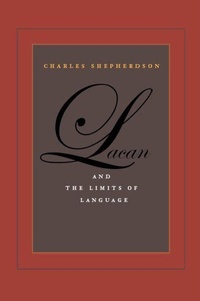
Lacan and the Limits of Language
1st Edition
Published on 25. August 2009
272 pages
978-0-8232-3784-5 (ISBN)
Description

This book weaves together three themes at the intersection of Jacques Lacan and the philosophical tradition. The first is the question of time and memory. How do these problems call for a revision of Lacan's purported "ahistoricism," and how does the temporality of the subject in Lacan intersect with the questions of temporality initiated by Heidegger and then developed by contemporary French philosophy? The second question concerns the status of the body in Lacanian theory, especially in connection with emotion and affect, which Lacanian theory is commonly thought to ignore, but which the concept of jouissance was developed to address. Finally, it aims to explore, beyond the strict limits of Lacanian theory, possible points of intersection between psychoanalysis and other domains, including questions of race, biology, and evolutionary theory.
By stressing the question of affect, the book shows how Lacan's position cannot be reduced to the structuralist models he nevertheless draws upon, and thus how the problem of the body may be understood as a formation that marks the limits of language. Exploring the anthropological category of "race" within a broadly evolutionary perspective, it shows how Lacan's elaboration of the "imaginary" and the "symbolic" might allow us to explain human physiological diversity without reducing it to a cultural or linguistic construction or allowing "race" to remain as a traditional biological category. Here again the questions of history and temporality are paramount, and open the possibility for a genuine dialogue between psychoanalysis and biology.
Finally, the book engages literary texts. Antigone, Ovid's Metamorphoses, Hamlet, and even Wordsworth become the muses who oblige psychoanalysis and philosophy to listen once again to the provocations of poetry, which always disrupts our familiar notions of time and memory, of history and bodily or affective experience, and of subjectivity itself.
By stressing the question of affect, the book shows how Lacan's position cannot be reduced to the structuralist models he nevertheless draws upon, and thus how the problem of the body may be understood as a formation that marks the limits of language. Exploring the anthropological category of "race" within a broadly evolutionary perspective, it shows how Lacan's elaboration of the "imaginary" and the "symbolic" might allow us to explain human physiological diversity without reducing it to a cultural or linguistic construction or allowing "race" to remain as a traditional biological category. Here again the questions of history and temporality are paramount, and open the possibility for a genuine dialogue between psychoanalysis and biology.
Finally, the book engages literary texts. Antigone, Ovid's Metamorphoses, Hamlet, and even Wordsworth become the muses who oblige psychoanalysis and philosophy to listen once again to the provocations of poetry, which always disrupts our familiar notions of time and memory, of history and bodily or affective experience, and of subjectivity itself.
Reviews / Votes
Refusing dogmas of the established paradigms of interpretation, and yetrespecting the specificity of psychoanalytic, philosophic, and literary
practices, "Lacan and the Limit of Language" stages refreshing
encounters between Lacanian psychoanalysis and its others: Kristeva,
Heidegger, Derrida, or Foucault, to name just a few thinkers treated in
this impressive study. In the process the book invites us to reflect
again on the key concepts structuring these encounters: emotion, the
body, race, sexuality, mood, tragedy, and above all, on the
ethico-political implications of the limits of signification. -- -Ewa Ziarek * author of "The Ethics of Dissensus" * In Lacan and the limits of language, Charles Shepherdson shows with admirable clarity, cogency and competence that psychoanalysis founds an anthropology of love, hate, desire, beauty, fantasy and memory while keeping its cutting edge in today's discussions of war, race, sexual difference and tragedy. Thanks to him, thinking with Lacan becomes an act of enlightenment. -- -Jean-Michel Rabate * Vartan Gregorian Professor in the Humanities at the University of Pennsylvania * "Shepherdson's knowledge and use of the history of philosophy is stunning." -- -Kelly Oliver * Vanderbilt University * Shepherdson's broadly learned background--in classics, philosophy, literature, critical and literary theory, and medical science--coupled with his lucid prose, makes him a compelling reader of Lacan. A more supple, nuanced and engaging Lacan emerges from the patient encounters Shepherdson stages among disciplines--a Lacan for our time, for time out of joint. Shepherdson is the analyst's analyst. -- -Arden Reed * Pomona College * He (Shepherdson) compels the reader to ask deeper question of psychoanalysis and, indeed, to question the very aim of psychoanalysis -- -Melissa Conroy * Muskingum College * Shepherdson's writings are crucial interventions in the seemingly endless debates about the excesses of 'discursive construction.' And while the essays in this volume range far beyond those debates, they remind the reader of the costs of being caught up in a kind of oppositional thinking that seems to cling to the nineteenth century, as if Freud had never existed. -- -Elizabeth Weed * Brown University *
More details
Language
English
Place of publication
NY
United States
Target group
Professional and scholarly
File size
1,07 MB
ISBN-13
978-0-8232-3784-5 (9780823237845)
Copyright in bibliographic data and cover images is held by Nielsen Book Services Limited or by the publishers or by their respective licensors: all rights reserved.
Schweitzer Classification
Other editions
Additional editions
Charles Shepherdson
Lacan and the Limits of Language
Book
03/2008
Fordham University Press
€110.10
Shipment within 10-20 days
Charles Shepherdson
Lacan and the Limits of Language
Book
03/2008
Fordham University Press
€43.50
Shipment within 10-20 days
Person
CHARLES SHEPHERDSON is Professor of English at the University at Albany, State University of New York. He is the author of Vital Signs: Nature, Culture, Psychoanalysis and
The Epoch of the Body.
The Epoch of the Body.
