

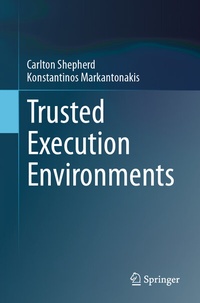
Trusted Execution Environments
1st Edition
Published on 26. June 2024
XXVIII, 196 pages
978-3-031-55561-9 (ISBN)
Description

Trusted execution environments (TEEs) protect sensitive code and data on computing platforms, even when the primary operating system is compromised. Once a technical curiosity, TEEs have rapidly become a key component in securing numerous systems from cloud servers to constrained devices. Today, TEEs have been deployed on billions of devices for protecting financial payments, personal files, copyrighted media content, and many others. Despite this, TEEs remain poorly understood due to their complexity and diversity. This book addresses this gap, providing a comprehensive treatment of different TEE technologies, their features, benefits, and shortcomings.
A holistic view of secure and trusted execution is taken, examining smart cards and CPU protection rings before discussing modern TEEs, such as Intel SGX and ARM TrustZone. A wide range of paradigms for building secure and trusted execution environments are explored, from dedicated security chips to system-on-chip extensions and virtualisation technologies. The relevant industry standards and specifications are covered in detail, including how TEEs are evaluated and certified in practice with respect to security. Several case studies are presented showing how TEEs are used in some common security mechanisms, such as secure boot sequences, biometric authentication, and file-based encryption. This book also discusses present challenges in the field, covering potential attack vectors against TEEs and concerns relating to fragmentation, interoperability, and transparency. Lastly, a selection of future directions are examined that may be used by the trusted execution environments of tomorrow.
This book is particularly targeted at practitioners and researchers in cyber security, such as penetration testers, security engineers, and security analysts. Additionally, this book serves as a valuable resource for university students, both postgraduate and advanced undergraduates, and professors in computer science and electrical engineering.
A holistic view of secure and trusted execution is taken, examining smart cards and CPU protection rings before discussing modern TEEs, such as Intel SGX and ARM TrustZone. A wide range of paradigms for building secure and trusted execution environments are explored, from dedicated security chips to system-on-chip extensions and virtualisation technologies. The relevant industry standards and specifications are covered in detail, including how TEEs are evaluated and certified in practice with respect to security. Several case studies are presented showing how TEEs are used in some common security mechanisms, such as secure boot sequences, biometric authentication, and file-based encryption. This book also discusses present challenges in the field, covering potential attack vectors against TEEs and concerns relating to fragmentation, interoperability, and transparency. Lastly, a selection of future directions are examined that may be used by the trusted execution environments of tomorrow.
This book is particularly targeted at practitioners and researchers in cyber security, such as penetration testers, security engineers, and security analysts. Additionally, this book serves as a valuable resource for university students, both postgraduate and advanced undergraduates, and professors in computer science and electrical engineering.
More details
Series
Language
English
Place of publication
Cham
Switzerland
Publishing group
Springer International Publishing
Target group
Professional and scholarly
Product notice
Reflowable
Illustrations
XXVIII, 196 p. 59 illus., 51 illus. in color.
File size
8,08 MB
ISBN-13
978-3-031-55561-9 (9783031555619)
DOI
10.1007/978-3-031-55561-9
Schweitzer Classification
Other editions
Additional editions
Carlton Shepherd | Konstantinos Markantonakis
Trusted Execution Environments
Book
06/2024
Springer
€42.79
Shipment within 15-20 days
Persons
Dr. Carlton Shepherd (Ph.D., B.Sc.) is a Lecturer (equivalent to Assistant Professor) in Computing at Newcastle University, UK. His expertise lies in security issues at the intersection of hardware and software on mobile and embedded systems. Specific areas of interest include trusted execution environments, CPU security, side-channel analysis, and fault injection attacks. He was previously a Senior Research Fellow at the Information Security Group at Royal Holloway, University of London, and held research and development positions in financial technology before becoming an academic. He holds a Ph.D. in Information Security from Royal Holloway, University of London, and a B.Sc. in Computer Science from Newcastle University.
Prof. Konstantinos Markantonakis (M.Sc., M.B.A., Ph.D.) is a Professor of Information Security in the Information Security Group in Royal Holloway University of London. He is also the Director of the Information Security Group Smart Card and IoT Security Centre (SCC). His main research interests include smart card security and applications, the Internet of Things (IoT), embedded systems, payment and avionics system security. He has published more than 200 papers in international conferences and journals, and attracted funding from industry and UK and EU funding sources. Prof. Markantonakis is also Director of the `Transformative Digital Technologies, Security and Society' Catalyst, at Royal Holloway University of London, responsible for coordinating multidisciplinary research and impact activities. He is the chair of IFIP WG 11.2 Pervasive Systems Security, has experience in commercialising cyber security research, and is an experienced consultant working across several technology companies. He received his B.Sc. in Computer Science from Lancaster University, and M.Sc. and Ph.D. in Information Security, and an M.B.A. in International Management all from Royal Holloway, University of London.
Prof. Konstantinos Markantonakis (M.Sc., M.B.A., Ph.D.) is a Professor of Information Security in the Information Security Group in Royal Holloway University of London. He is also the Director of the Information Security Group Smart Card and IoT Security Centre (SCC). His main research interests include smart card security and applications, the Internet of Things (IoT), embedded systems, payment and avionics system security. He has published more than 200 papers in international conferences and journals, and attracted funding from industry and UK and EU funding sources. Prof. Markantonakis is also Director of the `Transformative Digital Technologies, Security and Society' Catalyst, at Royal Holloway University of London, responsible for coordinating multidisciplinary research and impact activities. He is the chair of IFIP WG 11.2 Pervasive Systems Security, has experience in commercialising cyber security research, and is an experienced consultant working across several technology companies. He received his B.Sc. in Computer Science from Lancaster University, and M.Sc. and Ph.D. in Information Security, and an M.B.A. in International Management all from Royal Holloway, University of London.
Content
Introduction.- Background Material.- Operating System Controls.- Isolated Hardware Execution Platforms.- Building Execution Environments from the Trusted Platform Module.- Trusted World Systems.- Enclave Computing.- Deployment Issues, Attacks, and Other Challenges.- Conclusion.
