

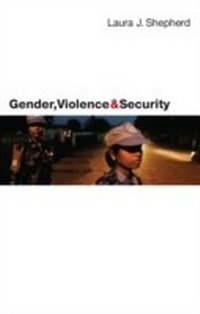
Gender, Violence and Security
Discourse as Practice
1st Edition
Published on 4. July 2013
224 pages
978-1-84813-681-6 (ISBN)
Description

How do understandings of the relationships between gender, violence, security and the international inform policy and practice in which these notions are central? What are the practical implications of basing policy on problematic discourses?
In this highly original poststructural feminist critique, the author maps the discursive terrains of institutions, both NGOs and the UN, which formulate and implement resolutions and guides of practice that affect gender issues in the context of international policy practices.
The author investigates UN Security Council Resolution 1325, passed in 2000 to address gender issues in conflict areas, in order to examine the discursive construction of security policy that takes gender seriously. In doing so, she argues that language is not merely descriptive of social/political reality but rather constitutive of it. Moving from concept to discourse, and in turn to practice, the author analyses the ways in which the resolution's discursive construction had an enormous influence over the practicalities of its implementation, and how the resulting tensions and inconsistencies in its construction contributed to its failures. The book argues for a re-conceptualisation of gendered violence in conjunction with security, in order to avoid partial and highly problematic understandings of their practical relationship.
Drawing together theoretical work on discourses of gender violence and international security, sexualised violence in war, gender and peace processes, and the domestic-international dichotomy with her own rigorous empirical investigation, the author develops a compelling discourse-theoretical analysis that promises to have far-reaching impact in both academic and policy environments.
In this highly original poststructural feminist critique, the author maps the discursive terrains of institutions, both NGOs and the UN, which formulate and implement resolutions and guides of practice that affect gender issues in the context of international policy practices.
The author investigates UN Security Council Resolution 1325, passed in 2000 to address gender issues in conflict areas, in order to examine the discursive construction of security policy that takes gender seriously. In doing so, she argues that language is not merely descriptive of social/political reality but rather constitutive of it. Moving from concept to discourse, and in turn to practice, the author analyses the ways in which the resolution's discursive construction had an enormous influence over the practicalities of its implementation, and how the resulting tensions and inconsistencies in its construction contributed to its failures. The book argues for a re-conceptualisation of gendered violence in conjunction with security, in order to avoid partial and highly problematic understandings of their practical relationship.
Drawing together theoretical work on discourses of gender violence and international security, sexualised violence in war, gender and peace processes, and the domestic-international dichotomy with her own rigorous empirical investigation, the author develops a compelling discourse-theoretical analysis that promises to have far-reaching impact in both academic and policy environments.
Reviews / Votes
Laura Shepherd shows us here how we can bring the burgeoning scholarships on violence against women and on human security into conversation with each other in a way that makes us smarter about each - and about the intricate trickily gendered political processes of the UN too. Quite a feat. * Cynthia Enloe, Clark University * In this book, we are invited to 'think differently' about gender, violence, security and the international, and a space is made for imagining, and so acting, otherwise ... it is a model of clarity, intellectual rigour, and empathetic engagement. * Jindy Pettman, Gender, The Australian National University * This is an excellent example of contemporary feminist poststructural research. It offers a sophisticated, perceptive and persuasive analysis of the discursive constitution of gender/violence. Written with exquisite clarity, it will be of great use in both teaching and research as well as to the policy community. * Marysia Zalewski, University of Aberdeen *More details
Edition
1. Auflage
Language
English
Place of publication
United Kingdom
Publishing group
Bloomsbury Publishing PLC
Target group
College/higher education
Professional and scholarly
ISBN-13
978-1-84813-681-6 (9781848136816)
Copyright in bibliographic data and cover images is held by Nielsen Book Services Limited or by the publishers or by their respective licensors: all rights reserved.
Schweitzer Classification
Other editions
Additional editions
Book
04/2008
Zed Books Ltd
€51.70
Shipment within 3-4 weeks
Person
Laura J. Shepherd is Lecturer in International Relations and International Law in the Department of Political Science and International Studies, University of Birmingham. She has published on gender/ed violence and security in Millennium: Journal of International Studies (2005) and British Journal of Politics and International Relations (2007).
Content
1. Introduction
2. Analytical Strategies
3. Literature Review
4. The Secretary-General's Reports
5. United Nations Security Council Resolution 1325
6. Exploring the Narratives of Production of UNSCR 1325
7. Conclusions
2. Analytical Strategies
3. Literature Review
4. The Secretary-General's Reports
5. United Nations Security Council Resolution 1325
6. Exploring the Narratives of Production of UNSCR 1325
7. Conclusions
