

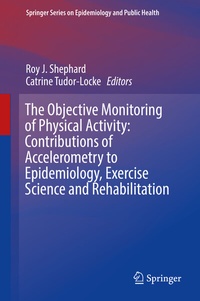
The Objective Monitoring of Physical Activity: Contributions of Accelerometry to Epidemiology, Exercise Science and Rehabilitation
Description

This book examines the new knowledge that has been gained from the objective monitoring of habitual physical activity by means of pedometers and accelerometers. It reviews current advances in the technology of activity monitoring and details advantages of objective monitors relative to physical activity questionnaires. It points to continuing gaps in knowledge, and explores the potential for further advances in the design of objective monitoring devices.
Epidemiologists have studied relationships between questionnaire assessments of habitual physical activity and various medical conditions for some seventy years. In general, they have observed positive associations between regular exercise and good health, but because of inherent limitations in the reliability and accuracy of physical activity questionnaires, optimal exercise recommendations for the prevention and treatment of disease have remained unclear.
Inexpensive pedometers and accelerometers now offer the epidemiologist the potential to collect relatively precisely graded and objective information on the volume, intensity and patterns of effort that people are undertaking, to relate this data to past and future health experience, and to establish dose/response relationships between physical activity and the various components of health. Such information is important both in assessing the causal nature of the observed associations and in establishing evidence-based recommendations concerning the minimal levels of daily physical activity needed to maintain good health.
More details
Other editions
Additional editions
Content
Introduction: a new perspective on the epidemiology of physical activity.- Chapter 1. Physical activity and optimal health: the challenge to epidemiology.- Chapter 2. History of physical activity measurement in epidemiology.- Chapter 3. Evolution of the pedometer.- Chapter 4. Newer approaches to the objective measurement of physical activity.- Chapter 5. Optimal patterns for the sampling of physical activity in various age groups and environments.- Chapter 6. New information on population activity patterns revealed by objective monitoring.- Chapter 7. Can the epidemiologist learn more from sedentary behaviour than from the measurement of physical activity?.- Chapter 8. New perspectives on activity/disease relationships yielded by objective monitoring.- Chapter 9. Excessive appetite vs. inadequate physical activity in the pathology of obesity. Evidence from objective monitoring.- Chapter 10. Objective monitoring and the challenge of defining dose/response relationships for the prevention of chronic disease.- Chapter 11. The economic benefits of increased physical activity as seen through an objective lens.- Chapter 12. Limitations of current objective monitors and the potential to overcome these problems.- Chapter 13. Future directions and conclusions.
