

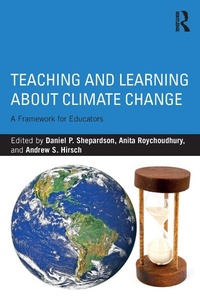
Teaching and Learning about Climate Change
A Framework for Educators
Published on 17. February 2017
280 pages
978-1-317-24525-4 (ISBN)
Description

Responding to the issues and challenges of teaching and learning about climate change from a science education-based perspective, this book is designed to serve as an aid for educators as they strive to incorporate the topic into their classes. The unique discussion of these issues is drawn from the perspectives of leading and international scholars in the field. The book is structured around three themes: theoretical, philosophical, and conceptual frameworks for climate change education and research; research on teaching and learning about global warming and climate change; and approaches to professional development and classroom practice.
Reviews / Votes
"This book is likely to be of interest to you if you are concerned about how the public perceives the issue of climate change... "It will also be of interest to you if you are interested in how students' beliefs affect the way they interpret evidence for any scientific theory..."- Carol Tear, School Science ReviewMore details
Language
English
Place of publication
London
United Kingdom
Publishing group
Taylor & Francis Ltd
Target group
Professional and scholarly
Illustrations
28 Tables, black and white; 35 Illustrations, black and white
File size
4,17 MB
ISBN-13
978-1-317-24525-4 (9781317245254)
Copyright in bibliographic data and cover images is held by Nielsen Book Services Limited or by the publishers or by their respective licensors: all rights reserved.
Schweitzer Classification
Other editions
Additional editions
Daniel P. Shepardson | Anita Roychoudhury | Andrew S. Hirsch
Teaching and Learning about Climate Change
A Framework for Educators
Book
02/2017
1st Edition
Routledge
€252.20
Shipment within 10-20 days
Daniel P. Shepardson | Anita Roychoudhury | Andrew S. Hirsch
Teaching and Learning about Climate Change
A Framework for Educators
Book
02/2017
1st Edition
Routledge
€74.70
Shipment within 10-20 days
Persons
Daniel P. Shepardson is Professor of Geoenvironmental and Science Education, Departments of Curriculum and Instruction and Earth, Atmospheric, and Planetary Sciences, Purdue University, USA.
Anita Roychoudhury is Professor of Curriculum and Instruction (Science Education/Physics Education) at Purdue University, USA.
Andrew S. Hirsch is Professor of Physics, Department of Physics and Astronomy, Purdue University, USA.
Anita Roychoudhury is Professor of Curriculum and Instruction (Science Education/Physics Education) at Purdue University, USA.
Andrew S. Hirsch is Professor of Physics, Department of Physics and Astronomy, Purdue University, USA.
Content
Preface
Section I. Theoretical, philosophical, and conceptual frameworks for climate change education and research
1. Teaching climate science as history
Spencer Weart
2. The role of history and nature of science in climate change teaching and learning
Michael P. Clough and Benjamin C. Herman
3. System thinking and teaching in the context of climate system and climate change
Anita Roychoudhury, Daniel P. Shepardson, and Andrew S. Hirsch
4. Attending to emotional expressions about climate change: A framework for teaching and learning
Elizabeth Hufnagel
5. Using a socioscientific issues framework for climate change education: An ecojustice approach Dana L. Zeidler and Mark Newton
Section II. Research on teaching and learning about global warming and climate change
6. Students' conception of a climate system: Implications for teaching and learning
Daniel P. Shepardson, Anita Roychoudhury, Andrew S. Hirsch, and Sara Top
7. Using conceptual and physical models to develop students' mental models of the greenhouse effect
Daniel P. Shepardson, Anita Roychoudhury, and Andrew S. Hirsch
8. Unpacking the climate change performance expectations in the Next Generation Science Standards
Wendy R. Johnson and Charles W. Anderson
9. Fundamental climate literacy and the promise of the NGSS
KC Busch and Diego Roman
10. Supporting the inclusion of climate change in U.S. science education curricula by use of learning progressions
J. Randy McGinnis, Wayne Breslyn, Chris McDonald, and Emily Hestness
11. Climate change as an issue for socio-scientific issues teaching and learning
Amanda Peel, Troy D. Sadler, Andrew T. Kinslow, Laura Zangori, and Patricia Friedrichsen
12. "This idea they have is not really to me, like, true:" How seventh grade students make meaning of scientific arguments about the impact of global warming on tornadoes and hurricanes Soyoung Choi and Dan Shepardson
Section III. Approaches to professional development and classroom practice
13. Using NGSS crosscutting concepts as a tool for climate change and citizenship education
Hannah K. Miller and Charles W. Anderson
14. The Earth's energy budget
Andrew S. Hirsch
15. Teaching informed by conceptual difficulties with understanding the greenhouse effect
Nicole Strickhouser, Anita Roychoudhury, Andrew S. Hirsch, and Jignesh V. Mehta
16. Developing and implementing a climate science toolkit for informal and formal educators Olivia Kellner
17. Adaptation of the Dynamics of Climate toolkit for informal and formal educators in the local community
Olivia Kellner, Brandy Yost, and Leslie Webb
18. Doubt and denial as challenges to, and in, teaching climate change
Minda Berbeco, Glenn Branch, & Kate Heffernan
About the Authors
Section I. Theoretical, philosophical, and conceptual frameworks for climate change education and research
1. Teaching climate science as history
Spencer Weart
2. The role of history and nature of science in climate change teaching and learning
Michael P. Clough and Benjamin C. Herman
3. System thinking and teaching in the context of climate system and climate change
Anita Roychoudhury, Daniel P. Shepardson, and Andrew S. Hirsch
4. Attending to emotional expressions about climate change: A framework for teaching and learning
Elizabeth Hufnagel
5. Using a socioscientific issues framework for climate change education: An ecojustice approach Dana L. Zeidler and Mark Newton
Section II. Research on teaching and learning about global warming and climate change
6. Students' conception of a climate system: Implications for teaching and learning
Daniel P. Shepardson, Anita Roychoudhury, Andrew S. Hirsch, and Sara Top
7. Using conceptual and physical models to develop students' mental models of the greenhouse effect
Daniel P. Shepardson, Anita Roychoudhury, and Andrew S. Hirsch
8. Unpacking the climate change performance expectations in the Next Generation Science Standards
Wendy R. Johnson and Charles W. Anderson
9. Fundamental climate literacy and the promise of the NGSS
KC Busch and Diego Roman
10. Supporting the inclusion of climate change in U.S. science education curricula by use of learning progressions
J. Randy McGinnis, Wayne Breslyn, Chris McDonald, and Emily Hestness
11. Climate change as an issue for socio-scientific issues teaching and learning
Amanda Peel, Troy D. Sadler, Andrew T. Kinslow, Laura Zangori, and Patricia Friedrichsen
12. "This idea they have is not really to me, like, true:" How seventh grade students make meaning of scientific arguments about the impact of global warming on tornadoes and hurricanes Soyoung Choi and Dan Shepardson
Section III. Approaches to professional development and classroom practice
13. Using NGSS crosscutting concepts as a tool for climate change and citizenship education
Hannah K. Miller and Charles W. Anderson
14. The Earth's energy budget
Andrew S. Hirsch
15. Teaching informed by conceptual difficulties with understanding the greenhouse effect
Nicole Strickhouser, Anita Roychoudhury, Andrew S. Hirsch, and Jignesh V. Mehta
16. Developing and implementing a climate science toolkit for informal and formal educators Olivia Kellner
17. Adaptation of the Dynamics of Climate toolkit for informal and formal educators in the local community
Olivia Kellner, Brandy Yost, and Leslie Webb
18. Doubt and denial as challenges to, and in, teaching climate change
Minda Berbeco, Glenn Branch, & Kate Heffernan
About the Authors
