

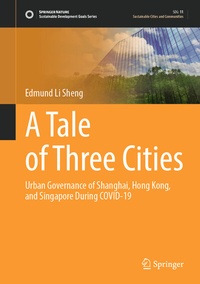
A Tale of Three Cities
Description

The proposed book presents the cutting-edge research on the urban development of three cities: Shanghai, Hong Kong, and Singapore. By comparing their responses to the COVID-19 pandemic from an international political economic perspective, this book examines the commonalities and differences in urban governance in these three widely recognized and well-developed Asian cities with outward-oriented economies through the lens of world-systems theory and related theories of historicism. These cities are all generally considered to be under authoritarian regimes, but there are substantial differences in their social systems, rules of law and justice, and administrative structures.
In the context of globalization, the cities are competing on a more even playing field. In addition, city governments worldwide are increasingly pursuing growth, land markets, urban regeneration, and large-scale public projects. With the advent of globalization, urban development is gradually changing from the past crude model of spatial expansion and land finance to a more refined model of socioeconomic development driven by industrial upgrading and enhanced consumption. However, cities' political and economic contexts and governance systems vary greatly. Unsurprisingly, given their differences, the three cities of Shanghai, Hong Kong, and Singapore demonstrated varied responses to the COVID-19 pandemic. This book discusses the efforts of these governments to address and reduce the spread of COVID-19 as well as how national responses to the pandemic outbreak were influenced by global dynamics, geopolitics, and each nation's particular historical context.
More details
Other editions
Additional editions
Person
Edmund Li Sheng, University Distinguished Professor of Shandong University, Executive Director of Shanghai Cooperation Organization Research Institute; B.A. in German Studies at Peking University, M.A. and Ph.D. in Economics from the University of Freiburg; has taught and held visiting professorships at the University of Freiburg, University of Macau, Sun Yat-sen University, Walter Eucken Institute, Kobe University, University of Erlangen-Nuremberg, and Florida State University. He has published more than 100 papers in international journals, including 46 papers in SSCI journals, 12 monographs in English and German, 1520 Google citations, H-index 26. He was awarded the second prize of the Excellence Award in Scientific Research (Humanities and Social Sciences) of the Chinese Ministry of Education.
Content
1. Dynamic clearing or group immunization? A tale of three cities and their COVID-19 responses.- 2. Divergence of anti-pandemic policies: origin and development.- 3. Differences and similarities in urban governance during the pandemic.- 4. Crisis management during the pandemic.- 5. Revitalization: new opportunities and challenges in the post-pandemic era.- 6. Future frontiers: a tale of three cities and the world.- 7. Conclusion.
