

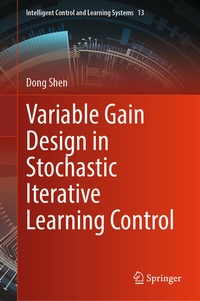
Variable Gain Design in Stochastic Iterative Learning Control
Description

This book investigates the critical gain design in stochastic iterative learning control (SILC), including four specific gain design strategies: decreasing gain design, adaptive gain design, event-triggering gain design, and optimal gain design. The key concept for the gain design is to balance multiple performance indices such as high tracking precision, effective noise reduction, and fast convergence speed. These gain design techniques can be applied to various control algorithms for stochastic systems to realize a high tracking performance. This book provides a series of design and analysis techniques for the establishment of a systematic framework of gain design in SILC. The book is intended for scholars and graduate students who are interested in stochastic control, recursive algorithms design, and iterative learning control.
Reviews / Votes
"The methods presented in this monograph, widely based on the author's contributions . . Each method is justified by a careful convergence analysis completed by nice simulation examples; the latter are very helpful for the reader and contribute to make the book pedagogical. The book ends with a list of more than 200 references and a (rather small) subject index." (Henri Bourlès, zbMATH 1561.93001, 2025)
More details
Other editions
Additional editions
Person
Dong Shen received the B.S. degree in mathematics from the School of Mathematics, Shandong University, Jinan, China, in 2005, and the Ph.D. degree in mathematics from the Academy of Mathematics and Systems Science, Chinese Academy of Sciences (CAS), Beijing, China, in 2010. From 2010 to 2012, he was a postdoctoral fellow with the Institute of Automation, CAS. From 2012 to 2019, he was with the College of Information Science and Technology, Beijing University of Chemical Technology, Beijing. In 2016 and 2019, he was a visiting scholar with the National University of Singapore, Singapore, and RMIT University, Melbourne, VIC, Australia, respectively. Since 2020, he has been a professor at the School of Mathematics, Renmin University of China, Beijing. His research interests include iterative learning control, stochastic optimization, stochastic systems, and distributed artificial intelligence.
Content
Introduction.- Preliminary Results.- Decreasing Gain Design.- Adaptive Gain Design.- Event triggering Gain Design.- Optimal Gain Design.- Conclusions and Open Problems.- References.
