

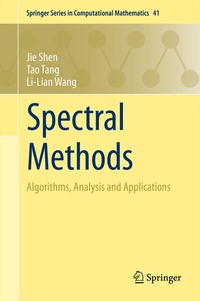
Spectral Methods
Description

Along with finite differences and finite elements, spectral methods are one of the three main methodologies for solving partial differential equations on computers. This book provides a detailed presentation of basic spectral algorithms, as well as a systematical presentation of basic convergence theory and error analysis for spectral methods. Readers of this book will be exposed to a unified framework for designing and analyzing spectral algorithms for a variety of problems, including in particular high-order differential equations and problems in unbounded domains. The book contains a large number of figures which are designed to illustrate various concepts stressed in the book. A set of basic matlab codes has been made available online to help the readers to develop their own spectral codes for their specific applications.
Reviews / Votes
From the reviews:
"This is a largely self-contained book on major parts of the application of spectral methods to the numerical solution of partial differential equations . . The material is accessible to . advanced students of mathematics and also to researchers in neighbouring fields wishing to acquire a sound knowledge of methods they might intend to apply." (H. Muthsam, Monatshefte für Mathematik, Vol. 170 (2), May, 2013)
"This book provides a self-contained presentation for the construction, implementation and analysis of spectral algorithms for some model equations of elliptic, dispersive and parabolic type. . a textbook for graduate students in mathematics and other sciences and engineering. . The book has nine chapters, each of them ending with a small collection of problems." (Julia Novo, Mathematical Reviews, January, 2013)
"This is a self-contained presentation on the construction, implementation, and analysis of spectral methods for various differential and integral equations, with wide applications in science and engineering. . Every chapter ends with a set of problems for practice. . This excellent and very well-written book could be used as s graduate textbook in mathematics and other engineering disciplines. It would also be a good reference book for active practitioners and researchers of spectral methods." (Srinivasan Natesan, ACM Computing Reviews, January, 2013)
"The text consists of nine main chapters, with the material naturally separating into two groups. . the text does a very good job at outlining the importance of creativity and analysis in the development of modern computational techniques for complex applications. . I read the text with enjoyment and expect it to be of great value as a reference, in particular for its careful presentation of key analytic results, and as a comprehensive introduction to the more detailed exposition of the authors' work . ."(Jan S. Hesthaven, SIAM Review, Vol. 55 (2), 2013)
More details
Other editions
Additional editions
Persons
Jie Shen: Ph.D., Numerical Analysis, Universite de Paris-Sud, Orsay, France, 1987; B.S., Computational Mathematics, Peking University, China, 1982.
Professor of Mathematics at Purdue University; Guest Professorships in Shanghai University and Xiamen University; Member of editorial boards for numerous top research journals.
Tao Tang: Ph.D., Applied Mathematics, University of Leeds, 1989;
Computational Mathematics, Peking University, China, 1984.
Head and Chair Professor of Hong Kong Baptist University; Cheung Kong Chair Professor under Ministry of Education of China; Winner of a Leslie Fox Prize in 1988 and a Feng Kang Prize in Scientific Computing in 2003; Member of editorial boards for numerous top research journals.
Lilian Wang: Ph.D, Computational Mathematics, Shanghai University, China 2000; B.S., Mathematics Education, Hunan University of Science and Technology, China, 1995.
Assistant Professor of Mathematics, Nanyang Technological University, Singapore. A prolific researcher with over twenty research papers in top journals.
