

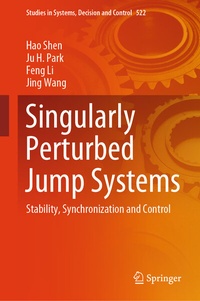
Singularly Perturbed Jump Systems
Description

In this book, various singularly perturbed jump system models in continuous-time or discrete-time domain, such as Markov jump singularly perturbed systems, semi-Markov jump singularly perturbed systems, hidden Markov jump singularly perturbed systems, and singularly perturbed jump complex network model, have been considered for some control synthesis problems. Also, some partial probability information cases are taken into account when addressing those control synthesis problems. To show the effectiveness and applicability of the obtained results, some numerical examples and practical industrial model examples are given.
Reviews / Votes
"The book contains a rich list of relevant references which are useful for the readers interest in better understanding of the facts. The audience of the book may include theoretical and applied mathematicians, research engineers, as well as graduate students in all these fields." (Vasile Dragan, zbMATH 1556.93005, 2025)
More details
Other editions
Additional editions
Persons
Hao Shen received the Ph.D. degree in control science and engineering from Nanjing University of Science and Technology, Nanjing, China, in 2011. From February 2013 to March 2014, he was a Post-Doctoral Fellow with the Department of Electrical Engineering, Yeungnam University, Republic of Korea. Since 2011, he has been with Anhui University of Technology, China, where he is currently a full Professor and a Ph.D. Supervisor with the School of Electrical and Information Engineering.
Dr. Shen has served on the technical program committee for several international conferences, such as The 2017 Australian and New Zealand Control Conference, ANZCC 2017, The 2018 Australian and New Zealand Control Conference, ANZCC 2017, The 34th Chinese Control Conference, CCC2015. He is an Associate Editor for several international journals, including Journal of The Franklin Institute, Applied Mathematics and Computation, Neural Processing Letters, IEEE Access, Transactions of the Institute Measurement and Control, Discrete Dynamics in Nature and Society and Mathematical Problems in Engineering. He has published 2 Monographs and more than 200 research papers in international referred journals, cited in Google 12501 times and his h-index is 65. He was a recipient of the Highly Cited Researcher Award by Clarivate Analytics (formerly, Thomson Reuters) in 2019-2022.
Content
Chapter 1 Introduction and Preview.- Chapter 2 Stochastic Stability Analysis and Stabilization.- Chapter 3 Control of Linear Systems Case.- Chapter 4 Control of Nonlinear Systems Case.- Chapter 5 Synchronization of Complex Networks Case.- Chapter 6 Stabilization of Linear Systems Case.- Chapter 7 Stabilization of Nonlinear Systems Case.- Chapter 8 Synchronization of Complex Networks Case.- Chapter 9 Control of Linear Systems Case.- Chapter 10 Control of Nonlinear Systems Case.- Chapter 11 Finite-time Control Case.
