

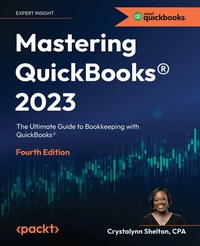
Mastering Quickbooks (R) 2023, Fourth Edition
Description

All prices
More details
Other editions
Additional editions
Person
Crystalynn Shelton is a licensed CPA and small business advisor specializing in financial accounting software training, coaching, and consulting. She has written two Amazon Bestsellers, Mastering QuickBooks 2020 and Mastering QuickBooks 2021. In addition to having experience as a small business owner, she has more than 20 years' experience in providing accountancy consultancy in the entertainment, oil and gas, education, and computer technology fields. Crystalynn is an Advanced Certified QuickBooks ProAdvisor and has taught accounting, bookkeeping, and QuickBooks courses for the last 12 years at the University of California at Los Angeles Extension. When she is not in the classroom, Crystalynn enjoys trying new restaurants and curling up with a good book!
Content
Getting Started with QuickBooks Online
Company File Setup
Migrating to QuickBooks Online
Customizing QuickBooks for Your Business
Managing Customer, Vendor, and Products and Services Lists
Managing Sales Tax
Recording Sales Transactions in QuickBooks Online
Recording Expenses in QuickBooks Online
Reconciling Uploaded Bank and Credit Card Transactions
Report Center Overview
Business Overview Reports
Customer Sales Reports in QuickBooks Online
Vendor and Expenses Reports
Managing Employees and 1099 Contractors in QuickBooks Online
Closing the Books in QuickBooks Online
Finding Apps and Handling Special Transactions in QuickBooks Online
QuickBooks Online Advanced
Shortcuts and Test Drive
QuickBooks Certified User Exam Objectives
Preface
Intuit QuickBooks is an accounting software package that helps small business owners manage all their bookkeeping tasks. Its complete range of accounting capabilities, such as tracking income and expenses, managing payroll, simplifying taxes, and accepting online payments, makes QuickBooks software a must-have for business owners and aspiring bookkeepers.
The goal of this book is to teach small business owners, bookkeepers, and aspiring accountants how to properly use QuickBooks Online. Using a fictitious company, we will demonstrate how to create a QuickBooks Online account; customize key settings for a business; manage customers, vendors, and products and services; enter transactions; generate reports; and close books at the end of the period. QuickBooks records debits and credits for you so that you don't have to know accounting. However, we will show you what's happening behind the scenes in QuickBooks so that you can understand how your actions in QuickBooks impact financial statements. We will also provide you with tips, shortcuts, and best practices to help you save time and become a QuickBooks pro.
The US edition of QBO was used to create this book. If you are using a version that is outside of the United States, results may differ.
Who this book is for
If you're a small business owner, bookkeeper, or accounting student who wants to learn how to make the most of QuickBooks Online, this book is for you. Business analysts, data analysts, managers, professionals working in bookkeeping, and QuickBooks accountants will also find this guide useful. If you are planning to take the QuickBooks Certified User (QBCU) exam, this book is an excellent study guide. No experience with QuickBooks Online is required to get started; however, some bookkeeping knowledge would be helpful.
What this book covers
Section 1: Setting Up Your Company File
Chapter 1, Getting Started with QuickBooks Online, starts off with a brief description of QuickBooks Online, then it outlines the key features in all four editions of the software. We also explain how to choose the right edition for your business. There are step-by-step instructions on how to create a QBO account and how to navigate the software. Finally, we provide you with some basic bookkeeping knowledge to help you understand what's going on behind the scenes in QuickBooks.
Chapter 2, Company File Setup, shows you how to customize the QuickBooks Online account created in Chapter 1 to meet your business needs. First, we explain the documents and key information you will need to have handy for the setup. Next, we walk you through all of the available preferences in QBO and explain the purpose and benefit of utilizing the various options available.
Chapter 3, Migrating to QuickBooks Online, gives you all the information required to migrate to QuickBooks Online from platforms such as Excel, QuickBooks Desktop, or another accounting/bookkeeping software.
Chapter 4, Customizing QuickBooks for Your Business, introduces customization for the chart of accounts and then dives into the different ways of connecting bank accounts and credit cards to your QuickBooks Online account, followed by granting users access to your QuickBooks data.
Chapter 5, Managing Customer, Vendor, and Products and Services Lists, gives you a detailed insight into how to manage your customers, vendors, products, and services. This includes importing customer, vendor, and product and services data from an Excel spreadsheet and manually entering it into the software.
Section 2: Recording Transactions in QuickBooks Online
Chapter 6, Managing Sales Tax, covers how to set up sales tax for the various tax jurisdictions you are required to collect sales tax for, how to create an invoice with sales tax, and what reports will help you to report and pay the appropriate sales tax amount when it becomes due.
Chapter 7, Recording Sales Transactions in QuickBooks Online, starts by giving detailed information on different forms of sales, followed by information on how the customer can record payments using different methods, and finally teaches you how to initiate refunds for your customers.
Chapter 8, Recording Expenses in QuickBooks Online, teaches you how to enter and pay bills for your QuickBooks Online account. Then, we'll start exploring how to manage recurring expenses, followed by writing and printing checks.
Chapter 9, Reconciling Uploaded Bank and Credit Card Transactions, gives you a brief overview of the Banking Center in QuickBooks Online and gives you a deep understanding of how the bank rules work, followed by how to edit QuickBooks Online transactions, and finally how to reconcile bank accounts.
Section 3: Generating Reports in QuickBooks Online
Chapter 10, Report Center Overview, takes you through the Report Center, followed by the different reports available, how to customize and export reports, and finally how to send reports via email.
Chapter 11, Business Overview Reports, discusses the three primary reports that provide a good overview of your business: the profit and loss statement, balance sheet report, and statement of cash flows. It also covers the cash flow planner and the audit log.
Chapter 12, Customer Sales Reports in QuickBooks Online, focuses on reports that will give you insight into your customers and sales. We will discuss what information you will find on each report, how to customize the reports, and how to generate each report.
Chapter 13, Vendor and Expenses Reports, dives into what information you can expect to find in each report, how to customize the report, and how to generate it. This chapter also discusses ways that you can use the report to help you manage your expenses and cash flow.
Section 4: Managing Employees and Contractors
Chapter 14, Managing Employees and 1099 Contractors in QuickBooks Online, shows you how to set up your payroll system, generate payroll, and fill payroll tax forms and payments. This chapter also covers how to set up 1099 contractors and make payments to them.
Section 5: Closing the Books and Handling Special Transactions
Chapter 15, Closing the Books in QuickBooks Online, covers the steps needed to close your books each month or for the year; including but not limited to reconciling all bank and credit card accounts, making year-end accrual adjustments (if applicable), recording fixed asset purchases made throughout the year, recording depreciation, taking a physical inventory, adjusting retained earnings, and preparing financial statements.
Chapter 16, Finding Apps and Handling Special Transactions in QuickBooks Online, starts by showing you how to discover and install apps in QuickBooks Online. Apps are a great way to help you streamline day-to-day business tasks that can otherwise be time-consuming. It also covers how to record credit card payments from customers, keep track of petty cash, and record delayed charges.
Chapter 17, QuickBooks Online Advanced, takes a deep dive into the features included in this top-tier QuickBooks Online subscription. We show you how to access the QuickBooks Online Advanced test drive account, add custom fields, manage customized user permissions, what workflow automation is and how to use it, how to import invoices and budgets, and much more.
Appendix
At the end of the book, there is a brief section called Shortcuts and Test Drive, which summarizes the keyboard shortcuts you can use in QuickBooks Online to save time, and also provides links to the QBO test drive account as well as a QBO discount code. This is followed by the QuickBooks Certified User Exam Objectives, where you'll find the full list of things you need to know to pass the QBCU exam, along with references to where the relevant content appears in the book - a handy reference for revision.
To get the most out of this book
This book is ideal for anyone who has accounting/bookkeeping knowledge as well as those that don't. Each chapter builds on the knowledge and information presented in the previous chapters. If you don't have any experience of using QuickBooks Online, we recommend you start with Chapter 1, Getting Started with QuickBooks Online, and complete the chapters in the order they are presented. If you have experience of using QuickBooks Online, feel free to advance to the chapters that cover the topics you need to brush up on.
Download additional files
The code bundle for the book is hosted on GitHub at https://packt.link/MQ23GitHub. We also have other code bundles from our rich catalog of books and videos available at https://github.com/PacktPublishing/. Check them out!
Download the color images
We also provide a PDF file that has color images of the screenshots/diagrams used in this book. You can download it here: https://packt.link/BjR3m.
Conventions used
Bold: Indicates a new term, an important word, or words that you see on screen. For example, words in menus or dialog boxes appear in the text like this. Here is an example: "Click on the Accounting tab located in the left menu bar and...
