

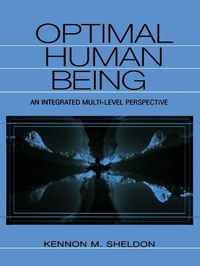
Optimal Human Being
An Integrated Multi-level Perspective
Published on 22. September 2004
250 pages
978-1-135-63625-8 (ISBN)
Description

Ken Sheldon's comprehensive new book addresses two questions: how can individuals best integrate the different facets of themselves to achieve "optimal human being", and how can researchers best integrate the different levels of analysis within the human sciences to understand "optimal human being" in general? In the process, the book supplies two new frameworks-one for viewing the human sciences as a group, and the other for viewing personality theory within that group.
Optimal Human Being features a multi-level model that moves from biologically based levels of analysis to higher, socially based levels, and demonstrates how these different levels interact to determine behavior. The author then proposes a new way of looking at personality by examining four "tiers": organismic foundations, personality traits, goals/intentions, and self-concepts, and demonstrates how these levels relate to the state of optimal human being. The book concludes with two higher levels of analysis relevant to personality-social interaction and culture-and proposes a new profile of optimal human being.
Intended for researchers and students in social and personality, clinical, developmental, and industrial psychology and other social sciences, the book will also serve as a supplement in a variety of courses including personality, positive psychology, well being, personal development, and motivation.
Optimal Human Being features a multi-level model that moves from biologically based levels of analysis to higher, socially based levels, and demonstrates how these different levels interact to determine behavior. The author then proposes a new way of looking at personality by examining four "tiers": organismic foundations, personality traits, goals/intentions, and self-concepts, and demonstrates how these levels relate to the state of optimal human being. The book concludes with two higher levels of analysis relevant to personality-social interaction and culture-and proposes a new profile of optimal human being.
Intended for researchers and students in social and personality, clinical, developmental, and industrial psychology and other social sciences, the book will also serve as a supplement in a variety of courses including personality, positive psychology, well being, personal development, and motivation.
Reviews / Votes
"...proposes a novel conceptual framework for personality psychology and its relation to other human sciences."-Book News
"The book provides a well-documented argument for an integration of ideas from the human sciences....exceptionally well referenced, and includes both an author and a subject index, making it especially useful as a supplemental textbook."
-Journal of Occupational Science
"...this book provides a valuable organizational framework for conceptualizing positive psychology as it relates to personality research."
-Journal of Personality Assessment
"Ken Sheldon takes on what is arguably the most important question in all of the social sciences: What is optimal human living? The answers he provides are convincing, and they are grounded in solid empirical research. Sheldon offers a compelling psychological model for understanding the different levels of personality and situating the person within a complex biological and cultural context...a conceptual tour de force that should be read by academics, researchers, clinicians, and others who look to psychological science to make sense of human nature."
-Dan P. McAdams, Ph.D.
Northwestern University
"Ken Sheldon proposes a model to integrate the human sciences with the biological and physical sciences....this convincing scholarly effort derives a value-free view of optimal functioning from the theoretical model."
-Ed Diener, Ph.D.
Alumni Professor of Psychology, University of Illinois, Champaign
" The author...presents the nuances and intricacies of many theories better than the originators of the theories themselves....The book should be required reading for professors and students interested in personality and/or optimal human functioning..."
-Richard Koestner, Ph.D.
McGill University
More details
Language
English
Place of publication
London
United Kingdom
Publishing group
Taylor & Francis Ltd
Target group
Professional and scholarly
File size
9,65 MB
ISBN-13
978-1-135-63625-8 (9781135636258)
Copyright in bibliographic data and cover images is held by Nielsen Book Services Limited or by the publishers or by their respective licensors: all rights reserved.
Schweitzer Classification
Other editions
Additional editions
Book
07/2004
1st Edition
Psychology Press
€205.60
Shipment within 10-20 days
Book
07/2004
1st Edition
Psychology Press
€71.80
Shipment within 10-20 days
Content
Contents: Part I: Introduction. What Is Optimal Human Being? Hierarchies and Levels of Analysis: Locating Behavior in the Physical World and Seeking Integration Between the Human Sciences. Focusing on the Personality Level: Comprehensive Models of Personality. Part II: Four Levels of Analysis Within Personality Theory. The Universal Human Organism: Species-Typical Human Nature. Personality Traits and Individual Differences: The Meaning of Variability. Goals and Intentions: The Method of Self-Organization. The Self-Homunculus: Fictional but Functional. Part III: Two Higher Levels of Analysis Relevant to Personality Theory. Social and Group Interaction: Game and Role Theory Perspectives. The Emergence of Culture: Memes, Genes, and Other Themes. Part IV: Towards Integration. Optimal Human Being and Optimal Human Science: Summary Prescriptions.
