

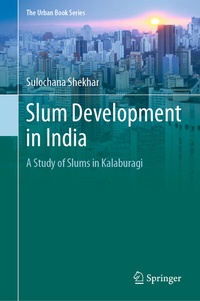
Slum Development in India
Description

This book is an earnest effort in understanding the slums and their needs by taking a case study of Kalaburagi, India. This study aims to contribute sustainable methodologies to advance the living conditions of slum dwellers and for better execution of slum policies. The core objectives are: 1) mapping the existing slums of Kalaburagi (formerly Gulbarga) city using slum ontology from very high-resolution data and validating the slum map through ground survey and using reliable data; 2) developing a model to understand the factors which are responsible for the present growth as well as to predict the future growth of slums; 3) estimating the housing demand of urban poor and suggesting a suitable site for the rehabilitation program; and 4) suggestions for the better intervention of government policies with special reference to in-situ program.
Urban is the future, and slums are its reality. Sustainable development goals are directly and indirectly concerned about theincreasing urbanization and the slums. Housing the urban poor and affordable housing to all are the national missions. Practically making these plans successful depends on a deep understanding of urban issues and proper methodology and technology to handle it. The participatory slum mapping, cellular automata slum model, housing demand analysis, and the spatial decision support system demonstrated in the book help in monitoring and managing the slums and thus lead towards a slum-free India.
More details
Other editions
Additional editions
Person
Prof. Sulochana Shekhar is the Dean of the School of Earth Sciences and Head of the Department of Geography at the Central University of Tamil Nadu, Thiruvarur, India. She is the proud recipient of Erasmus Mundus (European Commission) Fellowship, Commonwealth Academic Fellowship (United Kingdom) and Endeavor Research Fellowship (Australia). Her research interests include urban geography, application of remote sensing and geospatial techniques in urban environments.
She is presently teaching urban geography and the fundamentals and applications of geoinformatics at the post-graduation level. She has worked on cellular automata based urban growth models and urban sprawl assessment using entropy for her doctoral research. Object based image analysis was the main theme of her post-doctoral research. She has previously worked on projects involving spatial decision support system for slums and extraction of slums and urban green space using object-based image analysis.
