

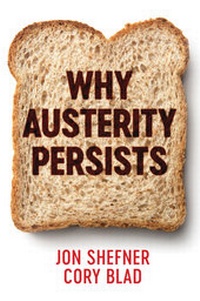
Why Austerity Persists
Description

Shefner and Blad trace the 45-year history of austerity and how it became the go-to policy to resolve a host of economic problems. The authors use a variety of international cases to address how austerity has been implemented, who has been hurt, and who has benefited. They argue that the policy has been used to address very different kinds of crises, making states and polities responsible for a variety of errors and misdeeds of private actors. The book answers a number of important questions: why austerity persists as a policy aimed at resolving national crises despite evidence that it often does not work; how the policy has evolved over recent decades; and which powerful people and institutions have helped impose it across the globe.
This timely book will appeal to students, researchers, and policymakers interested in globalization, development, political economy, and economic sociology.
More details
Other editions
Additional editions
Persons
Cory Blad is Professor of Sociology at Manhattan College
Content
Chapter 2. From Development to the Lost Decade in Latin America
Chapter 3. African Austerity
Chapter 4. Austerity in Asia and Oceania
Chapter 5. The United States and the Inevitability of Austerity
Chapter 6. Austerity Lands in the European Union
Chapter 7. Why Austerity Persists
Bibliography
2
From Development to the Lost Decade in Latin America
This chapter focuses on experiences of austerity in Latin America that preceded the 2008 global crisis. Latin America was the laboratory for austerity policies, which were imposed largely because of the seeming danger of unsustainable national debts. Then as the rhetoric of dangerous debt spread, and as debt burdens grew in the 1970s and 1980s, IFIs, primarily the IMF and the World Bank, joined the United States in responding to Latin American governments' requests for debt renegotiation by demanding they impose austerity policies. These conditions protected the creditors, but brought substantial social costs to debtor nations; the pain of those years was demonstrated by the often-used term the "Lost Decade of the 1980s," during which the advances in social and economic development of previous years were reversed (George 1992; Portes 1997; Stiglitz 2002). Despite the time-limited implication of that term, austerity in Latin America continues, along with a number of structural reforms that have built on austerity and been called second-wave and third-wave neoliberalism. Indeed, the application of austerity accelerated after the "Lost Decade." After that period, the "Pink Tide" transition, during which many Latin American nations elected leftist governments, diminished, but did not eliminate, the reach and depth of austerity. Recent electoral turnovers have meant many of the "Pink Tide" nations have returned to neoliberal governments. What began as an experiment became hegemonic policy, denounced by many political opponents until they came into office and saw no other course but to continue austerity.
We examine this moment of austerity by looking at key historical examples that fit our descriptive variables. Chile, Ecuador, and Mexico provide examples of austerity trajectories in differing political environments from the 1970s through the 2000s. This chapter demonstrates the disciplinary nature of austerity policies on less developed and newly industrializing countries. Governments in Latin America were criticized for taking on inappropriate levels of debt or exercising undue government intervention in national economies that fueled their overspending. The external locus of power is clear as the IFIs and the United States remained the dominant policymaking actors throughout these impositions of austerity, prioritizing debt repayment over social needs. The cases addressed in this chapter varied from dictatorship, to emerging democracy, to one-party populism, and from an economic power like Mexico, to a nation with a thriving middle class like Chile, to a very poor nation like Ecuador. This chapter further demonstrates that neither variety of political system nor economic strength could successfully resist the early imposition of hegemonic austerity.
The Path to Austerity in Latin America
Beginning in the 1940s and continuing through the 1970s, import substitution industrialization (ISI) provided a development roadmap for much of Latin America (Green 2003; Hershberg & Rosen 2006). Following the Great Depression, policymakers sought to become more independent from global economic forces during both good times and bad, and advocated a form of protected industrialization. With some of their international consumer markets disrupted by World War I and later by global depression, Latin America's economic dependency on more powerful nations was brought into stark relief (Schoultz 2009).1 Like many crises, the period from the Depression through World War II offered Latin American policymakers an opportunity, this time to step away from strictly externally focused economic policy. The shortages suffered during the war drove production and so nurtured industrialization as Latin Americans were able to supply not only raw materials, but also manufactured goods (Cardoso & Helwege 1992). The new intention was to protect domestic industry; the war supplied further flexibility to governments: "[W]ith the interruption of international finance, they naturally suspended debt payments and engaged in deficit spending. There was little incentive to follow free-market doctrine to attract foreign investment, since there was virtually no investment in the offing" (Drake 2006: 30).
Intellectuals from CEPAL2 encouraged ISI as a resolution to long-term problems of dependent economies, including over-reliance on low-priced primary commodity exports and higher-priced manufactured imports, and the need to protect national economies from the unpredictable cycles of the world market. ISI requires an activist state in economic and social policy alike. In order to nurture manufacturing, the shift in the economic base required new infrastructure, educating and often subsidizing labor, and protectionist trade policy so that infant industries did not lose out to long-established international competitors (Green 2003). Many key industries were created or controlled as state enterprises in order to prioritize investment. Because it advocated manufacturing more consumer goods, ISI also required the creation of a larger middle class and a more prosperous working class, both to produce the new manufactured goods and to consume them (Cardoso & Helwege 1992; Dussel Peters 2000).
For much of the period in which they were used, ISI policies were successful. In Latin America and the Caribbean, real per capita GDP grew at an annual rate of 4.5% between 1940 and 1968, slowing to 3.7% from 1965 to 1973, and then further to 2.6% from 1973 to 1980 (Cardoso & Helwege 1992; World Bank 1990). Nations like Brazil and Mexico achieved substantial increases in industrial output, with Brazil becoming the world's seventh largest industrial producer. Imports dropped, one of the policy's intentions, while working people enjoyed some gains of improved salaries and welfare state provision.
Despite this substantial growth, however, ISI evolved in a contradictory context, which led to paradoxical outcomes. On one hand, ISI sought greater economic inclusion, especially of urban populations. On the other hand, the policy was often carried through by authoritarian governments, or those that used labor policy for control rather than full participation. Argentina, Bolivia, Brazil, Chile, and Mexico, among other nations, had governments that ranged from military juntas to oligarchies operating under a façade of democracy. Where organized labor was strengthened, it was often under the political control of the state, and expected to support state policy and ruling parties. ISI also often brought increased quality of life by expanding welfare state expenditures on housing, healthcare, education, and other social protection, yet the political systems often remained exclusionary.
Industrial development was coordinated to diminish dependency, but the legacy of dependency meant that foreign capital was still crucial to the loans that ISI required. National policymakers intended to increase working- and middle-class consumption, but ISI was often captive to capital-intensive industrial growth, so limiting the amount of workers employed. Growth in aggregate measures such as GDP per capita was strong, but large sectors of the continent continued to suffer from low wages in agriculture, thus often leaving a poor majority's needs unaddressed. Governments protected nascent industries through tariffs, import controls, or nationalization in order to nurture production and compete with global predecessors with established production routines and markets, but at times these firms fell victim to poor quality or inefficient production. Then such industry required further investment, which meant governments had to loosen monetary expansion, resulting in inflation that swallowed some of the gains enjoyed by working people (Green 2003; Hershberg & Rosen 2006). Overcapacity at times proved to be a problem, as production outpaced salary increases and subsequent consumption. The urban bias of investment also shrank credit availability in the agricultural area, paving the way for increasing imports of food, while price controls meant to aid urban wage earners further hurt domestic farmers (Green 2003). Moreover, the expectation that key industries would have "positive spillover effects" with factories purchasing a variety of materials from domestic suppliers was stymied at times when entrepreneurs could not find secure material supplies. Finally, the coming globalization of production and the commodity chain supply model that began in the 1970s diminished the need for local suppliers.
Portes (1997) wrote about how the debt crisis supplanted the period of ISI, bringing austerity and other neoliberal measures first as a way to discipline indebted states and later as a development doctrine (see also Walton & Seddon 1994). Even this short discussion must recognize the influence of the Organization of the Petroleum Exporting Countries (OPEC), both in oil price hikes that leveled increased costs on production of all kinds, and in the enhanced revenue the price hikes brought member nations. Most nations suffered from the increased oil prices of the early and late 1970s, but the rising costs hurt much of the developing world in a way that played out over years. Banks simultaneously faced Western recession amid large OPEC deposits, and began to loan to developing world and socialist nations. Loans became newly and aggressively marketed with little regard for security because nations were not thought liable to bankruptcy (Drake 2006). During a time of global loan explosion, Latin America and the Caribbean accounted for half of the international...
