

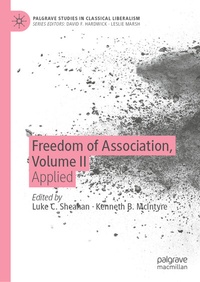
Freedom of Association, Volume II
Description

This two-volume set addresses freedom of association, one of the central liberties associated with classical liberalism. The concept of freedom of association has been largely neglected by political and moral philosophers over the past several centuries, despite the fact that the freedom to associate with fellow citizens (and non-citizens) is an implication of almost every version of liberalism capaciously considered. These two volumes take freedom of association seriously both as a theoretical concept and as an integral part of any genuine liberal regime. This second volume considers freedom of association from an applied perspective. It considers the freedom of association in conversation with various theorists (including Hobbes, Locke, Rousseau, and Tocqueville) and in the context of specific case studies.
More details
Other editions
Additional editions
Persons
Luke C. Sheahan is Associate Professor of Political Science at Duquesne University and a Senior Affiliate in the Program for Research on Religion and Urban Civil Society at the University of Pennsylvania. He is author of Why Associations Matter: The Case for First Amendment Pluralism (2020) and editor of International Comparative Approaches to Free Speech and Open Inquiry (2022).
Kenneth B. McIntyre is Professor of Political Science at Sam Houston State University. He is the author of The Limits of Political Theory: Michael Oakeshott on Civil Association (2004), Herbert Butterfield: History, Providence, and Skeptical Politics (2011), and Nomocratic Pluralism: Plural Values, Negative Liberty, and the Rule of Law (Palgrave Macmillan, 2021), and co-editor of Critics of Enlightenment Rationalism , and Critics of Enlightenment Rationalism Revisited (Palgrave Macmillan, 2022).
Content
Chapter 1: Introduction.- Part I: Treatments of specific authors.- Chapter 2: Hobbes-Travis Smith, Concordia University.- Chapter 3: Locke-Gabriel Benzecry, Middle Tennessee State.- Chapter 4: Rousseau-Nathanael Blake, Ethics and Public Policy Center.- Chapter 5: Tocqueville-Luke C. Sheahan, Duquesne University.- Chapter 6: Smith.- Chapter 7: Weber-Lucie Miryekta, Catholic University.- Chapter 8: Oakeshott-Nicholas Capaldi, Loyola University.- Chapter 9:Hayek.- Chapte 10: Popper.- Chapter 11: Nisbet-Luke Sheahan, Duquesne University.- Chapter 12: Ostrom-Stacy Ulbig, Sam Houston State University.- Part II:Treatment of specific topics.- Chapter 13: Associations in medieval Europe:Gierke and medieval associations-Ferenc Horcher, University of Public Service, Budapest, Hungary.- Chapter 14: Women and freedom of association-Sarah Wilford, Universidad de los Andes, Santiago, Chile.- Chapter 15: Expressive speech,assembly, petition rights-connection or lack thereof with the 1 st .- Chapter 16: Amendment as a whole or parts of 1st Amendment-Jack Simmons, Georgia Southern.
