

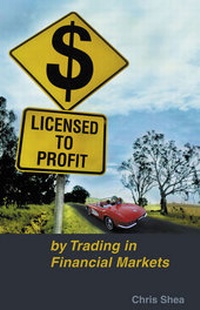
Licensed to Profit
Description

More details
Other editions
Additional editions
Person
Content
- Cover
- Contents
- Title
- Copyright
- About the author
- Introduction
- Chapter 1: Developing road sense: what's trading all about?
- Why trading is like driving a car
- Processes rather than outcomes
- How do markets pay you?
- Speculation: betting on the future
- The business of financial speculation
- How do the financial markets compare with other businesses?
- What are the special features of the business of speculation?
- Why is it so difficult to win consistently?
- Gamble, invest or trade for profit?
- From buyer to vendor: the crucial next step
- Personal requirements for success
- Summary
- Chapter 2: Road rules: performance standards
- Case study: amateur to professional
- Probability: the foundation of the business
- Simulation of 50 trades:applying an edge to the probability distribution
- Your success is important for you and society
- Where amateurs flounder
- Summary
- Chapter 3: Road maps: optimising analysis
- Why reliance on analysis alone can't succeed
- Why does the market map change?
- Attempting to make uncertainty certain
- Where are the high-probability, high-profit trades?
- Scenario planning moment by moment
- Summary
- Chapter 4: Speed and traffic: psychological barriers and speed bumps
- Oh, the anxiety!
- Two killers: impulsiveness and hesitation
- Fear and anxiety
- Personality issues: needs and aptitude
- Traders and investors: the Personality Needs Profile
- You've got the personality: do you have the aptitude?
- What holds 'traders' back?
- What values are important for a successful trader?
- Your hidden sub-personalities
- Summary
- Chapter 5: Driving processes and skills
- Your trading behaviour car
- Processes rather than outcomes
- Summary
- Chapter 6: L-plates: preparation for your trader's licence test
- Becoming consciously competent
- The trading gymnasium: practise the verbs under instruction
- Scenarios for the present moment
- Feedback to improve your performance
- Summary
- Chapter 7: Your driving test: theory and practice
- The theory examination
- Checklist of skill performance
- Practical test: achieving the benchmarks
- Award of your licence
- What if you don't get your licence first time around?
- Summary
- Chapter 8: The journey forward: from P-plates to peak performance
- A note of caution
- A case study: how to improve
- A model for progress
- Making the extraordinary ordinary
- Summary
- Index
Introduction
It’s generally believed that most people who intend to trade in financial markets don’t succeed. That is, most people do not profit from the financial markets. Rather, they forfeit part or all their trading capital, and then move on to other life projects with feelings of bitterness and betrayal about their market experience. The conventional wisdom is that about 70 per cent of market entrants end up in this category.
By my estimate, a further 20 per cent of traders have advanced to the extent that they are in what I call the ‘break-even rut’: their results are variable, neither consistently winning nor losing.
The remaining 10 per cent are the consistent winners. These market players have an edge that enables them to operate a highly profitable risk management business in financial markets.
In my professional life as a trading coach I have helped hundreds of traders all over the world to join the top 10 per cent. How do I do it? That’s what I’ve set out to explain in this book, taking a simple, step-by-step approach aimed at giving you all the tools you’ll need to become one of that 10 per cent.
Getting into the Zone — learning to drive
I call my clients who achieve outstanding profits ‘SuperTraders’, and I encourage all my clients to envision themselves as potential SuperTraders. SuperTraders operate in the ‘Peak Performance Zone’, achieving outstanding profits.
The Zone is the sweet spot that is experienced by top professionals in any field. Think of Tiger Woods winning a string of majors, an opera singer giving a virtuoso recital, or a surgeon doing open heart surgery.
The Zone is not an exclusive club. You will have experienced being in the Zone many times in your life. This is when you have practiced a skill so much that it becomes second nature, for example when you are driving your car. When you drive, you execute the actions required by the road conditions and the traffic (the information flow), moment by moment. When you drive your car well you are functioning flawlessly, beyond cognition. You don’t calculate the velocity difference or relative kinetic energy between you and the vehicle you are overtaking. You just do it. That’s the Zone.
Or, to put it another way, you are unconsciously working competently in a super-conscious state: the Zone. The term SuperTrader relates to working in a similar super-conscious state, this time in the trading environment.
Driving a car is far more dangerous than trading. Every time you take the car on the road you put your life at risk. But this does not inhibit good performance; rather it enhances it. It’s a must that you operate in the Zone without fear and anxiety but with the very positive expectation that you will achieve your destination.
To trade with consistent profitability it’s a must that you operate in exactly the same way: without fear and anxiety, but with positive expectations. Additionally, you must be up to responding intelligently, skilfully and spontaneously to the market ‘traffic’.
To achieve the consistency and trading success that being in the Zone affords, I ask my clients to look at all four elements of the Zone. Each is an attribute that you have. To operate in the Zone, you need to ensure that each of these four elements within you is functioning at a high level.
The first is physiological. Doesn’t it make sense that you will achieve better outcomes if your physiology allows you to operate in a powerful state of relaxed yet alert centeredness, rather than with adrenalin shock and the fight/flight impulse whenever you encounter stress?
The emotional element addresses the fear and anxiety associated with trading. You don’t know the future in a market; anything can happen. Fear and anxiety are natural emotions in this setting, but it’s important to be able to recognise these emotions and not allow yourself to be governed by them. Self-worth and knowing what you are doing go a long way to countering irrational fears. When you are feeling calmness, self-belief, and optimism, you will be functioning in the right emotional space to be in the Zone.
The Zone has an intellectual element. You have to know what you are doing. Are you gambling or running a profitable risk management business? Do you know that your trading strategy is resourceful and resilient enough to produce the outcomes you desire? Have you accessed the full repertoire of intellectual skills — believe it or not, there are eight or nine distinct skills — to improve your intellectual edge?
Action is the fourth and most important element of the Zone. You need to practise integrating your positive physiology and emotions with your strategy, so that you execute your trades intuitively and flawlessly. In practice, this means beginning initially with a small account size, performing deliberately and mechanically. With enough practice and appropriate feedback, you will develop the perception and precision to execute your strategy automatically. This takes time and perseverance — however the results are well and truly worth it.
Practice makes perfect
Research from the University of Sydney and the Westmead Hospital Brain Research Unit reveals that to fully learn a new skill, you will have to repeat the action up to 1000 times.
Think about when you first learned to drive a car. Remember how you mastered the four elements of the Zone over time, rather than all at once? At first you had to deliberately think: to start off in first gear, you need to let the clutch out a little, while simultaneously depressing the accelerator. When the car starts to move, then you let the clutch out quickly and entirely with more acceleration. It wasn’t that easy, right? And not only this, but you also had to be aware of other matters: Is the road ahead clear? What is the traffic behind you doing? What should your next manoeuvre be?
And so it goes. You continuously practise the new skills of driving under instruction until you present for your driving test. If you prove that you are competent against a standard set of criteria in a driving test then you’ll receive your driver’s licence. If you fail the test you can have another go, until eventually you pass.
It’s not until you have your licence that you can really perfect your new skills through the experience of driving on your own, in different road conditions and situations. In other words, your licence proves you are ‘consciously competent’; you can then advance with continual practice to the unconscious driving Zone.
Learning to drive a car is a much more complex and dangerous activity than learning to trade. Yet almost all who want to learn to drive succeed in their aim. It begs the question: If 99 per cent of learners can learn to drive a car well enough to gain their licence, then why is it that only 10 per cent of people succeed at trading?
The answer lies in the fact that most who attempt to trade never actually learn the skills of trading under instruction. Most never secure their licence to trade profitably. They expect the impossible: to start in the Zone.
Let me give you an example to illustrate my point. A heart surgeon does not start out doing open heart surgery at the beginning of her career. First she must study and be tested to receive a licence to be a doctor. As she advances from intern to resident to registrar to consultant in her area, her talent and skills develop. After years of study and examination, she can perform as surgeon. Years of practice and discipline have allowed her to perform confidently, consistently and flawlessly in the Zone. Rest assured her patients are thankful that she has achieved the heart surgery Zone. Yet most novice traders expect to acquire the heart surgeon income without even obtaining the initial trading licence.
I’ll put it another way. Would you allow a first-time driver to go onto a busy six-lane freeway alone without first obtaining a licence? Your answer is obviously ‘no’.
Yet this is what most novices do in trading. To extend the metaphor, the novice trader goes to the showroom where the software or systems salesperson sells the dream of freedom and persuades the novice to exchange hard-won capital for a shiny new trading car. The trader is given some analysis (let’s call it a road map) and is then expected to drive it away without practising any trading skills or securing the licence to drive. Little wonder that most people crash their trading car — and their dreams — before they develop the expertise to drive.
Whether you’re a novice needing the basics or you’re stuck in the break-even rut, this book aims to help you move on and into the Zone.
Preparing to obtain your licence to trade is a vital step in your transformation to becoming profitable and remaining permanently in the Zone. This book aims to fill the gap that your software and trading platform can’t provide. Its purpose is to enable you to take advantage of analytical techniques that present high probability set-ups.
In this book I’ll give you the trading ‘road’ rules and explain why you need to stick to these rules for safety. Licensed to Profit presents you with the full repertoire of skills needed to drive (and get the most out of) your trading ‘car’.
Licensed to Profit teaches you the necessity of practising these skills so you can become a competent, profitable trader.
I’ll also deal with some potential hurdles, especially with respect to your own negative self-talk, which needs to be overcome to allow...
