

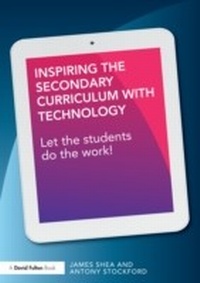
Inspiring the Secondary Curriculum with Technology
Let the students do the work!
1st Edition
Published on 24. October 2014
120 pages
978-1-317-59256-3 (ISBN)
Description

Are other teachers using technology in their lessons? Are you letting your own students down by not harnessing the power of your students' technology knowledge in your lessons? Is your school asking you to show where you are developing ICT in your subject teaching?
Technology in your subject does not mean teaching databases, spreadsheets or word processing. Having technical knowledge is no longer sufficient or indeed necessary in today's world - more important is the knowledge of how to advise and teach students to use technology efficiently and responsibly through their subject. Students faced with a 'problem' will need to hunt the internet for open source software, download apps and respond to the problem using technology as a problem solving tool. The scenarios are endless, but can be generated by the teacher - this could mean students publishing work through Amazon's Kindle or keeping a blog within a class wiki. Teachers do not need to have technical knowledge; rather they need knowledge of trends and opportunities. They then need to blend their basic subject pedagogy within these new trends to contextualise ICT skills.
This book looks at pedagogical approaches to using technology in the classroom that will help you to harness future trends, technology and software and embed them into your subject teaching. Full of practical advice, it illustrates how secondary teachers - of any discipline - can accelerate their students' learning, progress and ability within their subject whilst developing the ICT skills needed in the workplace and society. Including case studies and examples throughout, chapters cover:
Blended Learning (mixing traditional teaching methods with e-learning)
Developing interactive students
Mobile technologies
Student safety online
E-Portfolios and Virtual Learning Environments
This timely new book will help you structure your teaching to harness the latest developments in technology in tandem with the students you teach.
Technology in your subject does not mean teaching databases, spreadsheets or word processing. Having technical knowledge is no longer sufficient or indeed necessary in today's world - more important is the knowledge of how to advise and teach students to use technology efficiently and responsibly through their subject. Students faced with a 'problem' will need to hunt the internet for open source software, download apps and respond to the problem using technology as a problem solving tool. The scenarios are endless, but can be generated by the teacher - this could mean students publishing work through Amazon's Kindle or keeping a blog within a class wiki. Teachers do not need to have technical knowledge; rather they need knowledge of trends and opportunities. They then need to blend their basic subject pedagogy within these new trends to contextualise ICT skills.
This book looks at pedagogical approaches to using technology in the classroom that will help you to harness future trends, technology and software and embed them into your subject teaching. Full of practical advice, it illustrates how secondary teachers - of any discipline - can accelerate their students' learning, progress and ability within their subject whilst developing the ICT skills needed in the workplace and society. Including case studies and examples throughout, chapters cover:
Blended Learning (mixing traditional teaching methods with e-learning)
Developing interactive students
Mobile technologies
Student safety online
E-Portfolios and Virtual Learning Environments
This timely new book will help you structure your teaching to harness the latest developments in technology in tandem with the students you teach.
More details
Language
English
Place of publication
London
United Kingdom
Publishing group
Taylor & Francis Ltd
Target group
College/higher education
Professional and scholarly
Illustrations
1 s/w Tabelle
1 Tables, black and white
File size
0,58 MB
ISBN-13
978-1-317-59256-3 (9781317592563)
Copyright in bibliographic data and cover images is held by Nielsen Book Services Limited or by the publishers or by their respective licensors: all rights reserved.
Schweitzer Classification
Other editions
Additional editions
James Shea | Antony Stockford
Inspiring the Secondary Curriculum with Technology
Let the students do the work!
Book
11/2014
1st Edition
Routledge
€251.10
Shipment within 15-20 days
James Shea | Antony Stockford
Inspiring the Secondary Curriculum with Technology
Let the students do the work!
Book
11/2014
1st Edition
Routledge
€45.20
Shipment within 15-20 days
Persons
James Shea is Senior Lecturer in Education and Secondary Phase Lead in Teacher Education at the University of Bedfordshire, UK.
Antony Stockford is Senior Lecturer in Education as well as running the secondary computer science programme at the University of Bedfordshire, UK.
Antony Stockford is Senior Lecturer in Education as well as running the secondary computer science programme at the University of Bedfordshire, UK.
Content
1. Introduction
2. Blended learning
3. Mobile technologies and their impact on the secondary curriculum
4. Developing interactive students
5. Student safety
6. E-portfolios and Virtual Learning Environments
7. The Extended School
8. Embedding Technology in practice
9. Conclusion
2. Blended learning
3. Mobile technologies and their impact on the secondary curriculum
4. Developing interactive students
5. Student safety
6. E-portfolios and Virtual Learning Environments
7. The Extended School
8. Embedding Technology in practice
9. Conclusion
