

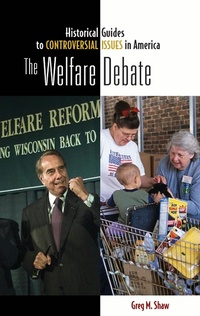
The Welfare Debate
1st Edition
Published on 30. September 2007
216 pages
978-0-313-08428-7 (ISBN)
Description

Welfare politics have now been part of American life for four centuries. Beyond a persistent general idea that Americans have a collective obligation to provide for the poorest among us, there has been little common ground on which to forge political and philosophical consensus. Are poor people poor because of their own shortcomings and moral failings, or because of systemic societal and economic obstacles? That is, does poverty have individual or structural causes? This book demonstrates why neither of these two polemical stances has been able to prevail permanently over the other and explores the public policy-and real-life-consequences of the stalemate. Author Greg M. Shaw pays special attention to the outcome of the 1996 act that was heralded as ending welfare as we know it.
Historically, people on all sides of the welfare issue have hated welfare-but for different reasons. Like our forebears, we have constantly disagreed about where to strike the balance between meeting the basic needs of the very poor and creating dependency, or undermining individual initiative. The shift in 1996 from New Deal welfare entitlement to workfare mirrored the national mood and ascendant political ideology, as had welfare policy throughout American history. The special contribution of this book is to show how evolving understandings of four key issues-markets, motherhood, race, and federalism-have shaped public perceptions in this contentious debate. A rich historical narrative is here complemented by a sophisticated analytical understanding of the forces at work behind attempts to solve the welfare dilemma.
How should we evaluate the current welfare-to-work model? Is a precipitous decline in state welfare caseloads sufficient evidence of success? Success, this book finds, has many measures, and ending welfare as an entitlement program has not ended arguments about how best to protect children from the ravages of poverty or how to address the plight of the most vulnerable among us.
Historically, people on all sides of the welfare issue have hated welfare-but for different reasons. Like our forebears, we have constantly disagreed about where to strike the balance between meeting the basic needs of the very poor and creating dependency, or undermining individual initiative. The shift in 1996 from New Deal welfare entitlement to workfare mirrored the national mood and ascendant political ideology, as had welfare policy throughout American history. The special contribution of this book is to show how evolving understandings of four key issues-markets, motherhood, race, and federalism-have shaped public perceptions in this contentious debate. A rich historical narrative is here complemented by a sophisticated analytical understanding of the forces at work behind attempts to solve the welfare dilemma.
How should we evaluate the current welfare-to-work model? Is a precipitous decline in state welfare caseloads sufficient evidence of success? Success, this book finds, has many measures, and ending welfare as an entitlement program has not ended arguments about how best to protect children from the ravages of poverty or how to address the plight of the most vulnerable among us.
More details
Series
Language
English
Place of publication
New York
United States
Publishing group
Bloomsbury Publishing Plc
Target group
College/higher education
File size
0,78 MB
ISBN-13
978-0-313-08428-7 (9780313084287)
Copyright in bibliographic data and cover images is held by Nielsen Book Services Limited or by the publishers or by their respective licensors: all rights reserved.
Schweitzer Classification
Other editions
Additional editions

Person
Greg M. Shaw is an Associate Professor in the Department of Political Science at Illinois Wesleyan University. He has published numerous articles in professional journals such as Public Opinion Quarterly, Policy Studies Journal, and Political Research Quarterly, chiefly on poverty issues and public opinion analysis.
Content
- Intro
- Contents
- Illustrations
- Preface
- Introduction
- 1 The Early American Roots of Welfare
- 2 Controlling the Poor in Nineteenth-Century America
- 3 From Mothers' Pensions to a Troubled Aid to Dependent Children Program
- 4 The Rise and Fall of the War on Poverty
- 5 The 1970s and 1980s-Backlash and an Emerging Neoconservative Consensus
- 6 The End of Welfare Entitlement
- 7 A New World of Welfare
- 8 Conclusions
- Appendix 1: Time Line of Significant Developments in American Social Welfare Provision
- Appendix 2: Annotated List of Further Readings
- Bibliography
- Index
