

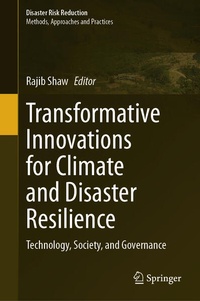
Transformative Innovations for Climate and Disaster Resilience
Description

This book explores cutting-edge innovations that strengthen disaster and climate resilience, highlighting the intersection of technology, society, finance, and ecosystems. It provides a comprehensive review of advancements in sustainable infrastructure, nature-based solutions, and integrated financial mechanisms that support resilient development. The volume examines social entrepreneurship, education, and community-led initiatives, emphasizing the role of civil society and early childhood disaster education in building long-term preparedness. Advanced technologies such as AI, machine learning, blockchain, drones, robotics, GIS, and remote sensing are explored for their transformative potential in disaster prediction, monitoring, response, and recovery. The book also delves into big data and open governance frameworks, demonstrating how accessible, data-driven decision-making can enhance resilience at local and global scales. Through case studies across Asia and beyond, the chapters collectively offer insights into practical strategies, policy innovations, and multidisciplinary approaches necessary to foster sustainable, adaptive, and inclusive resilience in the face of escalating climate and disaster challenges.
More details
Other editions
Additional editions
Person
Professor Rajib Shaw is a professor in the Graduate School of Media and Governance in Keio University, Japan. His expertise includes disaster governance, community-based disaster risk management, climate change adaptation, urban risk management, and disaster and environmental education. He is the editor-in-chief of the journal Progress in Disaster Science and series editor of a Springer book series on disaster risk reduction. Prof. Shaw has published 89 books and over 450 academic papers and book chapters. Professor Shaw is the recipient of prestigious Pravasi Bharatiya Samman Award in 2021 for his contribution in education. He also received United Nations Sasakawa Award in 2022 for his lifetime contribution in the field of disaster risk reduction.
Content
Trasformative Innovations in Enhancing Disaster and Climate Resilience.- Innovations in Sustainable and Resilient Infrastructure.- Innovation in Ecosystem-based Disaster and Climate Resilience.- Achieving sustainability and climate resilience through innovation in financial mechanism.- Social Entrepreneurship and Social Innovation for Disaster and Climate Resilience: A Case of Noto Peninsula, Ishikawa, Japan.- Innovation in Disaster Education for Early Childhood Education in Japan: The cases of XR Bosai and Bousai Terakoya.
