

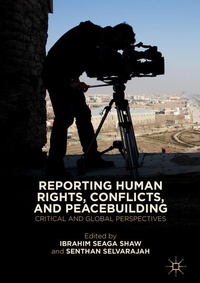
Reporting Human Rights, Conflicts, and Peacebuilding
Description

More details
Other editions
Additional editions
Persons
Dr Ibrahim Seaga Shaw is Chairman and Information Commissioner of the Right to Access Information Commission in Sierra Leone and Co-Director of the Centre for Media, Human Rights and Peacebuilding based in the UK. He was previously Senior Lecturer in Media and Politics at Northumbria University, UK and served as Secretary General of the International Peace Research Association (IPRA) between 2012 and 2016. He is the author of four books, including Human Rights Journalism (2012).
Dr Senthan Selvarajah is Co-Director of the Centre for Media, Human Rights and Peacebuilding based in the UK. He has over 18 years' experience as a journalist, editor and researcher, and currently serves as a Co-Convener of the Media, Conflicts, and Human Rights Commission of the International Peace Research Association.
Content
Chapter 1: Introduction: Reporting Human Rights, Conflicts, and Peacebuilding: Critical and Global Perspectives.- Chapter 2: Human Rights Journalism: Towards a Critical Constructivist Epistemological Approach.- Chapter 3: Advocacy journalism, the Politics of Humanitarian Intervention and the Syrian war.- Chapter 4: Beyond "bearing witness". Journalists resisting violence in Colombia's "after war".- Chapter 5: Re-designing the Media in Humanitarian Interventions Communicating with communities at times of crisis.- Chapter 6: Public service broadcasting and security issues: the case of 'blowback'.- Chapter 7: Communitarianism, Ethics and the Burden of Journalistic Objectivity: Reflections of 'Peace Journalists' Covering the Boko Haram Insurgency.- Chapter 8: The Politics of Representation of Migrants in Italian Media.- Chapter 9: Assessment of Media Coverage of Human Rights Abuses in Internally Displaced Peoples' Camps.- Chapter 10: Understanding and Practicing Human Rights Journalism in China.- Chapter 11: Unworthy Victims? The media, politics and the search for Justice through the International Criminal Court in Kenya.- Chapter 12: The media, conflict and peace during transitional times: The case of the Herald and the Newsday during the period of the Zimbabwe Government of National Unity (GNU)-2009-2014.- Chapter 13: Re-imaginging Human Rights Photography: Ariella Azoulay's Intervention.- Chapter 14: Journalists as human rights defenders: international protection of journalists in contexts of violence and impunity.- Chapter 15: Exiled Journalists as Active Agents of Change: Understanding their Journalistic Practices.- Chapter 16: Together and Separate? An exploratory study of political polarization on social media during the 2016 Brazilian political crisis.
