

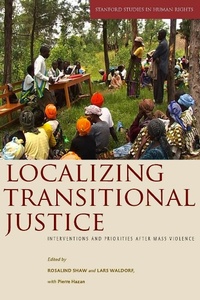
Localizing Transitional Justice
Interventions and Priorities After Mass Violence
Published on 23. April 2010
368 pages
978-0-8047-7463-5 (ISBN)
Description

Through war crimes prosecutions, truth commissions, purges of perpetrators, reparations, and memorials, transitional justice practices work under the assumptions that truth telling leads to reconciliation, prosecutions bring closure, and justice prevents the recurrence of violence. But when local responses to transitional justice destabilize these assumptions, the result can be a troubling disconnection between international norms and survivors' priorities.
Localizing Transitional Justice traces how ordinary people respond to-and sometimes transform-transitional justice mechanisms, laying a foundation for more locally responsive approaches to social reconstruction after mass violence and egregious human rights violations. Recasting understandings of culture and locality prevalent in international justice, this vital book explores the complex, unpredictable, and unequal encounter among international legal norms, transitional justice mechanisms, national agendas, and local priorities and practices.
Localizing Transitional Justice traces how ordinary people respond to-and sometimes transform-transitional justice mechanisms, laying a foundation for more locally responsive approaches to social reconstruction after mass violence and egregious human rights violations. Recasting understandings of culture and locality prevalent in international justice, this vital book explores the complex, unpredictable, and unequal encounter among international legal norms, transitional justice mechanisms, national agendas, and local priorities and practices.
Reviews / Votes
"This book addresses key questions and present thoroughgoing critiques through a broad and yet detailed approach, providing an essential grounding for further investigations into the contemporary realities of transitional justice."-Federica Guglielmo, Journal of Africa "An impressive panel of nineteen authors with diverse backgrounds and expertise has collectively produced a highly stimulating and challenging book that provides a rare combination of intellectual scrutiny, unconventional thinking, and solid field knowledge. Shaw and Waldorf bring impeccable personal knowledge of at least two countries that have experienced major international, hybrid, and national transitional justice undertakings: Sierra Leone and Rwanda. Their intellectual rigor can be felt throughout the publication, which generally brings great coherence and relevance to an unusually eclectic array of countries and contexts."-Thierry Cruvellier, African Affairs "[Localizing Transitional Justice shows a] compelling sensitivity to the realities of international intervention's complex and sometimes contradictory nature . . . By identifying problems in current conceptualizations of transitional justice, and by urging shifts in thinking that address these issues, the essays in this volume seek to encourage both more responsive and more effective approaches to localized intervention."-Yale Journal of International Law "Localizing Transitional Justice addresses extremely current debates on transitional justice and post-conflict justice interventions, bringing together a range of excellent cases. The contributors are doing some of the most exciting, cutting-edge work in this area. Together, they have written a sterling book which maps out a new field with remarkable breadth and clarity. It will definitely be a key reference in the field."-Rachel Sieder, Centro de Investigaciones y Estudios Superiores en Antropologia Social (CIESAS), Mexico "Full of innovative ideas and trenchant critiques, Localizing Transitional Justice offers smart recommendations for how we should approach and conceive of transitional justice today. Among its strengths are its distinction between post-repression and post-war transitional justice, its critique of equating the local with the traditional, and its incisive assessment of the 'toolkit' approach to transitional justice. This is a powerful new contribution to the study of human rights."-Mike McGovern, Yale UniversityAll prices
More details
Series
Edition
New edition
Language
English
Place of publication
Palo Alto
United States
Target group
College/higher education
Edition type
New edition
ISBN-13
978-0-8047-7463-5 (9780804774635)
Copyright in bibliographic data and cover images is held by Nielsen Book Services Limited or by the publishers or by their respective licensors: all rights reserved.
Schweitzer Classification
Other editions
Additional editions
Rosalind Shaw | Lars Waldorf | Pierre Hazan
Localizing Transitional Justice
Interventions and Priorities After Mass Violence
Book
04/2010
Stanford University Press
€131.50
Shipment within 15-20 days
Rosalind Shaw | Lars Waldorf | Pierre Hazan
Localizing Transitional Justice
Interventions and Priorities After Mass Violence
Book
04/2010
Stanford University Press
€30.50
Shipment within 15-20 days
Persons
Rosalind Shaw is Associate Professor of Anthropology at Tufts University. Lars Waldorf is Senior Lecturer in the Centre for Applied Human Rights at the University of York (UK), and previously ran Human Rights Watch's field office in Rwanda. Pierre Hazan is Visiting Professor of Post-Conflict Justice at the Graduate Institute for International and Development Studies in Geneva, Switzerland.
Content
- Intro
- Contents
- Preface (Ruti G. Teitel)
- Acknowledgments
- Contributors
- Part I: Frames
- 1. Introduction: Localizing Transitional Justice (Rosalind Shaw and Lars Waldorf)
- 2. Stay the Hand of Justice: Whose Priorities Take Priority? (Harvey M. Weinstein, Laurel E. Fletcher, Patrick Vinck, and Phuong N. Pham)
- 3. Transitional Justice After September 11: A New Rapport with Evil (Pierre Hazan)
- Part II: Local Engagements
- 4. An Acknowledged Failure: Women, Voice, Violence, and the South African Truth and Reconciliation Commission (Fiona C. Ross)
- 5. Histories of Innocence: Postwar Stories in Peru (Kimberly Theidon)
- 6. Linking Justice with Reintegration? Ex-Combatants and the Sierra Leone Experiment (Rosalind Shaw)
- Part III: Power, Politics, and Priorities
- 7. Reconciliation Grown Bitter? War, Retribution, and Ritual Action in Northern Uganda (Sverker Finnström)
- 8. Silence and Dialogue: Burundians' Alternatives to Transitional Justice (Ann Nee and Peter Uvin)
- 9. "Like Jews Waiting for Jesus": Posthumous Justice in Post-Genocide Rwanda (Lars Waldorf)
- Part IV: Practicing Place-Based Justice
- 10. Weaving a Braid of Histories: Local Post-Armed Conflict Initiatives in Guatemala (Laura J. Arriaza and Naomi Roht-Arriaza)
- 11. Dealing with the Past when the Conflict Is Still Present: Civil Society Truth-Seeking Initiatives in the Israeli-Palestinian Conflict (Ron Dudai and Hillel Cohen)
- 12. Local Transitional Justice Practice in Pretransition Burma (Patrick Falvey)
- Afterword: Elevating Transitional Local Justice or Crystallizing Global Governance? (Moses Chrispus Okello)
- Notes
- Bibliography
- Index
