

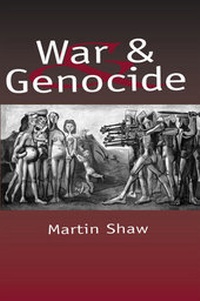
War and Genocide
Description

Most accounts of war and genocide treat them as separate phenomena. This book thoroughly examines the links between these two most inhuman of human activities. It shows that the generally legitimate business of war and the monstrous crime of genocide are closely related. This is not just because genocide usually occurs in the midst of war, but because genocide is a form of war directed against civilian populations. The book shows how fine the line has been, in modern history, between 'degenerate war' involving the mass destruction of civilian populations, and 'genocide', the deliberate destruction of civilian groups as such.
Written by one of the foremost sociological writers on war, War and Genocide has four main features:
* an original argument about the meaning and causes of mass killing in the modern world;
* a guide to the main intellectual resources - military, political and social theories - necessary to understand war and genocide;
* summaries of the main historical episodes of slaughter, from the trenches of the First World War to the Nazi Holocaust and the killing fields of Cambodia, Bosnia and Rwanda;
* practical guides to further reading, courses and websites.
This book examines war and genocide together with their opposites, peace and justice. It looks at them from the standpoint of victims as well as perpetrators. It is an important book for anyone wanting to understand - and overcome - the continuing salience of destructive forces in modern society.
More details
Other editions
Additional editions

Person
Content
Foreword by Gareth Evans viii
Preface and Acknowledgements xi
List of Abbreviations xvi
Introduction 1
1 Conceptual Building Blocks 5
2 "Humanitarian" Interventions: Thumbnail Sketches 31
3 New Wars and New Humanitarianisms 59
4 New Thinking: The Responsibility to Protect 88
5 So What? Moving from Rhetoric to Reality 119
Notes 155
Selected Readings 183
Index 187
1
War and Slaughter
Human beings are unique in the animal kingdom in the wide extent to which they kill their own kind. The ubiquity of human killing raises the question of whether it is built in to our individual makeup: thus some scientists search for biological or psychological roots of war (see box 1.1). Certainly killers' bodies, as well as minds, are often fully implicated in their activities. It is the argument of this book, however, that we will never find the key to understanding killing in such investigations. Killing is always and necessarily an extreme form of human social relation. When one person kills another, it is, on the one hand, an expression of their social relations and, on the other hand, their negation. One person destroys the life, meaning and story of the other by destroying their bodily existence. This is what the killing of humans by others means.
People kill each other within many different kinds of social relations. You may notice that I write relations, not relationships. Shockingly many relations in which people kill each other do not have the consistency to be dignified as relationships. A relationship involves some mutual, although not necessarily equal, understanding. The robber who shoots or the rapist who strangles often does not have a relationship with his victim. The social relation that he forces on his victim is one of transient exploitation, gratification or humiliation. A great deal of human killing is of this kind, casual and instrumental.
Other killing is the outcome of more developed social relationships. Notoriously, a small number of people regularly kill their wives, husbands and sexual partners - even their parents and children. Clearly such killing is the outcome of tensions within these relationships. But it cannot be understood only in terms of the relationship between killer and killed. Wider social relations, in which they are both involved, also contribute to the killing. A person may kill her spouse because he is having an affair with a third party, for insurance money because she is in debt to a bank, or even because her religious beliefs lead her to think of the victim as evil.
The contrast between opportunist killing and killing arising from relationship tells us something about how we can understand killing in general. Each killing comes out of larger sets of social relations that lead towards the result. These relations may include meaningful relationships between killer and killed, in which case we will want to trace the patterns, immediate and also remote, that lead to the final outcome. But even more in the absence of such relationships, we will want to trace the complex relationships of power which produce the need, greed, obsession or anger that leads one person to destroy another, in this case unknown, individual life.
Box 1.1 Natural versus social explanations of war War is a near-universal feature of human societies. So it is not surprising that many think of it as something that people are programmed to engage in. In the twentieth century, arguments for understanding war as 'natural' centred on the idea that war expressed a universal 'instinct' for aggression (Lorenz 1966). There was even a feminist variant: that war expressed the aggressive instinct in men. At the beginning of the twenty-first century, it will not be surprising, given the widespread predilection for genetic explanations, if someone claims to find a 'gene for war'. But, such naturalistic explanations of mass killing inevitably confuse relations between the natural and the social. They raise three insurmountable problems: 1 If anger and aggression may be considered universal human traits, so may love and co-operation. They all arise, however, through people's relations with each other. They cannot be separated from the social character of human life. Therefore we cannot explain aggressive behaviour except by examining the social circumstances in which people become aggressive. 2 Aggression may be universal, but we don't express it all the time, and certainly not usually through violence or killing. In our one-to-one social relations, anger and aggression are usually restrained by the norms that we live by. We express them mainly in socially designated ways. The ways in which we are aggressive are not universal, but are specific to our culture and social conditions. So we need to explain the specific circumstances and ways in which we express aggression. We particularly need to explain why we turn to violence and killing. 3 War and genocide are not simple outcomes of aggression. They are socially defined forms of mass killing. These are complex collective activities, undertaken by political authorities and other organized groups. They result more from political calculation than from instinct or emotion. This is not to deny that emotions enter into political leaders' decisions, nor that organizing killing fosters powerful emotions among armies and populations. Nevertheless, leaders keep a powerful grip on their own and their followers' feelings, channel them in particular ways and have to overcome deep instinctual revulsion to slaughter. Arguments from the 'natural' character of warlike instincts are deeply conservative. They diminish the areas of peace in human society and suggest that we can only repeat behaviour that has brought catastrophic suffering to previous generations. These ideas can have unfortunate political consequences. For example, those feminists who believed that all men were naturally aggressive divided the 1980s peace movements by refusing to co-operate with men who opposed nuclear weapons. Certainly, powerful emotions are involved in political conflict But there is no reason to believe that human beings as such have to kill each other en masse in the pursuit of these rivalries. We can look for other ways of expressing and overcoming them.Mass killing
Killing is the ultimate violation of an individual human being by another. Mass killing is merely the destruction of many individual lives, either more or less simultaneously or in circumstances that lead the killer, the killed or observers to see the killings as part of a single process.
Individual human beings carry out mass killing, whether or not these individuals are part of a group or an organization. Thus mass killing can be the work of a lone mass murderer. Or it may be the work of linked individuals, a group or an organization. When an individual kills repeatedly, we call him a serial killer. The most prolific such killers have more victims than some collective killers - the notorious late twentieth-century British doctor, Harold Shipman, may have secretly killed as many as 250 people, more than some armed forces kill in some episodes of war.
Where there is more than one killer, their killing too can be limited to a single incident or be serial in character. What makes it mass killing is simply that a number of people are killed. To be killed along with others often makes a difference to the experience leading to death, as well as to its meaning for people left alive. But the end, the annihilation of life, is the same for the victim whether she is alone or among millions. In this sense killing more than one person is not different in quality from killing a single individual, although the process of plural killing may normalize the act for killers. There is no intrinsic cut-off point at which plural killing becomes mass killing - this is simply a label that we use in the modern age. The term has something to do with our ambiguous attitudes to plural killing: both a shocking event outside our normal experience and something we know happens frequently across the world. Plural, even large-scale, killing has been common throughout recorded history, long before it was called mass killing. It is its forms, and the labels we give to it, that change.
The key question about any kind of killing, especially mass killing, is its legitimacy. Although killing is very common in human life, it is always the subject of intense moral discourse. The simple biblical injunction, 'You shall not kill', is shared within most cultures. It is almost always followed by 'except', but the extent of prohibitions on killings is generally wide. When a person kills another in pursuit of immoral ends, this is a singular aggravation of his crime. In some societies individual killing in the pursuit of valid ends - for example, in revenge for the prior killing of a family member - may be accepted or even required. In most societies, however, the scope of such legitimate individual killing is narrow. Moreover, the ways in which killing is defined as justifiable or not enter deeply into how people kill. The strength of the basic taboo, however much it is qualified or transgressed, means that killers are nearly always conscious of a problem of legitimacy. People kill either invoking law or moral right, or in the knowledge that they are violating it. The killing of one person by one other is never just an isolated act, but is connected in these ways to the patterns of social beliefs in which killers are involved.
Even when hunger and disease have made life cheap, deliberate life taking has always been problematic. But modernity has seen the introduction of deeper prohibitions. Law rigorously defines who can take life and when. The circumstances in which individuals can kill have increasingly been limited to (and in) self-defence. Premeditated killing is generally seen as an even more serious offence than killing in a spontaneous rage....
