

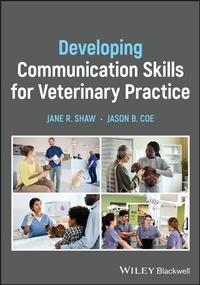
Developing Communication Skills for Veterinary Practice
Description

Developing Communication Skills for Veterinary Practice provides a thorough grounding in practical communication principles for client and team interactions, and helps veterinarians and staff take their communication skills to the next level through self-development and coaching colleagues. The book describes specific evidence-based techniques, gives examples of their use, and demonstrates how to use each skill in the clinical setting, with learning activities to put into practice. It covers every mode of communication, including face-to-face, virtual, telephone, and written communication.
Organized by the tasks of the clinical appointment, each chapter showcases specific communication skills. The book introduces a communication toolbox of 20 key communication skills, which can be applied to any area of veterinary practice or veterinary career path. The book:
* Defines each communication skill, demonstrates techniques, and provides examples
* Emphasizes the importance of communicating effectively with clients and colleagues
* Provides a process and structure for coaching communication with colleagues
* Discusses client and team interactions using many methods, including in-person meetings, telephone conversations, and emails
* Outlines best practices for effectively communicating using technology
Developing Communication Skills for Veterinary Practice is an invaluable resource for veterinary professionals at any level seeking to develop their communication skills and improve clinical outcomes.
More details
Other editions
Additional editions
Persons
The authors
Jane R. Shaw, DVM, PhD, is a Professor in the Department of Clinical Sciences at the College of Veterinary Medicine and Biomedical Sciences, Colorado State University in Fort Collins, Colorado, USA.
Jason B. Coe, DVM, PhD, is a Professor in the Department of Population Medicine at the Ontario Veterinary College, University of Guelph, in Guelph, Ontario, Canada.
Content
About the Authors xiii
How to Use This Book xv
Acknowledgments xviii
1 Introduction 1
Communication Matters 1
Equip Your Communication Toolbox 2
Practice, Practice, Practice 3
Appreciate Communication is An Art and a Science 4
Build, Maintain, and Sustain Relationships 4
Enhance Clinical Outcomes 5
Foster Veterinary Team Culture 8
Make Time to Communicate 9
Answer Key 10
References 10
2 Communication Styles 12
Introduction 12
Set the Scene 14
Adapt Communication Styles to Clients 14
Adapt Communication Styles to the Team 22
Put the Communication Styles into Practice 26
Take It Away 29
Answer Key 29
References 29
3 Opening-the-Interaction 31
Introduction 31
Set the Scene 32
Opening Client Interactions 33
Opening Team Interactions 41
Put the Opening Skills into Practice 43
Take It Away 46
Answer Key 46
References 48
4 Information- Gathering 49
Introduction 49
Set the Scene 51
Gather Patient, Client, and Environment Information 52
Gather Situation, Colleague, and Environment Information 72
Put the Information- Gathering Skills into Practice 76
Take It Away 79
Answer Key 80
References 80
5 Attending to Relationships 82
Introduction 82
Set the Scene 83
Attend to Client Relationships 84
Attend to Team Relationships 93
Put the Relationship Skills into Practice 94
Take It Away 96
Answer Key 97
References 97
6 Attending to Tasks 98
Introduction 98
Set the Scene 100
Attend to Client Tasks 101
Attend to Team Tasks 108
Put the Task Skills into Practice 111
Take It Away 113
Answer Key 113
References 113
7 Diagnostic and Treatment Planning 115
Introduction 115
Set the Scene 117
Plan with Clients 117
Plan with the Team 143
Put the Planning Skills into Practice 145
Take It Away 150
Answer Key 150
References 151
8 Closing-the-Interaction 155
Introduction 155
Set the Scene 157
Closing Client Interactions 158
Closing Team Interactions 161
Put the Closing Skills into Practice 163
Do- It- Yourself Exercises 163
Take It Away 164
Answer Key 164
References 164
9 Communication Coaching 165
Introduction 165
Set the Scene 168
Attend to the Process of Communication Coaching 168
Attend to the Content of Communication Coaching 182
Commonly Asked Questions Related to Communication Coaching 183
Colleague Scenario 185
Team Scenario 186
Talk Through Technology - Video- Recording 187
Put the Coaching Skills into Practice 189
Take It Away 190
Answer Key 191
References 191
10 Transferring the Skills to Various Contexts 193
Introduction 193
Scenarios 194
Client Conversations 194
Team Conversations 205
Take It Away 213
References 214
11 Now What? 216
Twelve Recommendations 217
Put the Communication Skills into Practice 218
Take It Away 224
References 224
Appendices - Tools to Support Coaching and Communication Skills Learning Sessions 225
Appendix A: 20 Communication Skills 226
Appendix B: Coaching Process Card 229
Appendix C: Communication Skills Checklist 233
Index 235
How to Use This Book
We would like to begin by sharing our underlying intentions for developing this communication resource and by highlighting a number of unique aspects of the book. We strove for this book to be user-friendly, accessible, practical, and applicable to all members of the veterinary team. We hope the book is used as a communication skills operating manual; we expect the cover to become coffee-stained, sections to be highlighted and underlined throughout, and pages to be marked and dog-eared.
The book is organized into tasks of the clinical appointment, with chapters flowing from opening-the-interaction, information-gathering, and attending to relationships and tasks to diagnostic and treatment planning, and closing-the-interaction. In each chapter, we showcase key communication skills integral to achieving these tasks. We define the communication skill, demonstrate techniques, and provide examples. Over the course of the book, we introduce a communication toolbox including 20 communication skills.
We emphasize the importance of effective communication with clients and colleagues. In each chapter, we present routine and challenging scenarios in day-to-day practice, and we model how to use the communication skills in both caregiver and collegial interactions. How you communicate with your clients is the bread and butter of your business and establishes long-term client relationships and a strong client base. How you communicate with your colleagues defines the veterinary practice culture, which is integral to creating a healthy, functional workplace environment in which employees thrive.
At the end of each chapter, we offer learning activities to work through, individually or collaboratively, in a small group or with the entire practice team. Through these exercises, we outline a developmental curriculum to build a strong communication toolbox. The book provides ample opportunities to practice the communication skills through either a self-led or guided experiential learning process. The tasks progress from easier, structured, low-risk approaches (e.g. skill spotting exercises, guided reflections, and individual role-play) to more challenging, small-group, high-stakes methods (e.g. in-the-moment coaching or communication and video-review rounds). Over time, the focus shifts from personal communication skill development to coaching and mentoring colleagues.
One key takeaway is that the communication toolbox is transferable to all areas of veterinary practice, to any career path, and to one's own personal life. Although this book is situated in companion animal primary care, the communication tools are critical to success and fulfillment in both general and specialty practices, and in equine, livestock, avian, exotic, zoo, and wildlife medicine. They are equally important for working in laboratory medicine, governmental and non-governmental agencies, public health, regulatory medicine, and industry - not to mention supporting the inter- and intra-professional communication that is instrumental in the referral DVM-specialist relationship, as well as in developing partnerships with vendors, behaviorists, groomers, doggie daycare providers, breeders, and crematorium directors. Finally, these are life skills, and they work well with spouses, partners, children, other family members, and neighbors and at book clubs, on ballfields, or in volunteer organizations.
We take into consideration the myriad of ways in which we communicate with our clients and colleagues. Face-to-face interactions still predominate, followed by telephone and then electronic communication (e.g. email or text) or virtual care. Each method has its own purpose and special considerations and can be highly effective in getting a message across. Unfortunately, if used inappropriately, each modality can result in miscommunication and challenges.
Furthermore, we weave in aspects of technology that can enhance or detract from communication. As with any tool, technology has its time and place. It is critical to know when and how to use each type, from the telephone, whiteboards, and printed care instructions to treatment plans sent via email, or interactive video consultations. In the "Talk through Technology" section of each chapter, we outline best practices for complementary use of technology.
As leading researchers in veterinary communication, we also share Research Spotlights that highlight relevant findings from our veterinary communication studies. Two strong evidence-based books, one on medical communication (Silverman et al. 2013) and the other on veterinary communication (Adams and Kurtz 2017), provide a more thorough and extensive review of the broader clinical-communication literature. Our emphasis is on translating our research into practice - how to apply the findings to real-life scenarios that will inform and enhance client and colleague interactions, develop the veterinary practice, and further veterinary careers.
Here are our 12 recommendations for how to get the most out of this book:
- Capitalize on strengths. Be aware of your communication assets on the table. Know what they are and how they work. Then use this book to fine-tune, dust off, or sharpen communication skills that may be currently underutilized.
- Stretch outside your comfort zone. Try on the communication skills, even if they do not "fit" at first. Start with learning the stem phrases, then implement the scripted examples, and, finally, improvise and own the skills. It may feel fake or artificial at first; however, with continued application and adaption of the skills to fit individual styles, over time the skills will feel natural, authentic, and genuine.
- Be forgiving, and let go of perfection. Practice makes better, not perfect. Communication competency has a high ceiling, like many other clinical skills - clinical reasoning, surgery, or interpreting test results. Strive to be a good communicator, know that mistakes will be made, and make a recovery when it does not go as liked. The resulting relationship is often stronger after repairing a mishap.
- Self-reflect, and be courageous. Be fearless, vulnerable, and open to taking a good hard look at the current communication skills in your toolbox. Regrettably, our perceptions of our communication competence are far from accurate. So, self-reflect on client and colleague interactions, and be bold and request feedback from mentors and peers to identify blind spots.
- Engage with this book. Each chapter includes a traditional knowledge component to foster awareness and understanding of communication concepts. And an interactive section with learning exercises that provide opportunities to practice the skills, identify strengths and challenges, and set learning goals for continued development.
- Keep a journal, and document progress. Before embarking, start a communication journal to capture insights, lessons learned, and communication goals and to mark growth, progress, and milestones. Look back in the pages to see the headway made and be accountable for achieving objectives.
- Apply the skills with clients and colleagues. Use these communication skills to transform day-to-day client interactions, address challenging conversations, and lend a compassionate ear to clients. Do the very same thing with colleagues to create a veterinary team culture characterized by strong communication, morale, teamwork, and retention. Enhance self-esteem and confidence. Enjoy going to work. And make a difference in the lives of colleagues, clients, and patients.
- Read this book multiple times with different intents. For example, on the first read, work on building your communication skills toolbox. Then, the second time, lead your team or veterinary practice through the exercises, developing their skills and coaching techniques. On the third read, mentor others on the practice team while they coach their colleagues. The goal is to create a critical mass of individuals to build, lead, and sustain a communicative and collaborative team culture.
- Teach the team the communication skills. It takes a village in a veterinary practice to serve clients and care for patients. Set colleagues up for success by equipping them with the communication skills they need to excel in their positions. Set the practice up for success by expanding the team of effective communicators and delegating appropriate conversations (e.g. agenda-setting, preventive care education, follow-up progress calls, or sharing diagnostic test results).
- Be creative in involving the team. Depending on the personality, character, and culture of the team, make it fun by designing communication role-plays, Jeopardy, or "choose your own adventure." Or, as the team implements skills, set goals, assess metrics, and monitor trends, such as changes in appointment efficiency, veterinarian average client transaction, or client reviews. Ask teammates who model exemplary communication skills to mentor and coach colleagues.
- Get a leg up or a new lease on practice. For new employees or early-career veterinary graduates, the communication skills ease the professional transition. Entering with a well-equipped communication toolbox promotes victories and reduces failures associated with trial and error. For...
