

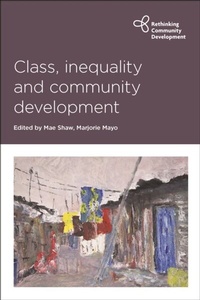
Class, Inequality and Community Development
1st Edition
Published on 6. September 2016
280 pages
978-1-4473-2249-8 (ISBN)
Description

This book, the second title in the Rethinking Community Development series, starts from concern about increasing inequality worldwide and the re-emergence of community development in public policy debates.
It argues for the centrality of class analysis and its associated divisions of power to any discussion of the potential benefits of community development. It proposes that, without such an analysis, community development can simply mask the underlying causes of structural inequality. It may even exacerbate divisions between groups competing for dwindling public resources in the context of neoliberal globalisation.
Reflecting on their own contexts, a wide range of contributors from across the global north and south explore how an understanding of social class can offer ways forward in the face of increasing social polarisation. The book considers class as a dynamic and contested concept and examines its application in policies and practices past and present. These include local/global and rural/urban alliances, community organising, ecology, gender and education.
It argues for the centrality of class analysis and its associated divisions of power to any discussion of the potential benefits of community development. It proposes that, without such an analysis, community development can simply mask the underlying causes of structural inequality. It may even exacerbate divisions between groups competing for dwindling public resources in the context of neoliberal globalisation.
Reflecting on their own contexts, a wide range of contributors from across the global north and south explore how an understanding of social class can offer ways forward in the face of increasing social polarisation. The book considers class as a dynamic and contested concept and examines its application in policies and practices past and present. These include local/global and rural/urban alliances, community organising, ecology, gender and education.
Reviews / Votes
"quite simply a wonderful book about the challenge of rethinking what community development can become in the twenty-first Century...deserves to be read widely" Community Development Journal "although community work/development is no longer in the repertoire of most social workers, this book reminds us what the possibilities once were and perhaps could be again." Professional Social Work "This coherent and timely collection makes the convincing case for social class to be moved from the sidelines back to the centre of theory and practice in contemporary community development." Mick Carpenter, Emeritus Professor, University of Warwick "This wonderful new book is a welcomed contribution to the literature which relates community development to social class and public policy --- with special emphasis on inequalities in society." Barry Checkoway, University of Michigan, USAMore details
Series
Edition
First Edition
Language
English
Place of publication
Bristol
United Kingdom
Publishing group
Bristol University Press
Target group
Professional and scholarly
Illustrations
Not illustrated
File size
0,52 MB
ISBN-13
978-1-4473-2249-8 (9781447322498)
Copyright in bibliographic data and cover images is held by Nielsen Book Services Limited or by the publishers or by their respective licensors: all rights reserved.
Schweitzer Classification
Other editions
Additional editions
Mae Shaw | Marjorie Mayo
Class, Inequality and Community Development
Book
09/2016
1st Edition
Policy Press
€101.00
Shipment within 15-20 days
Mae Shaw | Marjorie Mayo
Class, Inequality and Community Development
Book
09/2016
1st Edition
Policy Press
€42.60
Shipment within 15-20 days
E-Book
09/2016
1st Edition
Policy Press
€231.99
Available for download
Persons
Mae Shaw is Senior Lecturer in Community Education at the University of Edinburgh, Scotland. With a background in practice, she has a long established interest in the politics of community development and has published widely in this field.
Marjorie Mayo is Emeritus Professor of Community Development, Goldsmiths, University of London. Her research has included learning for active citizenship, and access to justice in disadvantaged communities.
Marjorie Mayo is Emeritus Professor of Community Development, Goldsmiths, University of London. Her research has included learning for active citizenship, and access to justice in disadvantaged communities.
Content
Series editors' preface;
PART 1: Contested concepts of class, past and present;
Class, inequality and community development: editorial introduction ~ Mae Shaw and Marjorie Mayo;
Competing concepts of class: implications and applications for community development ~ Lorraine C. Minnite and Frances Fox Piven;
Community development in the UK: whatever happened to class? A historical analysis ~ Gary Craig
PART 2: Class, inequality and community development in context;
Working-class communities and ecology: reframing environmental justice around the Ilva steel plant in Taranto (Apulia, Italy) ~ Stefania Barca and Emanuele Leonardi;
Race, class and green jobs in low-income communities in the US: challenges for community development ~ Sekou Franklin;
Community development practice in India: Interrogating caste and common sense ~ Mohd. Shahid and Manish K. Jha;
The impact of gender, race and class on women's political participation in post-apartheid South Africa: challenges for community development ~ Janine Hicks and Sithembiso Myeni;
What happens when community organisers move into government? Recent experience in Bolivia ~ Mike Geddes;
Community development: (un)fulfilled hopes for social equality in Poland ~ Anna Bilon, Ewa Kurantowicz and Monika Noworolnik-Mastalska;
Rural-urban alliances for community development through land reform from below ~ Maria Elena Martinez-Torres and Frederico Daia Firmiano;
PART 3: Reconnecting class and inequality through community development;
Reconciling participation and power in international development: a case study ~ Kate Newman;
Transformative education and community development: sharing learning to challenge inequality ~ Anindita Adhikari and Peter Taylor;
Community development and class in the context of an East Asian productivist welfare regime ~ Kwok-kin Fung;
Community organising for social change: the scope for class politics ~ Marilyn Taylor and Mandy Wilson;
Concluding chapter: Community unionism: looking backwards, looking forwards ~ Marjorie Mayo and Pilgrim Tucker, with Mat Danaher.
PART 1: Contested concepts of class, past and present;
Class, inequality and community development: editorial introduction ~ Mae Shaw and Marjorie Mayo;
Competing concepts of class: implications and applications for community development ~ Lorraine C. Minnite and Frances Fox Piven;
Community development in the UK: whatever happened to class? A historical analysis ~ Gary Craig
PART 2: Class, inequality and community development in context;
Working-class communities and ecology: reframing environmental justice around the Ilva steel plant in Taranto (Apulia, Italy) ~ Stefania Barca and Emanuele Leonardi;
Race, class and green jobs in low-income communities in the US: challenges for community development ~ Sekou Franklin;
Community development practice in India: Interrogating caste and common sense ~ Mohd. Shahid and Manish K. Jha;
The impact of gender, race and class on women's political participation in post-apartheid South Africa: challenges for community development ~ Janine Hicks and Sithembiso Myeni;
What happens when community organisers move into government? Recent experience in Bolivia ~ Mike Geddes;
Community development: (un)fulfilled hopes for social equality in Poland ~ Anna Bilon, Ewa Kurantowicz and Monika Noworolnik-Mastalska;
Rural-urban alliances for community development through land reform from below ~ Maria Elena Martinez-Torres and Frederico Daia Firmiano;
PART 3: Reconnecting class and inequality through community development;
Reconciling participation and power in international development: a case study ~ Kate Newman;
Transformative education and community development: sharing learning to challenge inequality ~ Anindita Adhikari and Peter Taylor;
Community development and class in the context of an East Asian productivist welfare regime ~ Kwok-kin Fung;
Community organising for social change: the scope for class politics ~ Marilyn Taylor and Mandy Wilson;
Concluding chapter: Community unionism: looking backwards, looking forwards ~ Marjorie Mayo and Pilgrim Tucker, with Mat Danaher.
