

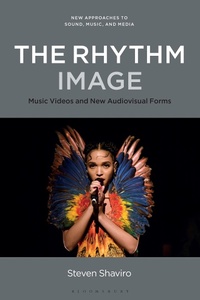
The Rhythm Image
Music Videos and New Audiovisual Forms
1st Edition
Published on 17. November 2022
240 pages
978-1-5013-8858-3 (ISBN)
Description

Music videos play a critical role in our age of ubiquitous streaming digital media. They project the personas and visions of musical artists; they stand at the cutting edge of developments in popular culture; and they fuse and revise multiple frames of reference, from dance to high fashion to cult movies and television shows to Internet memes. Above all, music videos are laboratories for experimenting with new forms of audiovisual expression.
The Rhythm Image explores all these dimensions. The book analyzes, in depth, recent music videos for artists ranging from pop superstar The Weeknd to independent women artists like FKA twigs and Dawn Richard. The music videos discussed in this book all treat the traditional themes of popular music: sex and romance, money and fame, and the lived experiences of race and gender. But they twist these themes in strange and unexpected ways, in order to reflect our entanglement with a digital world of social media, data gathering, and 24/7 demands upon our attention.
The Rhythm Image explores all these dimensions. The book analyzes, in depth, recent music videos for artists ranging from pop superstar The Weeknd to independent women artists like FKA twigs and Dawn Richard. The music videos discussed in this book all treat the traditional themes of popular music: sex and romance, money and fame, and the lived experiences of race and gender. But they twist these themes in strange and unexpected ways, in order to reflect our entanglement with a digital world of social media, data gathering, and 24/7 demands upon our attention.
Reviews / Votes
A quarter-century back, MTV's Amp showcased electronica videos, eerie creatures of beats-driven posthumanism. The show ended, but the videos multiplied, digital tinkering to visualize hip-hop, R&B, and new divas alongside EDM for stop-start viewing on YouTube. Steven Shaviro philosopher of speculative fiction, at last names this core category: the rhythm image. Gazing and auditing, applying theory as needed, he makes that tweak in the assemblage on your screen a frontier. The filmic nugget pulsates, in his cuts from micro to macro analysis, becoming a fundamental cultural reshaping-the visual groove as 21st century homeland. * Eric Weisbard, author of Songbooks: The Literature of American Popular Music * When is a book on music video not "just" a book on music video? When it deftly weaves descriptions of digital art-making with the ideas of Henri Bergson, Immanuel Kant, Marshall McLuhan, and Vivian Sobchack to expand on Gilles Deluge's film-philosophy and articulate a new regime of the image: the rhythm image. Through luxuriant close readings and invigorating exposition, Shaviro shows how contemporary music videos immerse viewers in the new temporal and affective relationship that organize digital media culture. A delight to read and to contemplate! * Caetlin Benson-Allott, Professor of English and Film & Media Studies, Georgetown University, USA * In recent years, the once denigrated and impure object of the music video has received more serious attention and nowhere more so than in Steven Shaviro's ground-breaking work, The Rhythm Image. Combining close engagement with the audiovisual expressive properties of specific digital music videos with broader sociological and philosophical concerns, this book argues for the emergence of a new diagram of audiovisual expression based neither in movement nor pure temporality but in rhythm. While, on the one hand this book engages with Deleuze's cinema books and through them a range of philosophical references from Kant to Whitehead, read in conjunction with contemporary accounts of post-cinema and digital media, at its core is an intense engagement with the contemporary music videos for artists including Massive Attack, FKA Twigs, Tierra Whack and Tkay Maidza that it engages with in loving detail. Ultimately it suggests that these music videos allow for the grasping of contemporary social transformations affecting race, gender, sexuality and mediated desires intensively via moments of audiovisual bliss. * Michael N. Goddard, Reader in Film and Screen Media, Goldsmiths, University of London, UK *More details
Series
Edition
1. Auflage
Language
English
Place of publication
New York
United States
Publishing group
Bloomsbury Publishing PLC (Digital)
ISBN-13
978-1-5013-8858-3 (9781501388583)
Copyright in bibliographic data and cover images is held by Nielsen Book Services Limited or by the publishers or by their respective licensors: all rights reserved.
Schweitzer Classification
Other editions
Additional editions
Book
12/2022
Bloomsbury Academic USA
€29.00
Shipment within 15-20 days
Book
12/2022
Bloomsbury Academic USA
€123.90
Shipment within 15-20 days
Person
Steven Shaviro is the DeRoy Professor of English at Wayne State University in Detroit. His books include The Cinematic Body (1993), Connected, Or, What It Means To Live in the Network Society (2003), Post-Cinematic Affect (2010), Discognition (2016), and Digital Music Videos (2017).
Content
List of Figures
Preface
1. The Rhythm Image
2. Post-Cinematic Articulations of Sound and Vision (Massive Attack)
3. Cyborg Avatars (Dawn Richard)
4. Pulses of Distraction (Tierra Whack)
5. Living With Time-Space Compression (Bonobo)
6. The Passion According to FKA twigs
7. Vanishing Voices (Moses Sumney)
8. Metamorphoses of a Severed Head (The Weeknd)
9. Submerged (Tkay Maidza)
Afterword
Books and Articles Cited
Music and Videos Cited
Index
Preface
1. The Rhythm Image
2. Post-Cinematic Articulations of Sound and Vision (Massive Attack)
3. Cyborg Avatars (Dawn Richard)
4. Pulses of Distraction (Tierra Whack)
5. Living With Time-Space Compression (Bonobo)
6. The Passion According to FKA twigs
7. Vanishing Voices (Moses Sumney)
8. Metamorphoses of a Severed Head (The Weeknd)
9. Submerged (Tkay Maidza)
Afterword
Books and Articles Cited
Music and Videos Cited
Index
