

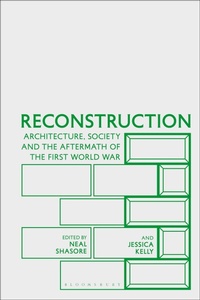
Reconstruction
Architecture, Society and the Aftermath of the First World War
1st Edition
Published on 23. February 2023
408 pages
978-1-350-15296-0 (ISBN)
Description

Commendation, the Colvin Prize 2023 (Society of Architectural Historians of Great Britain)
Reconstruction explores the impact of the First World War on the built environment - examining the immediate and longer term aftermath of the Great War on the architecture of Britain and the British Empire during the interwar years.
While much attention has been paid by historians to post-war architectural reconstruction after 1945, the earlier developments of the interwar period (1919-1939) have been comparatively overlooked. This volume reveals how the architectural developments of this period not only provided important foundations for what happened after 1945 - they are also of real significance in their own right.
Sixteen essays written by leading and emerging scholars bring together new and diverse approaches to the period - a period of reconstruction, fraught with the challenges of modernity and democratisation. The collection considers the complex effects of reconstruction on design, discourse, practice, and professionalism, and deals with the full spectrum of architectural styles and approaches, privileging neither Modernism nor traditional styles like the neo-Georgian. It brings to the fore social and political histories of the built environment, and makes important postcolonial interventions into the architectural history of British Imperialism at home and in its far reaches; in Cairo, South Africa, Australia, and India.
Reconstruction explores the impact of the First World War on the built environment - examining the immediate and longer term aftermath of the Great War on the architecture of Britain and the British Empire during the interwar years.
While much attention has been paid by historians to post-war architectural reconstruction after 1945, the earlier developments of the interwar period (1919-1939) have been comparatively overlooked. This volume reveals how the architectural developments of this period not only provided important foundations for what happened after 1945 - they are also of real significance in their own right.
Sixteen essays written by leading and emerging scholars bring together new and diverse approaches to the period - a period of reconstruction, fraught with the challenges of modernity and democratisation. The collection considers the complex effects of reconstruction on design, discourse, practice, and professionalism, and deals with the full spectrum of architectural styles and approaches, privileging neither Modernism nor traditional styles like the neo-Georgian. It brings to the fore social and political histories of the built environment, and makes important postcolonial interventions into the architectural history of British Imperialism at home and in its far reaches; in Cairo, South Africa, Australia, and India.
More details
Edition
1. Auflage
Language
English
Place of publication
London
United Kingdom
Publishing group
Bloomsbury Publishing PLC
Target group
Professional and scholarly
Illustrations
86 bw illus
ISBN-13
978-1-350-15296-0 (9781350152960)
Copyright in bibliographic data and cover images is held by Nielsen Book Services Limited or by the publishers or by their respective licensors: all rights reserved.
Schweitzer Classification
Other editions
Additional editions
Neal Shasore | Jessica Kelly
Reconstruction
Architecture, Society and the Aftermath of the First World War
Book
06/2024
Bloomsbury Visual Arts
€36.50
Shipment within 15-20 days
Neal Shasore | Jessica Kelly
Reconstruction
Architecture, Society and the Aftermath of the First World War
Book
02/2023
Bloomsbury Visual Arts
€121.50
Article exhausted; check different version
Persons
Neal Shasore is Leverhulme Early Career Fellow at the School of Architecture, Liverpool University.
Jessica Kelly is Senior Lecturer in Contextual and Theoretical Studies in Design at The University for the Creative Arts, Farnham.
Jessica Kelly is Senior Lecturer in Contextual and Theoretical Studies in Design at The University for the Creative Arts, Farnham.
Content
List of figures
List of contributors
Foreword: Towards Narratives of Modernity After Reconstruction - Elizabeth Darling
Acknowledgements
Introduction - Neal Shasore and Jessica Kelly
Section I: Promoting the Business of Architecture
Introduction - Neal Shasore and Jessica Kelly
I: Criticism: The Architectural Press and the Public - Jessica Kelly
II: Professionalism: The American Influence on British Architectural Practice - H Horatio Joyce
III: Regulation: The New London - Eileen Chanin
IV: Development: Speculative Office Development and Public Sector Tenants - Jonathan Clarke
Section II: Designing Community Infrastructure
Introduction - Neal Shasore and Jessica Kelly
V: Community Centre: New Housing Estates in Scotland - Alistair Fair
VI: Public House: The Carlisle Experiment and the Improved Public House - Julian Holder
VII: Parish: Democratic Participation in Suburban Parish Churches - Clare Price
Section III: Building a Rural Citizenry
Introduction - Neal Shasore and Jessica Kelly
VIII: Yeoman: Land Settlement and Cottage Small Holdings - Rebecca Preston and Joanna Smith
IX: Veteran: Annabel Dott and Colonial, Metropolitan and Rural Communities - Elizabeth McKellar
X: Student: Henry Morris and the First Village Colleges - Kieran Mahon
Section IV: Binding Subjects through Statecraft
Introduction - Neal Shasore
XI: Citizenship: Welfare and the Democratic State in Percy Thomas's Civic Architecture - Robert Proctor
XII: Memory: Sir Herbert Baker, Rhodes House and the Architecture of Memory - Geoffrey Tyack
XIII: Diocese: Cairo Cathedral and the Politics of Liberal Anglican Church Design - David Lewis
Section V: Wedding Peace with Well-Being
XIV: Sickness: Advances in British Hospital Design after the First World War - Harriet Richardson Blakeman
XV: Health: Democracy, Diversity, Dispersal - Barry Doyle
Index
List of contributors
Foreword: Towards Narratives of Modernity After Reconstruction - Elizabeth Darling
Acknowledgements
Introduction - Neal Shasore and Jessica Kelly
Section I: Promoting the Business of Architecture
Introduction - Neal Shasore and Jessica Kelly
I: Criticism: The Architectural Press and the Public - Jessica Kelly
II: Professionalism: The American Influence on British Architectural Practice - H Horatio Joyce
III: Regulation: The New London - Eileen Chanin
IV: Development: Speculative Office Development and Public Sector Tenants - Jonathan Clarke
Section II: Designing Community Infrastructure
Introduction - Neal Shasore and Jessica Kelly
V: Community Centre: New Housing Estates in Scotland - Alistair Fair
VI: Public House: The Carlisle Experiment and the Improved Public House - Julian Holder
VII: Parish: Democratic Participation in Suburban Parish Churches - Clare Price
Section III: Building a Rural Citizenry
Introduction - Neal Shasore and Jessica Kelly
VIII: Yeoman: Land Settlement and Cottage Small Holdings - Rebecca Preston and Joanna Smith
IX: Veteran: Annabel Dott and Colonial, Metropolitan and Rural Communities - Elizabeth McKellar
X: Student: Henry Morris and the First Village Colleges - Kieran Mahon
Section IV: Binding Subjects through Statecraft
Introduction - Neal Shasore
XI: Citizenship: Welfare and the Democratic State in Percy Thomas's Civic Architecture - Robert Proctor
XII: Memory: Sir Herbert Baker, Rhodes House and the Architecture of Memory - Geoffrey Tyack
XIII: Diocese: Cairo Cathedral and the Politics of Liberal Anglican Church Design - David Lewis
Section V: Wedding Peace with Well-Being
XIV: Sickness: Advances in British Hospital Design after the First World War - Harriet Richardson Blakeman
XV: Health: Democracy, Diversity, Dispersal - Barry Doyle
Index
