

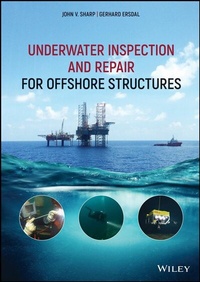
Underwater Inspection and Repair for Offshore Structures
Description

Benefit from a much-needed, up-to-date handbook on underwater inspection and repair processes and technologies
Underwater Inspection and Repair for Offshore Structures fills a gap in the literature to provide an overview of the inspection and repair processes for both steel and concrete offshore structures. Authors and noted experts on the topic John V. Sharp and Gerhard Esdal guide readers through the reasons why inspection and repair are performed and how both are linked to the management of structural integrity, statutory requirements, and various types of damage.
The book addresses critical topics, including the execution and planning of inspection and repair, the tools and methods used, and their deployment underwater. The authors put particular focus on steel and concrete offshore oil and gas installations, but the content is also applicable to the substructures of offshore wind turbines. Underwater Inspection and Repair for Offshore Structures is complementary to the authors' book Ageing and Life Extension of Offshore Structures, also from Wiley. This important book:
* Covers current inspection and monitoring techniques to evaluate existing structures
* Includes coverage of robotic (ROV) inspection and repair methods
* Provides an overview of repair and maintenance techniques applicable to the splash-zone and underwater operations
Written for engineers, designers, and safety auditors working with offshore structures. Underwater Inspection and Repair for Offshore Structures is a comprehensive resource for understanding how to effectively inspect and repair these vulnerable structures.
More details
Other editions
Additional editions
Persons
John V. Sharp is a Visiting Professor at Cranfield University, UK. His main research interests include the ageing and life extension of structures and their inspection and repair. Formerly he was responsible for the UK Health & Safety Executive's offshore research programme.
Gerhard Ersdal is a Professor in the Department of Mechanical and Structural Engineering and Material science at the University of Stavanger, Norway. His main research interests include structural integrity management, life extension of structures, and risk management.
Content
Preface xiii
Definitions and abbreviations xv
1 Introduction to Underwater Inspection and Repair 1
1.1 Background 1
1.2 Why Do We Inspect and Repair Structures 3
1.3 Types of Offshore Structures 6
1.3.1 Fixed Steel Structures 6
1.3.2 Floating Structures 8
1.3.3 Concrete Platforms 9
1.4 Overview of this Book 10
1.5 Bibliographic Notes 11
References 11
2 Statutory Requirements for Inspection and Repair of Offshore Structures 13
2.1 Introduction 13
2.2 Examples of Country Statutory Requirements 14
2.2.1 Introduction 14
2.2.2 Regulation in the US Offshore Industry 15
2.2.3 Regulation in the UK Offshore Industry 16
2.2.4 Regulation in the Norwegian Offshore Industry 17
2.3 Standards and Recommended Practices for Steel Structures 17
2.3.1 Introduction 17
2.3.2 API RP-2A and API RP-2SIM (Structural Integrity Management) 18
2.3.3 API RP-2FSIM (Floating Systems Integrity Management) 21
2.3.4 ISO 19902 22
2.3.5 ISO 19901-9 23
2.3.6 NORSOK N-005 23
2.4 Standards and Recommended Practices for Mooring Systems 24
2.4.1 Introduction 24
2.4.2 API RP-2MIM (Mooring Integrity Management) 25
2.4.3 IACS Guideline for Survey of Offshore Moorings 26
2.5 Standards and Guidance Notes for Concrete Structures 27
2.5.1 Introduction 27
2.5.2 ISO 19903-Concrete Structures 27
2.5.3 Department of Energy Guidance Notes 31
2.5.4 NORSOK N-005-Concrete Structures 32
2.6 Discussion and Summary 33
References 34
3 Damage Types in Offshore Structures 37
3.1 Introduction 37
3.1.1 General 37
3.1.2 Corrosion 38
3.1.3 Cracking Due to Fatigue 40
3.1.4 Dents, Bows and Gouges Due to Impact 41
3.1.5 Cracking Due to Hydrogen Embrittlement 42
3.1.6 Erosion, Wear and Tear 42
3.1.7 Brittle Fracture 43
3.1.8 Grout Crushing and Slippage 43
3.2 Previous Studies on Damage to Offshore Structures 43
3.3 Previous Studies on Damage to Fixed Steel Structures 44
3.3.1 MTD Underwater Inspection of Steel Offshore Structures 44
3.3.2 MTD Review of Repairs to Offshore Structures and Pipelines 46
3.3.3 PMB AIM Project for MMS 47
3.3.4 HSE Study on Causes of Damage to Fixed Steel Structures 50
3.3.5 Single-Sided Closure Welds 51
3.3.6 MSL Rationalization and Optimisation of Underwater Inspection Planning Report 52
3.3.7 Studies on Hurricane and Storm Damage 54
3.4 Previous Studies on Damage to Floating Steel Structures 57
3.4.1 D.En. Studies on Semi-Submersibles 57
3.4.2 SSC Review of Damage Types to Ship-Shaped Structures 57
3.4.3 Defect Type for Tanker Structure Components 59
3.4.4 Semi-Submersible Flooding Incident Data 59
3.5 Previous Studies on Damage Types to Mooring Lines and Anchors 61
3.5.1 Introduction and Damage Statistics for Moorings 61
3.5.2 API RP-2MIM Overview of Damage Types to Mooring Lines 62
3.5.3 HSE Studies on Mooring Systems 63
3.5.4 Studies on Corrosion of Mooring Systems 64
3.5.5 Studies on Fatigue of Mooring Systems 64
3.6 Previous Studies on Concrete Structures 66
3.6.1 Concrete in the Oceans Project 66
3.6.2 Durability of Offshore Concrete Structures 67
3.6.3 PSA Study on Damage to Offshore Concrete Structures 68
3.7 Previous Studies on Marine Growth (Marine Fouling) 70
3.8 Summary of Damage and Anomalies to Offshore Structures 72
3.8.1 General 72
3.8.2 Damage Types Specific to Steel Structures 72
3.8.3 Damage Types Specific to Concrete Structures 75
3.8.4 Summary Table of Damage to Different Types of Structures 75
3.9 Bibliographic Notes 76
References 76
4 Inspection Methods for Offshore Structures Underwater 79
4.1 Introduction to Underwater Inspection 79
4.2 Previous Studies on Inspection 81
4.2.1 Introduction 81
4.2.2 SSC Survey of Non-Destructive Test Methods 81
4.2.3 Underwater Inspection / Testing / Monitoring of Offshore Structures 84
4.2.4 HSE Handbook for Underwater Inspectors 85
4.2.5 MTD Underwater Inspection of Steel Offshore Structures 85
4.2.6 Department of Energy Fourth Edition Guidance Notes on Surveys 86
4.2.7 HSE Detection of Damage to Underwater Tubulars and Its Effect on Strength 87
4.2.8 MSL Rationalization and Optimisation of Underwater Inspection Planning Report 89
4.2.9 Projects on Testing of Inspection Methods and Their Reliability 93
4.2.10 Concrete in the Oceans Programme 96
4.3 Inspection and Inspection Methods 100
4.3.1 Introduction 100
4.3.2 Visual Inspection 100
4.3.3 Ultrasonic Testing Methods 103
4.3.4 Electromagnetic Methods 104
4.3.5 Radiographic Testing 106
4.3.6 Flooded Member Detection 106
4.3.7 Rebound Hammer 108
4.3.8 Chloride Ingress Test 108
4.3.9 Electro-Potential Mapping 109
4.3.10 Cathodic Protection Inspection 111
4.4 Deployment Methods 112
4.4.1 Introduction 112
4.4.2 Divers 113
4.4.3 ROV and AUV 114
4.4.4 Splash Zone Access 116
4.4.5 Summary of Inspection Methods and Their Deployment 117
4.5 Competency of Inspection Personnel and Organisations 117
4.5.1 Introduction 117
4.5.2 Regulatory Requirements on Competency 119
4.5.3 Requirements on Competency in Standards 119
4.5.4 Certification and Training of Inspectors 121
4.5.5 Trials to Study Inspector Competency 121
4.5.6 Organisational Competency 122
4.6 Reliability of Different Inspection Methods Underwater 124
4.7 Inspection of Fixed Steel Structures 126
4.8 Inspection of Concrete Structures 128
4.9 Inspection of Floating Structures and Mooring Systems 133
References 137
5 Structural Monitoring Methods 141
5.1 Introduction 141
5.1.1 General 141
5.1.2 Historical Background 142
5.1.3 Requirements for Monitoring in Standards 145
5.2 Previous Studies on Structural Monitoring Methods 146
5.2.1 MTD Underwater Inspection of Steel Offshore Installations 146
5.2.2 HSE Review of Structural Monitoring 146
5.2.3 HSE Updated Review of Structural Monitoring 148
5.2.4 SIMoNET 150
5.3 Structural Monitoring Techniques 151
5.3.1 Introduction 151
5.3.2 Acoustic Emission Technique 151
5.3.3 Leak Detection 152
5.3.4 Global Positioning Systems and Radar 152
5.3.5 Fatigue Gauge 153
5.3.6 Continuous Flooded Member Detection 153
5.3.7 Natural Frequency Monitoring 153
5.3.8 Strain Monitoring 154
5.3.9 Riser and Anchor Chain Monitoring 155
5.3.10 Acoustic Fingerprinting 155
5.3.11 Monitoring with Guided Waves 155
5.4 Structural Monitoring Case Study 155
5.5 Summary on Structural Monitoring 157
5.6 Bibliographic Notes 159
References 159
6 Inspection Planning, Programme and Data Management 161
6.1 Introduction 161
6.1.1 General 161
6.1.2 Long-Term Inspection Plan 162
6.1.3 Approaches for Long-Term Inspection Planning 163
6.1.4 Inspection Programme 167
6.1.5 Integrity Data Management 170
6.1.6 Key Performance Indicators 173
6.2 Previous Studies on Long-Term Planning of Inspections 173
6.2.1 PMB AIM Project for MMS 173
6.2.2 MSL Rationalization and Optimisation of Underwater Inspection Planning Report 174
6.2.3 HSE Study on the Effects of Local Joint Flexibility 175
6.2.4 HSE Ageing Plant Report 176
6.2.5 Studies on Risk-Based and Probabilistic Inspection Planning 176
6.2.6 EI Guide to Risk-Based Inspection Planning 180
6.3 Summary on Inspection Planning and Programme 180
6.3.1 Introduction 180
6.3.2 Fixed Steel Platforms 181
6.3.3 Floating Steel Structures 182
6.3.4 Concrete Platforms 183
6.4 Bibliographic Notes 184
References 184
7 Evaluation of Damage and Assessment of Structures 187
7.1 Introduction 187
7.2 Previous Studies on Evaluation of Damaged Tubulars 189
7.2.1 Remaining Fatigue Life of Cracked Tubular Structures 189
7.2.2 Static Strength of Cracked Tubular Structures 195
7.2.3 Effect of Multiple Member Failure 199
7.2.4 Corroded Tubular Members 201
7.2.5 Dent and Bow Damage to Underwater Tubulars and Their Effect on Strength 205
7.2.6 Studies on Assessment of System Strength 208
7.2.7 PMB AIM Project for MMS 209
7.2.8 MSL Significant JIP for MMS 211
7.2.9 MSL Assessment of Repair Techniques for Ageing or Damaged Structures 214
7.3 Previous Studies on Evaluation of Damaged Plated Structures 215
7.3.1 Introduction 215
7.3.2 SSC Studies on Residual Strength of Damaged Plated Marine Structures 216
7.4 Previous Studies on Evaluation of Damaged Concrete Structures 218
7.4.1 Department of Energy Assessment of Major Damage to the Prestressed Concrete Tower 218
7.4.2 Department of Energy Review of Impact Damage Caused by Dropped Objects 220
7.4.3 HSE Review of Durability of Prestressing Components 220
7.4.4 HSE Review of Major Hazards to Concrete Platforms 220
7.4.5 Department of Energy Review of the Effects of Temperature Gradients 221
7.4.6 Concrete in the Oceans Review of Corrosion Protection of Concrete Structures 221
7.4.7 Norwegian Road Administration Guideline V441 222
7.5 Practice of Evaluation and Assessment of Offshore Structures 223
7.5.1 General 223
7.5.2 Fixed and Floating Steel Structures 225
7.5.3 Concrete Structures 230
References 232
8 Repair and Mitigation of Offshore Structures 239
8.1 Introduction to Underwater Repair 239
8.2 Previous Generic Studies on Repair of Structures 242
8.2.1 UEG Report on Repair to North Sea Offshore Structures 242
8.2.2 MTD Study on Repairs of Offshore Structures 242
8.2.3 UK Department of Energy Fourth Edition Guidance Notes 247
8.2.4 DNV GL Study on Repair Methods for PSA 248
8.3 Previous Studies on Repair of Tubular Structures 250
8.3.1 Grout Repairs to Steel Offshore Structures 250
8.3.2 UK Joint Industry Repairs Research Project 252
8.3.3 UK Department of Energy and TWI Study on Repair Methods for Fixed Offshore Structures 254
8.3.4 UK Department of Energy-Funded Work on Adhesive Repairs 257
8.3.5 Residual and Fatigue Strength of Grout-Filled Damaged Tubular Members 260
8.3.6 Fatigue Life Enhancement of Tubular Joints by Grout Injection 261
8.3.7 ATLSS Projects on Repair to Dent-Damaged Tubular Members 261
8.3.8 ATLSS Projects on Repair to Corrosion Damaged Tubulars 263
8.3.9 MSL Strengthening, Modification and Repair of Offshore Installations 265
8.3.10 MSL Underwater Structural Repairs Using Composite Materials 266
8.3.11 HSE Experience from the Use of Clamps Offshore 267
8.3.12 MSL Study on Neoprene-Lined Clamps 269
8.3.13 MSL Repair Techniques for Ageing and Damaged Structures 270
8.3.14 MMS Studies on Hurricane Damage and Repair 273
8.3.15 BOEME Report on Wet Weld Repairs to US Structures 274
8.4 Previous Studies on Repair of Concrete Structures 276
8.4.1 Introduction 276
8.4.2 Repair of Major Damage to Concrete Offshore Structures 277
8.4.3 Scaling of Underwater Concrete Repairs 278
8.4.4 Assessment of Materials for Repair of Damaged Concrete Underwater 280
8.4.5 Effectiveness of Concrete Repairs 285
8.5 Previous Studies on Repair of Plated Structures 286
8.6 Repair of Steel Structures 289
8.6.1 Introduction 289
8.6.2 Selection of Mitigation and Repair Methods 290
8.6.3 Machining Methods (Grinding) 295
8.6.4 Re-Melting Methods 297
8.6.5 Weld Residual Stress Improvement Methods (Peening) 297
8.6.6 Stop Holes and Crack-Deflecting Holes 298
8.6.7 Structural Modifications 300
8.6.8 Underwater Welding 301
8.6.9 Doubler Plates 305
8.6.10 Removal of Structural Elements 305
8.6.11 Bonded-Type Repairs 306
8.6.12 Structural Clamps and Sleeves 307
8.6.13 Grout Filling of Members 310
8.6.14 Grout Filling of Tubular Joints 312
8.6.15 Installation of New Structural Elements 312
8.6.16 Summary of Steel Repairs 313
8.7 Repair of Corrosion and Corrosion Protection Systems 316
8.7.1 Introduction 316
8.7.2 Repair of Damaged Coatings 318
8.7.3 Replacement of Corroded Material 318
8.7.4 Repair or Replacement of the Corrosion Protection System 318
8.8 Repair of Mooring Systems 319
8.9 Repair of Concrete Structures 320
8.9.1 Introduction 320
8.9.2 Choice of Repair Method 322
8.9.3 Concrete Material Replacement 323
8.9.4 Injection Methods 325
8.9.5 Repair of Reinforcement and Prestressing Tendons 326
8.9.6 Summary of Concrete Repairs 327
8.10 Overview of Other Mitigation Methods 328
8.11 Bibliographic Notes 329
References 329
9 Conclusions and Future Possibilities 337
9.1 Overview of the Book 337
9.2 Emerging Technologies 338
9.3 Final Thoughts 340
References 341
Index 342
Definitions and abbreviations
Accidental limit state (ALS) Check of the collapse of the structure due to the same reasons as described for the ultimate limit state but exposed to abnormal and accidental loading situations Acoustic emission The production of sound waves by a material when it is subjected to stress ACFM Alternating Current Frequency Modulated (type of inspection) ACPD Alternating Current Potential Drop (type of inspection) Admixture Material added during the mixing process of concrete in small quantities related to the mass of cement to modify the properties of fresh or hardened concrete Ageing Process in which integrity (i.e., safety) of a structure or component changes with time or use AIM project A project undertaken by the US Mineral Management Services (MMS) for assessment, inspection and maintenance, providing guidance on managing the integrity of existing fixed steel platforms in the Gulf of Mexico. Anomaly In-service measurement (damage, deterioration, defect, degradation, etc.) that is outside the threshold acceptable from the design or most recent fitness for service assessment As-built documentation Documentations that includes as-built documentation collected during in-service Asset integrity management (AIM) AIM is the means of ensuring that the people, systems, processes and resources that deliver integrity are in place, in use and will perform when required over the whole life cycle of the asset Barrier A measure intended to either identify conditions that may lead to failure or hazardous and accidental situations, prevent an actual sequence of events occurring or developing, influence a sequence of events in a deliberate way, or limit damage and/or loss Bilge The area on the outer surface of a ship's hull where the bottom shell plating meets the side shell plating Caisson Major part of fixed concrete offshore structure, providing buoyancy during floating phases and the possibility of oil storage within the structure, also used for pipework from topside to underwater typically water lift (intake of firewater, cooling water, etc.) and outlet of wastewater CFRP Carbon Fiber Reinforced Polymer Clamp A fabricated steel construction encompassing an existing tubular member or a nodal joint. A clamp consists of two or more parts that are bolted together. There are a number of clamp variants depending on whether or not the clamp parts are compressed against the existing member/joint and on whether there is a medium (grout or neoprene) placed between the clamp steelwork and the member/joint. A clamp should not be confused with a guide, which can appear to be superficially similar Collapse Total loss of the load bearing capacity of the platform through failure of one or more structural components CP Cathodic Protection Curing Action taken to maintain favourable moisture and temperature conditions of freshly placed concrete or cementitious materials during a defined period of time following placement CVI Close visual inspection (type of inspection) Defect An imperfection, fault or flaw in a component Design service life Assumed period for which a structure is to be used for its intended purpose with anticipated maintenance but without substantial repair from ageing processes being necessary DFI resume A document summarising key information concerned with the design, fabrication and installation Discontinuity A lack of continuity or cohesion; an intentional or unintentional interruption in the physical structure or configuration of a material or component Duty holder A UK term for the operator in the case of a fixed installation (including fixed production and storage units) and for the owner in the case of a mobile installation DVI Detailed visual inspection (type of inspection) EC, ET Eddy current testing (type of inspection) Evaluation The process of evaluating whether identified changes, defects or anomalies need repair, further inspection or a more detailed assessment Fairlead A device to guide a mooring line and to stop it moving laterally before it enters the vessel False indication An indication that is interpreted to be caused by a discontinuity at a location where no discontinuity exists Fatigue limit state (FLS) Check of the cumulative fatigue damage due to repeated loads or the fatigue crack growth capacity of the structure Fatigue Utilisation Index (FUI) FUI is the ratio between the effective operational time and the documented fatigue life FCAW Acronym for Fluxed Cored Arc Welding Fixed structure Structure that is bottom founded and transfers all actions on it to the sea floor Flaw An imperfection or discontinuity that may be detectable by non-destructive testing FRP Fiber Reinforced Polymer FSU Floating storage units FSO Floating storage and offloading units FPSO Floating production, storage and offloading units Flooded member detection (FMD) Inspection technique that relies on the detection of water penetrating a member by using radiographic or ultrasonic methods GMAW Gas Metal Arc Welding Gross errors Significant errors, mistakes and omissions in the form of anomaly or defects that may lead to local or global failures Grout A mixture of cementitious materials and water, with or without aggregate, to fill cavities and components to form a solid mass when set GTAW Gas Tungsten Arc Welding GVI General visual inspection (type of inspection) HAZ Heat affected zone related to welding Hazard Situations with potential for human injury, damage to the environment, damage to property, or a combination of these High Strength Steels (HSS) Steels with yield strengths in excess of 500 MPa Hydrogen induced cracking (HIC) or hydrogen induced stress cracking (HISC) The process by which hydride-forming metals such as steel become brittle and fracture due to the introduction and subsequent diffusion of hydrogen into the metal Inspection programme Scope of work for the offshore execution of the inspection activities to determine the condition and configuration of the structure Integrity The state of the structure, ideally being fit for service, and with an acceptable level of safety against failure Integrity management Continuous process to manage all changes that will occur during operational life that may affect the integrity of structures and marine systems Jack-ups Mobile offshore unit with a buoyant hull and legs that can be moved up and down relative to the hull JIP Joint Industry Project, usually in research and development Kenter shackle A device for joining two chain links as a repair KPI Key performance indicator, measurement of performance against targets Life extension The use of structures beyond their originally defined design life Limit state A state beyond which the structure no longer fulfils the relevant design criteria Management of change (MoC) A recognised process that is required when significant changes are...
