

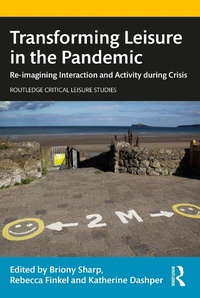
Transforming Leisure in the Pandemic
Re-imagining Interaction and Activity during Crisis
1st Edition
Published on 22. December 2022
240 pages
978-1-000-82630-2 (ISBN)
Description

This is the first book to critically explore international leisure during the COVID-19 pandemic. It analyses the ways in which the pandemic has impacted upon our leisure practices and our leisure lives, focusing on three key spaces ? public, private, and digital.
The book seeks to understand how changes in leisure have led to transformations in the ways we have had to 'do' and 'redo' activities, such as incorporating digitalisation and distancing measures, as well as dealing with restrictions on social interaction, gatherings, and cultural activities. It presents a series of case studies covering topics as diverse as music festivals, theatre on-screen, walking, static cycling, smartphone use, holidays, and the 'lockdown leisure' of preschool children, including people across the life course, from young children to older retired people. The book discusses changes in patterns of behaviour, leisure experiences, and leisure environments worldwide and critically re-evaluates what leisure is and what it means in contemporary societies. It illustrates both the significant impact the pandemic has had on leisure and the important role leisure plays in helping support and maintain individual and community well-being.
This is fascinating reading for any student, researcher, or practitioner with an interest in leisure studies, tourism, events, sociology, cultural studies, or performance studies.
The book seeks to understand how changes in leisure have led to transformations in the ways we have had to 'do' and 'redo' activities, such as incorporating digitalisation and distancing measures, as well as dealing with restrictions on social interaction, gatherings, and cultural activities. It presents a series of case studies covering topics as diverse as music festivals, theatre on-screen, walking, static cycling, smartphone use, holidays, and the 'lockdown leisure' of preschool children, including people across the life course, from young children to older retired people. The book discusses changes in patterns of behaviour, leisure experiences, and leisure environments worldwide and critically re-evaluates what leisure is and what it means in contemporary societies. It illustrates both the significant impact the pandemic has had on leisure and the important role leisure plays in helping support and maintain individual and community well-being.
This is fascinating reading for any student, researcher, or practitioner with an interest in leisure studies, tourism, events, sociology, cultural studies, or performance studies.
More details
Series
Edition
1. Auflage
Language
English
Place of publication
London
United Kingdom
Publishing group
Taylor & Francis Ltd
Target group
College/higher education
Illustrations
9 Tables, black and white; 6 Line drawings, black and white; 3 Halftones, black and white; 9 Illustrations, black and white
ISBN-13
978-1-000-82630-2 (9781000826302)
Copyright in bibliographic data and cover images is held by Nielsen Book Services Limited or by the publishers or by their respective licensors: all rights reserved.
Schweitzer Classification
Other editions
Additional editions
Briony Sharp | Rebecca Finkel | Katherine Dashper
Transforming Leisure in the Pandemic
Re-imagining Interaction and Activity during Crisis
Book
12/2022
1st Edition
Routledge
€60.20
Shipment within 10-20 days
Briony Sharp | Rebecca Finkel | Katherine Dashper
Transforming Leisure in the Pandemic
Re-imagining Interaction and Activity during Crisis
Book
12/2022
1st Edition
Routledge
€186.10
Shipment within 10-20 days
Persons
Briony Sharp is Lecturer in Marketing, Innovation, Tourism, and Events division at the University of the West of Scotland, UK, and Fellow of the Higher Education Academy. Her most recent research focuses on the social impacts and legacies from events, event governance, volunteering and engagement, and critical event studies.
Rebecca Finkel is Professor of Critical Event Studies at Queen Margaret University, UK, and Senior Fellow of the Higher Education Academy. Rebecca's research situates events and festivals within social justice, gender in/equality, and cultural identity frameworks.
Katherine Dashper is Professor and Director of Research Degrees in the School of Events, Tourism, and Hospitality Management at Leeds Beckett University, UK. Her research focuses on gender and multispecies approaches to understanding leisure, sport, tourism, and events.
Rebecca Finkel is Professor of Critical Event Studies at Queen Margaret University, UK, and Senior Fellow of the Higher Education Academy. Rebecca's research situates events and festivals within social justice, gender in/equality, and cultural identity frameworks.
Katherine Dashper is Professor and Director of Research Degrees in the School of Events, Tourism, and Hospitality Management at Leeds Beckett University, UK. Her research focuses on gender and multispecies approaches to understanding leisure, sport, tourism, and events.
Content
List of contributors. Introduction. PART I Transformations in public spaces. 1 Nightlife leisure activities during COVID-19: Restrictions, spatial transformations, and social changes in clubbing space in the examples of Polish cities. 2 The ritualistic nature of pandemic leisure. 3 The impact of COVID-19 on travel behaviour and holiday intentions: Evidence from Greece. 4 Exploring African American college student experiences of leisure-time physical activity and psychological wellbeing during COVID-19. 5 How did music festival stakeholders face pandemic uncertainty? Two case studies: Bachfest in Leipzig and BAM Festival in Barcelona. PART II Transformations in private spaces. 6 Toddler and pre-school children's physical activity during a pandemic. 7 Children's and families' changing everyday geographies: Playing, learning, and exercising outdoors during COVID-19. 8 Bridge during a time of disruption: Pandemic playing, everyday habits, and situated writing. 9 Rhythms in home-based leisure during the COVID-19 lockdown. PART III Transformations in digital spaces. 10 Changing "theatre-going" behaviours during COVID-19: Theatre on the screen. 11 Digital leisure as sites of diasporic solidarity. 12 COVID-19's impact on leisure coping and smartphone use. 13 Stories of older adults' resilience in adapting leisure behaviours due to COVID-19 restrictions. Index.
