

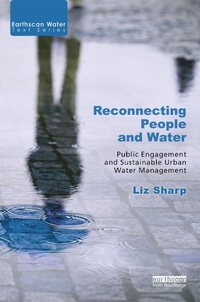
Reconnecting People and Water
Public Engagement and Sustainable Urban Water Management
Published on 18. May 2017
248 pages
978-1-317-91640-6 (ISBN)
Description

Water management in industrialised western countries has long been seen as a technical process associated with pipes, drains and bureaucracies. This technical model of water management is now being questioned. This book examines the nature of contemporary water management and the prospects for and barriers to different forms of engagement with the public.
In particular, it shows how historical and social scientific understandings develop and question current water management norms in relation to water in the landscape, water in the home and the hidden management of water beneath our streets and behind our walls. It is shown that the four-fold challenges of climate change, urbanisation, changing environmental standards and fiscal accountability mean that we can no longer rely on unseen technical fixes to erase the threats of pollution, water shortages and floods. Such concerns offer two prompts for public engagement and participation. First, on a purely instrumental level, public engagement can complement, or offer an obvious alternative to, technical fixes. Second, public engagement may provide a route to find new ways of addressing water and related challenges.
The author offers a unique social science perspective on many of the socio-technical issues facing the management of water in urban settings in developed countries, where urban is interpreted broadly to include all areas served by piped water. Drawing on historical context and an extensive review of the published literature, as well as the author's own empirical studies, the work prompts broader discussions about how we manage water in contemporary society. It is invaluable for students and professionals in water resource management and planning.
In particular, it shows how historical and social scientific understandings develop and question current water management norms in relation to water in the landscape, water in the home and the hidden management of water beneath our streets and behind our walls. It is shown that the four-fold challenges of climate change, urbanisation, changing environmental standards and fiscal accountability mean that we can no longer rely on unseen technical fixes to erase the threats of pollution, water shortages and floods. Such concerns offer two prompts for public engagement and participation. First, on a purely instrumental level, public engagement can complement, or offer an obvious alternative to, technical fixes. Second, public engagement may provide a route to find new ways of addressing water and related challenges.
The author offers a unique social science perspective on many of the socio-technical issues facing the management of water in urban settings in developed countries, where urban is interpreted broadly to include all areas served by piped water. Drawing on historical context and an extensive review of the published literature, as well as the author's own empirical studies, the work prompts broader discussions about how we manage water in contemporary society. It is invaluable for students and professionals in water resource management and planning.
Reviews / Votes
"If I were asked to highlight one of the most important trends in water research and practice to emerge over the last 25 years, it would be a realisation and increasing understanding of the role water plays in people's lives and how they use this. The water industry has arguably been so successful in delivering clean water and in removing dirty and drainage water, that neither providers nor users have hardly anything left to say to each other unless the system malfunctions. Dr Liz Sharp has masterfully written a text that should be essential reading for water engineers, environmental scientists and applied social scientists with an interest in sustainable water management. She expertly weaves together insights from the scientific literature, personal research, case studies and informed comment to make a compelling case for the need to reconnect people with water and the means to start doing it." Professor David Butler, FREng, Centre for Water Systems, University of Exeter, UK"The book's call for greater emphasis in research and practice on a hydro-social perspective will reinvigorate debate about the balance between technical and non-technical interventions in urban water management." Paul Jeffrey, Professor of Water Management, Cranfield University, UK
"This most timely book's importance is not that it brings together the concerns of scientific and technical water managers, publics, and social scientists, though it does this admirably. Even more significantly, it weaves disparate strands of social research on water into a coherent framework, with a lucid vision of how this growing body of social science expertise can make direct and practical contributions to water planning and management, especially for water sustainability and resilience." Zoe Sofoulis, University of Western Sydney, Australia
More details
Series
Language
English
Place of publication
London
United Kingdom
Publishing group
Taylor & Francis Ltd
Target group
College/higher education
Illustrations
8 s/w Abbildungen, 25 s/w Tabellen, 8 s/w Zeichnungen
25 Tables, black and white; 8 Line drawings, black and white; 8 Illustrations, black and white
File size
2,22 MB
ISBN-13
978-1-317-91640-6 (9781317916406)
Copyright in bibliographic data and cover images is held by Nielsen Book Services Limited or by the publishers or by their respective licensors: all rights reserved.
Schweitzer Classification
Other editions
Additional editions
Book
05/2017
1st Edition
Routledge
€215.41
Shipment within 15-20 days
Book
05/2017
1st Edition
Routledge
€84.10
Shipment within 15-20 days
Person
Liz Sharp is a Senior Lecturer in the Department of Urban Studies and Planning at the University of Sheffield, UK.
Content
Acknowledgements
Introduction
1 Visions for water management
2 Urban water use in context
3 The governance of water supply and demand
4 Water in the home: learning from the past
5 Understanding water practices and mobilising change
6 Water qualities
7 Water out of place
8 Flood risk governance
9 Water in the landscape
10 Conclusion
References
Index
Introduction
1 Visions for water management
2 Urban water use in context
3 The governance of water supply and demand
4 Water in the home: learning from the past
5 Understanding water practices and mobilising change
6 Water qualities
7 Water out of place
8 Flood risk governance
9 Water in the landscape
10 Conclusion
References
Index
