

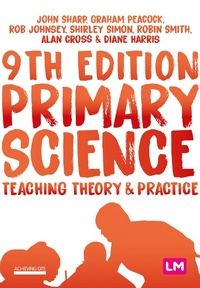
Primary Science: Teaching Theory and Practice
9th Edition
Published on 16. December 2020
216 pages
978-1-5297-5534-3 (ISBN)
Description

All you need to know about the theory and practice of teaching primary science.
If you are training to be a primary school teacher, a knowledge of the primary science curriculum is not enough, you need to know HOW to teach science in primary schools.
This is the essential teaching theory and practice text for primary science. It takes a focused look at the practical aspects of teaching and covers the important skills of classroom management, planning, monitoring and assessment, and relates them specifically to primary science.
This new edition now includes a new chapter on creative curriculum approaches.
If you are training to be a primary school teacher, a knowledge of the primary science curriculum is not enough, you need to know HOW to teach science in primary schools.
This is the essential teaching theory and practice text for primary science. It takes a focused look at the practical aspects of teaching and covers the important skills of classroom management, planning, monitoring and assessment, and relates them specifically to primary science.
This new edition now includes a new chapter on creative curriculum approaches.
More details
Series
Edition
Ninth Edition
Language
English
Place of publication
London
United Kingdom
Publishing group
Sage Publications Ltd
Target group
College/higher education
Product notice
Reflowable
ISBN-13
978-1-5297-5534-3 (9781529755343)
Copyright in bibliographic data and cover images is held by Nielsen Book Services Limited or by the publishers or by their respective licensors: all rights reserved.
Schweitzer Classification
Other editions
Additional editions
John Sharp | Graham A. Peacock | Rob Johnsey
Primary Science: Teaching Theory and Practice
Teaching Theory and Practice
Book
02/2021
9th Edition
Learning Matters Ltd
€103.20
Shipment within 15-20 days
John Sharp | Graham A. Peacock | Rob Johnsey
Primary Science: Teaching Theory and Practice
Teaching Theory and Practice
Book
02/2021
9th Edition
Learning Matters Ltd
€55.20
Shipment within 15-20 days
Persons
John Sharp is Professor of Higher Education and Head of the Lincoln Higher Education Research Institute (LHERI) at the University of Lincoln.
Graham Peacock is Principal Lecturer in Education at Sheffield Hallam University. He has taught children across the primary and secondary age ranges. Rob Johnsey, formerly a primary school teacher, lectured in primary science in the Institute of Education at the University of Warwick for several years. Shirley Simon is Lecturer in the School of Education at King's College, London. I was appointed Lecturer in Sociology in 2012. I am currently PhD Programme Co-ordinator and convenor of three undergraduate modules. My research and teaching is concerned with the everyday life of urban public spaces. I am interested in, and encourage students to take an interest in, both the street-level politics of city life and the mundane accomplishment of mobility practices and interaction. These themes have been addressed through research on everyday sense-making in regenerated space, practices of street-based welfare and vulnerable urban groups and, most recently, an investigation of co-operative mobility practices. I also have an abiding interest in social science methodology as a topic of inquiry.
Graham Peacock is Principal Lecturer in Education at Sheffield Hallam University. He has taught children across the primary and secondary age ranges. Rob Johnsey, formerly a primary school teacher, lectured in primary science in the Institute of Education at the University of Warwick for several years. Shirley Simon is Lecturer in the School of Education at King's College, London. I was appointed Lecturer in Sociology in 2012. I am currently PhD Programme Co-ordinator and convenor of three undergraduate modules. My research and teaching is concerned with the everyday life of urban public spaces. I am interested in, and encourage students to take an interest in, both the street-level politics of city life and the mundane accomplishment of mobility practices and interaction. These themes have been addressed through research on everyday sense-making in regenerated space, practices of street-based welfare and vulnerable urban groups and, most recently, an investigation of co-operative mobility practices. I also have an abiding interest in social science methodology as a topic of inquiry.
Content
Introduction
The nature of scientific understanding
Processes and methods of scientific enquiry
Children's ideas
Science in the Foundation Stage
Teaching strategies
Planning
Classroom organisation and management
Assessment, recording and reporting
Using ICT in science
Health and safety
Creative curriculum approaches
The nature of scientific understanding
Processes and methods of scientific enquiry
Children's ideas
Science in the Foundation Stage
Teaching strategies
Planning
Classroom organisation and management
Assessment, recording and reporting
Using ICT in science
Health and safety
Creative curriculum approaches
