

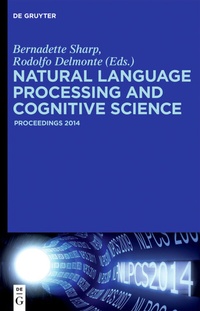
Natural Language Processing and Cognitive Science
Proceedings 2014
1st Edition
Published on 10. March 2015
XII, 314 pages
978-1-5015-0128-9 (ISBN)
Description

Peer reviewed articles from the Natural Language Processing and Cognitive Science (NLPCS) 2014 meeting in October 2014 workshop. The meeting fosters interactions among researchers and practitioners in NLP by taking a Cognitive Science perspective. Articles cover topics such as artificial intelligence, computational linguistics, psycholinguistics, cognitive psychology and language learning.
More details
Language
English
Place of publication
Boston
United States
Target group
Professional and scholarly
US School Grade: College Graduate Student
Illustrations
16 farbige Abbildungen, 55 s/w Tabellen, 50 s/w Abbildungen
50 b/w and 16 col. ill., 55 b/w tbl.
File size
5,80 MB
ISBN-13
978-1-5015-0128-9 (9781501501289)
Schweitzer Classification
Other editions
Additional editions
Bernadette Sharp | Rodolfo Delmonte
Natural Language Processing and Cognitive Science
Proceedings 2014
E-Book
03/2015
1st Edition
De Gruyter
€174.95
Available for download
Bernadette Sharp | Rodolfo Delmonte
Natural Language Processing and Cognitive Science
Proceedings 2014
Book
02/2015
1st Edition
De Gruyter
€174.95
Shipment within 3-4 weeks
Persons
Bernadette Sharp, Staffordshire Univeristy, UK; Rodolfo Delmonte, Universita Ca'Foscari, Venice.
Content
- Intro
- Preface
- Contets
- Workshop Chairs
- Programme Committee
- Benchmarking Automated Text Correction Services
- Enhancing Word Sense Disambiguation Using A Hybrid Knowledge-Based Technique
- Disambiguating Distributional Neighbors Using a Lexical Substitution Dataset
- An Evolutionary Game Theoretic Approach to Word Sense Disambiguation
- The Main Challenge of Semi-Automatic Term Extraction Methods
- News Text Segmentation in Human Perception
- Preliminary Study of TV Caption Presentation Method for Aphasia Sufferers and Supporting System to Summarize TV captions
- Extraction of Concrete Entities and Part-Whole Relations
- Human Association Network and Text Collection
- Using Function Words for Authorship Attribution: Bag-Of-Words vs. Sequential Rules
- Recognition of Discursive Verbal Politeness
- Politeness versus Perceived Engagement: An Experimental Study
- Sentiment, Polarity and Function Analysis in Bibliometrics: A Review
- The Detection and Analysis of Bi-Polar Phrases and Polarity Conflicts
- Automatically Evaluating Atypical Language in Narratives by Children with Autistic Spectrum Disorder
- How to Make Right Decisions Based on Currupt Information and Poor Counselors&subtitle/&Tuning an Open-Source Question Answering System
- Meta-Learning for Fast Dialog System Habituation to New Users
- Evaluation of Freely Available Speech Synthesis Voices for Halef
- You Shall Find the Target Via its Companion Words: Specifications of a Navigational Tool to Help Authors to Overcome the Tip-Of-The-Tongue Problem
- Topic Modeling for Entity Linking Using Keyphrase
- Extraction of Polish Multiword Expressions
- Beyond Classical Set
- Exploring the Effects of Root Expansion, Sentence Splitting and Ontology on Arabic Answer Selection
- Computer Assisted Translation of Ancient Texts: The Babylonian Talmud Case Study
- A Rational Statistical Parser
