

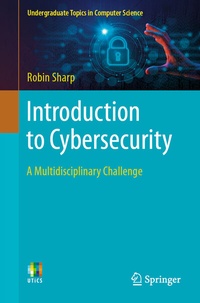
Introduction to Cybersecurity
Description

This book provides an introduction to the basic ideas involved in cybersecurity, whose principal aim is protection of IT systems against unwanted behaviour mediated by the networks which connect them. Due to the widespread use of the Internet in modern society for activities ranging from social networking and entertainment to distribution of utilities and public administration, failures of cybersecurity can threaten almost all aspects of life today.
Cybersecurity is a necessity in the modern world, where computers and other electronic devices communicate via networks, and breakdowns in cybersecurity cost society many resources.
The aims of cybersecurity are quite simple: data must not be read, modified, deleted or made unavailable by persons who are not allowed to. To meet this major challenge successfully in the digitally interconnected world, one needs to master numerous disciplines because modern IT systems contain software, cryptographic modules, computing units, networks, and human users-all of which can influence the success or failure in the effort.
Topics and features:
- Introduces readers to the main components of a modern IT system: basic hardware, networks, operating system, and network-based applications
- Contains numerous theoretical and practical exercises to illustrate important topics
- Discusses protective mechanisms commonly used to ensure cybersecurity and how effective they are
- Discusses the use of cryptography for achieving security in IT systems
- Explains how to plan for protecting IT systems based on analysing the risk of various forms of failure
- Illustrates how human users may affect system security and ways of improving their behaviour
- Discusses what to do if a security failure takes place
- Presents important legal concepts relevant for cybersecurity, including the concept of cybercrime
This accessible, clear textbook is intended especially for students starting a relevant course in computer science or engineering, as well as for professionals looking for a general introduction to the topic.
Dr. Robin Sharp is an emeritus professor in the Cybersecurity Section at DTU Compute, the Dept. of Applied Mathematics and Computer Science at the Technical University of Denmark (DTU).
More details
Other editions
Additional editions
Person
After obtaining a Ph.D in physics from Cambridge University, Robin Sharp has been working in the IT area since the early 1970s. He has many years experience in the design and analysis of computer networks, both at the academic level and in collaboration with industrial companies. He is currently an emeritus profesor at DTU Compute, the Department of Applied Mathematics and Computer Science at the Technical University of Denmark (DTU), where he has been employed since 1973.
He is the author of the book "Principles of Protocol Design" on network protocols, whose second edition was published by Springer Verlag in 2008. His book "What's Cybersecurity All About?", aimed at ordinary computer users, was published by Polyteknisk Forlag, the university publishers at DTU, in 2020.
Since the 1990s, the main focus of his work has been on security in networks and methods for secure design of computer systems. This has included work on aspects of human interaction with computer systems and its affect on cybersecurity. He has had the operative responsibility for IT security as CISO at DTU Compute.
Robin Sharp is an experienced teacher, having taught courses on computer security and network security since the middle 1990s, including a course for non-IT specialists, which has been an inspiration for the current book.
Content
Chapter 1. Introduction: Why cybersecurity?.- Chapter 2. Technique and human beings.- Chapter 3. Risk.- Chapter 4. Cryptography.- Chapter 5. Applied Cryptography.- Chapter 6. Communication networks.- Chapter 7. Network Applications.- Chapter 8. Network Security.- Chapter 9. Security in operating systems.- Chapter 10. Software security.- Chapter 11. Incident handling and system availability.- Chapter 12. Law and ethics.- Epilogue.- Appendix A. What's in the box?.- Appendix B. Mathematics.- Appendix C. Acronyms.- References.- Index.
