

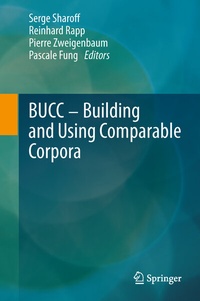
Building and Using Comparable Corpora
Description

The 1990s saw a paradigm change in the use of corpus-driven methods in NLP. In the field of multilingual NLP (such as machine translation and terminology mining) this implied the use of parallel corpora. However, parallel resources are relatively scarce: many more texts are produced daily by native speakers of any given language than translated. This situation resulted in a natural drive towards the use of comparable corpora, i.e. non-parallel texts in the same domain or genre. Nevertheless, this research direction has not produced a single authoritative source suitable for researchers and students coming to the field.
The proposed volume provides a reference source, identifying the state of the art in the field as well as future trends. The book is intended for specialists and students in natural language processing, machine translation and computer-assisted translation.
Reviews / Votes
"I would like to recommend 'Building and Using Comparable . to those who are working with or are interested in multilingual and monolingual comparable corpora. . it is easy to say that the notion of comparable corpora was not only visionary, long-sighted, and productive. It is also easy to say that this volume remains the optimal starting point for any research or for any applications in Language Technology leveraging on comparable corpora." (Marina Santini, forum.santini.se, February, 2017)More details
Other editions
Additional editions
Content
Preface - Building and Using Comparable Corpora . S.Sharoff, R.Rapp, P.Zweigenbaum.- Overviewing Important Aspects of the Last 20 Years of Research in Comparable Corpora.- S.Sharoff, R.Rapp, P.Zweigenbaum.- Part I: Compiling and Measuring Comparable Corpora .- Multilingual Corpus Collection. S.Shi, P.Fung.- Automatic Comparable Web Corpora Collection and Bilingual Terminology Extraction for Specialized Dictionary Making. A.Gurrutxaga, I.Leturia, I.San Vicente, X.Saralegi.- Statistical Comparability: Methodological Caveats. R.Köhler.- Methods for Collection and Evaluation of Comparable Documents. M.Lestari Paramita, D.Guthrie, E.Kanoulas, R.Gaizauskas, P.Clough and M.Sanderson.- Measuring the Distance between Comparable Corpora between Languages. S.Sharoff.- Exploiting Comparable Corpora for Lexicon Extraction: Measuring and Improving Corpus Quality. B.Li, E.Gaussier.- Statistical Corpus and Language Comparison on Comparable Corpora. T.Eckart, U.Quasthoff.- Comparable Multilingual Patents as Large-scale Parallel Corpora. B.Lu and B.Tsou.- Part II: Using Comparable Corpora.- Extracting Parallel Phrases from Comparable Data. S.Hewavitharana, S.Vogel.- Exploiting Comparable Corpora. D.S.Munteanu, D.Marcu.- Paraphrase Detection in Comparable Monolingual Corpora. L.Deleger, B.Cartoni, P.Zweigenbaum.- Information Network Construction and Alignment from Automatically Acquired Comparable Corpora. H.Ji, W.-P.Lin.- Bilingual Terminology Mining from Comparable Corpora. B.Daille, E.Morin.- The Place of Comparable Corpora in Providing Terminological Reference Information to Online Translators: A Strategic Framework. K.Kageura, T.Abekawa.- Old Needs, New Solutions: Comparable Corpora for Language Professionals. S.Bernardini, A.Ferraresi.- Exploiting the Incomparability of Comparable Corpora for Contrastive Linguistics and Translation Studies. S.Neumann, S.Hansen-Schirra.
