

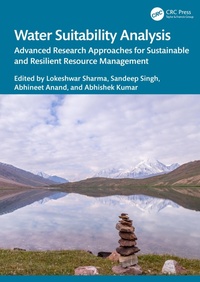
Water Suitability Analysis
Advanced Research Approaches for Sustainable and Resilient Resource Management
1st Edition
Published on 19. May 2026
214 pages
978-1-040-86240-7 (ISBN)
Description

This edited volume presents a comprehensive exploration of modern techniques and methodologies for evaluating water quality and suitability. It bridges traditional experimental approaches with cutting-edge artificial intelligence and remote sensing tools, offering an innovative perspective on sustainable water resource management.
It delves into multidisciplinary insights that combine environmental science, data analytics, and hydrological modeling. Key topics include experimental water quality analysis, GIS-based assessment, groundwater and surface water case studies, and AI applications in hydroinformatics. Readers will benefit from practical frameworks, real-world case studies, and research-driven solutions designed to address complex challenges in water suitability evaluation.
This is an essential resource for researchers, academicians, environmental engineers, policymakers, and postgraduate students working in water resource management, environmental sustainability, and artificial intelligence applications. It serves as both a reference guide and an inspiration for professionals seeking to implement intelligent, data-driven, and sustainable approaches to water assessment and planning.
It delves into multidisciplinary insights that combine environmental science, data analytics, and hydrological modeling. Key topics include experimental water quality analysis, GIS-based assessment, groundwater and surface water case studies, and AI applications in hydroinformatics. Readers will benefit from practical frameworks, real-world case studies, and research-driven solutions designed to address complex challenges in water suitability evaluation.
This is an essential resource for researchers, academicians, environmental engineers, policymakers, and postgraduate students working in water resource management, environmental sustainability, and artificial intelligence applications. It serves as both a reference guide and an inspiration for professionals seeking to implement intelligent, data-driven, and sustainable approaches to water assessment and planning.
More details
Edition
1. Auflage
Language
English
Place of publication
London
United Kingdom
Publishing group
Taylor & Francis Ltd
Target group
College/higher education
Professional and scholarly
Product notice
Reflowable
Illustrations
33 Tables, black and white; 16 Line drawings, color; 41 Line drawings, black and white; 1 Halftones, color; 3 Halftones, black and white; 17 Illustrations, color; 44 Illustrations, black and white
File size
5,17 MB
ISBN-13
978-1-040-86240-7 (9781040862407)
Copyright in bibliographic data and cover images is held by Nielsen Book Services Limited or by the publishers or by their respective licensors: all rights reserved.
Schweitzer Classification
Other editions
Additional editions
Lokeshwar Sharma | Sandeep Singh | Abhineet Anand
Water Suitability Analysis
Advanced Research Approaches for Sustainable and Resilient Resource Management
Book
05/2026
1st Edition
CRC Press
€161.50
Shipment within 15-20 days
Lokeshwar Sharma | Sandeep Singh | Abhineet Anand
Water Suitability Analysis
Advanced Research Approaches for Sustainable and Resilient Resource Management
Book
05/2026
1st Edition
CRC Press
€66.00
Shipment within 15-20 days
Persons
Lokeshwar Sharma is an academic and researcher specializing in environmental and water resources engineering. His research interests include water quality analysis, groundwater modeling, and sustainable resource management. He has been actively involved in projects related to AI-based water suitability assessment and environmental monitoring. As an editor, he contributes his expertise in hydrological modelling and interdisciplinary environmental systems to ensure the book reflects modern approaches to water research and sustainability.
Sandeep Singh is a distinguished researcher in civil and environmental engineering, focusing on sustainable water management and GIS-based hydrological analysis. His expertise lies in remote sensing applications, water resources planning, and policy development for environmental sustainability. He has published numerous papers in Scopus-indexed journals and guided several research projects integrating machine learning in water quality assessment. His editorial contribution ensures a scientific and policy-oriented approach to the study of water suitability.
Abhineet Anand is an Assistant Professor and researcher with expertise in groundwater hydrology, water suitability analysis, and computational modelling. His academic and professional work focuses on developing data-driven and AI-based solutions for assessing groundwater potential and quality. He has contributed extensively to research on MODFLOW modelling and the application of machine learning in hydrogeological studies. His involvement in this book strengthens its technical and analytical depth in AI-driven water suitability assessment.
Abhishek Kumar is a researcher and educator specializing in environmental engineering and water resource management. His research focuses on integrating artificial intelligence, GIS, and remote sensing for water quality monitoring and prediction. With several peer-reviewed publications, Dr. Kumar has made notable contributions to the field of sustainable water management and SDG 6 implementation strategies. As an editor, he brings valuable experience in data analytics and interdisciplinary research for advancing AI-driven water assessment methodologies.
Sandeep Singh is a distinguished researcher in civil and environmental engineering, focusing on sustainable water management and GIS-based hydrological analysis. His expertise lies in remote sensing applications, water resources planning, and policy development for environmental sustainability. He has published numerous papers in Scopus-indexed journals and guided several research projects integrating machine learning in water quality assessment. His editorial contribution ensures a scientific and policy-oriented approach to the study of water suitability.
Abhineet Anand is an Assistant Professor and researcher with expertise in groundwater hydrology, water suitability analysis, and computational modelling. His academic and professional work focuses on developing data-driven and AI-based solutions for assessing groundwater potential and quality. He has contributed extensively to research on MODFLOW modelling and the application of machine learning in hydrogeological studies. His involvement in this book strengthens its technical and analytical depth in AI-driven water suitability assessment.
Abhishek Kumar is a researcher and educator specializing in environmental engineering and water resource management. His research focuses on integrating artificial intelligence, GIS, and remote sensing for water quality monitoring and prediction. With several peer-reviewed publications, Dr. Kumar has made notable contributions to the field of sustainable water management and SDG 6 implementation strategies. As an editor, he brings valuable experience in data analytics and interdisciplinary research for advancing AI-driven water assessment methodologies.
Content
1. Introduction to Water Suitability 2. Experimental Methods in Wa ter Quality Assessment 3. Analysis of Water Quality Index for Indian Rivers using AI Techniques 4. GIS and Remote Sensing Applications 5. Machine Learning and AI in Water Assessment 6. Case Study I - Ground Suitability in an Arid Region 7. Case Study II - Surface Water Suitability in Hilly Regions 8. Groundwater Modeling and Spatial Assessment of the East Kolkata Wetlands Using Processing MODFLOW and Remote Sensing 9. SDG 6: Program, Community, Planning Framework 10. Water Security Management: Future Research Directions and Emerging Tools
