

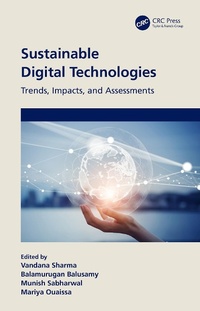
Sustainable Digital Technologies
Trends, Impacts, and Assessments
1st Edition
Published on 6. September 2023
222 pages
978-1-000-93443-4 (ISBN)
Description

This book is a reference on digital technology and its impact on sustainability, providing insight into sustainable practices globally. It focuses on the critical practices leading to sustainable initiatives among various organizations, IT infrastructure, communities, and government compliance. The book describes the green computing paradigms and the impact of a circular economy with a focus on sustainable practices in a post-pandemic world.
Sustainable Digital Technologies: Trends, Impacts, and Assessments discusses the critical factors leading to sustainable initiatives in a global economy. It highlights the impact of digital technology and Industry 4.0 in today's world. The book focuses on the role, responsibility, and the effect of the Internet of Things for digital sustainability and practices. It describes implementation strategies for green cloud computing and presents additional strategies for sustainable practices in a post-pandemic world.
This publication is designed for use by technology development academicians, data scientists, industrial professionals, researchers, and students interested in uncovering the latest innovations in the field and the current research on problem-oriented processing techniques in sustainable and evolutionary computing applications with reduced energy channelization.
Sustainable Digital Technologies: Trends, Impacts, and Assessments discusses the critical factors leading to sustainable initiatives in a global economy. It highlights the impact of digital technology and Industry 4.0 in today's world. The book focuses on the role, responsibility, and the effect of the Internet of Things for digital sustainability and practices. It describes implementation strategies for green cloud computing and presents additional strategies for sustainable practices in a post-pandemic world.
This publication is designed for use by technology development academicians, data scientists, industrial professionals, researchers, and students interested in uncovering the latest innovations in the field and the current research on problem-oriented processing techniques in sustainable and evolutionary computing applications with reduced energy channelization.
More details
Edition
1. Auflage
Language
English
Place of publication
London
United Kingdom
Publishing group
Taylor & Francis Ltd
Target group
College/higher education
Professional and scholarly
Product notice
Reflowable
Illustrations
13 Tables, black and white; 53 Line drawings, black and white; 51 Halftones, black and white; 104 Illustrations, black and white
ISBN-13
978-1-000-93443-4 (9781000934434)
Copyright in bibliographic data and cover images is held by Nielsen Book Services Limited or by the publishers or by their respective licensors: all rights reserved.
Schweitzer Classification
Other editions
Additional editions
Vandana Sharma | Balamurugan Balusamy | Munish Sabharwal
Sustainable Digital Technologies
Trends, Impacts, and Assessments
Book
01/2025
1st Edition
CRC Press
€71.20
Shipment within 10-20 days
Vandana Sharma | Balamurugan Balusamy | Munish Sabharwal
Sustainable Digital Technologies
Trends, Impacts, and Assessments
Book
09/2023
1st Edition
CRC Press
€170.80
Shipment within 10-20 days
Persons
Dr. Vandana Sharma is an Associate Professor at CHRIST (Deemed to be University), Delhi NCR, India. Dr. Sharma has served NAAC-accredited A++ institutions like Guru Gobind Singh Indraprastha University, Delhi and Galgotias University, Greater Noida Campus and Amity Institute of Information Technology, Amity University Noida Campus, India. Dr. Sharma has 15 + years of teaching experience at the postgraduate level and has guided 100+ student dissertations. Dr. Sharma obtained her doctoral degree from Amity University, Masters of Technology and Bachelor of Electronic Commerce degrees from Guru Gobind Singh Indraprastha University, a Delhi state university in India. She is a Senior Member of IEEE, member of Women in Engineering Society and member of IEEE Consumer Technology Society popularly known as CTSoc. As a keen researcher, she has published 50+ research papers in SCI and Scopus Indexed international journals and conferences. Dr. Sharma has contributed voluntarily as a keynote speaker, session chair, Reviewer and Technical Program Committee (TPC) member for reputed International Journals and IEEE Conferences and has presented her work across India and abroad. Currently, she is a post-doctoral fellow at Lincoln University College, Malaysia. Also, she is honorary Adjunct Professor and Senior Fellow of Scientific Innovation Research Group (SIRG) at Beni Suef University, Egypt and Adjunct Professor at Perdana University, Malaysia. Her primary areas of interest include Artificial Intelligence, Blockchain Technology, and the Internet of Things (IoT).
Balamurugan Balusamy has served as a professor and has 14 years of experience with VIT University, Vellore. He completed his bachelor's, master's, and doctorate at top premier institutions in India. He has published 30-plus books on various technologies and visited 15-plus countries teaching his technical course. He has several top-notch conferences on his resume and has been published in over 150 quality journals, conferences, and book chapters. Dr. Balusamy serves on the advisory committee for several start-ups and forums, and does consultant work on industrial IoT. He has given over 175 talks at various events and symposiums, and is currently working as an associate dean at Shiv Nadar University, India. Prior to this assignment, he was a professor at Galgotias University; his research interests are blockchain and IoT.
Munish Sabharwal has a doctorate in computer science and a doctorate in management information systems, and has contributed more than 22 years to teaching education management and research as well as software development. He is currently spearheading efforts as dean and professor at Galgotias University, Greater Noida, India. His research interests include data science, artificial intelligence, machine learning, biometrics, and e-banking.
Mariya Ouaissa is a professor/trainer, researcher, and practitioner with industry and academic experience. She earned a doctorate in 2019 in computer science and networks at the Laboratory of Modelisation of Mathematics and Computer Science from ENSAM, Moulay Ismail University, Meknes, Morocco. She is a networks and
telecoms engineer, who graduated in 2013 from the National School of Applied Sciences Khouribga. Her main research topics are Internet of Things (IoT), machine to machine (M2M), device to device (D2D), wireless sensor networks (WSN), cellular networks, and vehicular networks.
Balamurugan Balusamy has served as a professor and has 14 years of experience with VIT University, Vellore. He completed his bachelor's, master's, and doctorate at top premier institutions in India. He has published 30-plus books on various technologies and visited 15-plus countries teaching his technical course. He has several top-notch conferences on his resume and has been published in over 150 quality journals, conferences, and book chapters. Dr. Balusamy serves on the advisory committee for several start-ups and forums, and does consultant work on industrial IoT. He has given over 175 talks at various events and symposiums, and is currently working as an associate dean at Shiv Nadar University, India. Prior to this assignment, he was a professor at Galgotias University; his research interests are blockchain and IoT.
Munish Sabharwal has a doctorate in computer science and a doctorate in management information systems, and has contributed more than 22 years to teaching education management and research as well as software development. He is currently spearheading efforts as dean and professor at Galgotias University, Greater Noida, India. His research interests include data science, artificial intelligence, machine learning, biometrics, and e-banking.
Mariya Ouaissa is a professor/trainer, researcher, and practitioner with industry and academic experience. She earned a doctorate in 2019 in computer science and networks at the Laboratory of Modelisation of Mathematics and Computer Science from ENSAM, Moulay Ismail University, Meknes, Morocco. She is a networks and
telecoms engineer, who graduated in 2013 from the National School of Applied Sciences Khouribga. Her main research topics are Internet of Things (IoT), machine to machine (M2M), device to device (D2D), wireless sensor networks (WSN), cellular networks, and vehicular networks.
Content
1. Critical Factors Leading to Sustainable Initiatives in the Global Market, 2. Patents and Innovations for Digital Sustainability, 3. Adoption of Sustainable Digital Technologies in Industry 4.0, 4. Industry 4.0: Features Adopting Digital Technologies in the Oil and Gas Industry, 5. Effects of Contaminated Ocean Water on the Ecosystem: A Review Using Machine Learning, 6. Trends and Challenges in Green Computing, 7. Implementation Strategies for Green Computing, 8. Strategies for Sustainable Practices in a Post-Pandemic World, 9. Strategies for Sustainable Supply Chains in a Circular Economy: Bibliometric Analysis and an Overview, 10. Research Potentials and Future Trends of Digital Sustainability.
