

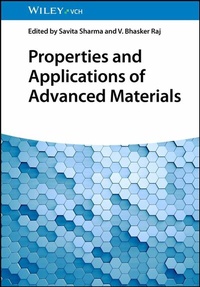
Properties and Applications of Advanced Materials
1st Edition
Published on 10. December 2025
288 pages
978-3-527-85415-8 (ISBN)
Description

"Physics of Materials" is a handy reference book that reviews fundamental and advanced physical properties of various materials such as semiconductors, dielectric materials, magnetic materials, polymers, liquid crystals, and carbon-based materials. It concludes with chapters on the synthesis of nanomaterials and thin films composed of such materials, and nanomaterials and thin films. The book is unique in its focus on practical applications and the technological significance of the covered materials.
More details
Other editions
Additional editions
Savita Sharma | Bhasker Raj
Properties and Applications of Advanced Materials
Book
01/2026
1st Edition
Wiley-VCH
€139.00
Available immediately
Persons
Dr. Savita Sharma and Dr. V. Bhasker Raj are Assistant Professors in the Department of Physics at Kalindi College, University of Delhi, India. They specialize in condensed matter physics and have extensive experience in teaching and research.
Content
Chapter 1. Semiconductors
1.1 Introduction to Semiconductors
1.2 Mobility and Conductivity
1.3 Density of States
1.4 Electron and Hole Concentration In Doped Semiconductor
1.5 Fermi Concepts
1.6 Electrical Properties
Chapter 2. Dielectric Materials
2.1 Fundamentals of Dielectrics, Polarization mechanisms, Dielectric constant and loss tangent, Applications in capacitors
2.2 Ferroelectric Materials, Structural characteristics and hysteresis behavior, Applications in memory devices and sensors
2.3 Piezoelectric Materials, Principles and properties of piezoelectricity, Applications in micro-positioners, actuators, and sonar devices
2.3 Pyroelectric Materials, Mechanisms of pyroelectricity, Applications in radiation detectors and thermometry
Chapter 3. Magnetic Materials
3.1 Magnetic Classification 2
3.2 Applications of Magnetic Materials 3
3.3 Spintronics
Chapter 4. Polymers
4.1. Overview
4.2. Chemical Structure of Polymers
4.3. Components of Polymer Structure
4.4. Classification of Polymers
4.5. Thermoplastic vs. Thermosetting Polymers
4.6. Properties of Specific Polymers
4.7. Conducting Polymers
Chapter 5. Liquid Crystals
5.1 Introduction to Liquid Crystals
5.2 Phases and Phase Transition
5.3 Optical Properties and Applications
Chapter 6. Carbon-Based Materials
6.1 Introduction
6.2 Structural Properties of Carbon Allotropes
6.3 Properties and synthesis of fullerenes (C60)
6.4 Single-walled and multi-walled CNTs
6.5 Graphene: Structure and energy band diagram
6.6 Optical properties of carbon materials
6.7 Applications of Carbon Materials
Chapter 7. Synthesis and Processing of Materials
7.1 Ceramic Materials
7.2 Crystal and Their Growth Techniques
7.3 Polymer Synthesis
Chapter 8. Synthesis of Thin Films
8.1 Introduction
8.2 Thin films explained
8.3 Key properties of thin films
8.4 Where do vacuum systems fit in
8.5 Thin-Film Deposition Techniques
8.6 Factors Influencing Thin-Film Quality
8.7 Thin-Film Deposition Methods
8.8 Applications of Thin Films
Chapter 9. Oxide-based materials
9.1 Introduction to Oxide Materials
9.2 Fabrication of Oxide thin films and its nanoparticles
9.3 Optical properties of the oxide Material
9.4 Applications of Oxide Materials
Chapter X: Optical, thermal, mechanical and viscoelastic properties of conjugated polymer nanocomposites
10.1 Introduction
10.2 Synthesis of conjugated polymer nanocomposites
10.3 Properties of conjugated polymer nanocomposites
10.4 Challenges
10.5 Summary
1.1 Introduction to Semiconductors
1.2 Mobility and Conductivity
1.3 Density of States
1.4 Electron and Hole Concentration In Doped Semiconductor
1.5 Fermi Concepts
1.6 Electrical Properties
Chapter 2. Dielectric Materials
2.1 Fundamentals of Dielectrics, Polarization mechanisms, Dielectric constant and loss tangent, Applications in capacitors
2.2 Ferroelectric Materials, Structural characteristics and hysteresis behavior, Applications in memory devices and sensors
2.3 Piezoelectric Materials, Principles and properties of piezoelectricity, Applications in micro-positioners, actuators, and sonar devices
2.3 Pyroelectric Materials, Mechanisms of pyroelectricity, Applications in radiation detectors and thermometry
Chapter 3. Magnetic Materials
3.1 Magnetic Classification 2
3.2 Applications of Magnetic Materials 3
3.3 Spintronics
Chapter 4. Polymers
4.1. Overview
4.2. Chemical Structure of Polymers
4.3. Components of Polymer Structure
4.4. Classification of Polymers
4.5. Thermoplastic vs. Thermosetting Polymers
4.6. Properties of Specific Polymers
4.7. Conducting Polymers
Chapter 5. Liquid Crystals
5.1 Introduction to Liquid Crystals
5.2 Phases and Phase Transition
5.3 Optical Properties and Applications
Chapter 6. Carbon-Based Materials
6.1 Introduction
6.2 Structural Properties of Carbon Allotropes
6.3 Properties and synthesis of fullerenes (C60)
6.4 Single-walled and multi-walled CNTs
6.5 Graphene: Structure and energy band diagram
6.6 Optical properties of carbon materials
6.7 Applications of Carbon Materials
Chapter 7. Synthesis and Processing of Materials
7.1 Ceramic Materials
7.2 Crystal and Their Growth Techniques
7.3 Polymer Synthesis
Chapter 8. Synthesis of Thin Films
8.1 Introduction
8.2 Thin films explained
8.3 Key properties of thin films
8.4 Where do vacuum systems fit in
8.5 Thin-Film Deposition Techniques
8.6 Factors Influencing Thin-Film Quality
8.7 Thin-Film Deposition Methods
8.8 Applications of Thin Films
Chapter 9. Oxide-based materials
9.1 Introduction to Oxide Materials
9.2 Fabrication of Oxide thin films and its nanoparticles
9.3 Optical properties of the oxide Material
9.4 Applications of Oxide Materials
Chapter X: Optical, thermal, mechanical and viscoelastic properties of conjugated polymer nanocomposites
10.1 Introduction
10.2 Synthesis of conjugated polymer nanocomposites
10.3 Properties of conjugated polymer nanocomposites
10.4 Challenges
10.5 Summary
