

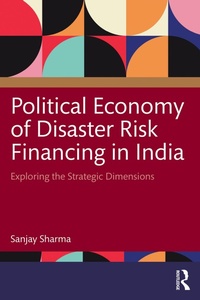
Political Economy of Disaster Risk Financing in India
Exploring the Strategic Dimensions
Will be published approx. on 3. July 2026
248 pages
978-1-040-94685-5 (ISBN)
Description

This book examines the political-economic perspective on the strategic dimensions of disaster risk financing in India. It argues that financing is an essential part of disaster governance and needs periodic review. While disaster governance is a relatively recent development in India, disaster financing began in 1957 with the introduction of the Margin Money Scheme by the Second Finance Commission. It also throws light on the Calamity Relief Fund and the State Disaster Risk Management Fund, which provide financial assistance to states to respond to disasters.
This volume is divided into three parts. Part I covers the approaches, policies, and institutions involved in disaster risk financing in India. Part II provides a comprehensive analysis of the four strategic domains of the disaster risk funding: methodology and its revision; federal discourse on the notified list of disasters, disaster risk financing schemes, and additional funding for mitigation; inclusion of local governance in strengthening disaster governance; and India's global outlook, policy, and reach for disaster assistance. Part III uncovers how resiliency can be achieved in Indian disaster risk financing through alternative sources of financing, disaster resilience infrastructure, and insurance coverage for disasters.
This book will be useful to students, researchers, and teachers of political science, public administration, public policy, economics, and governance. It will also benefit the Centre and State Finance Commissions, policy makers and general readers.
This volume is divided into three parts. Part I covers the approaches, policies, and institutions involved in disaster risk financing in India. Part II provides a comprehensive analysis of the four strategic domains of the disaster risk funding: methodology and its revision; federal discourse on the notified list of disasters, disaster risk financing schemes, and additional funding for mitigation; inclusion of local governance in strengthening disaster governance; and India's global outlook, policy, and reach for disaster assistance. Part III uncovers how resiliency can be achieved in Indian disaster risk financing through alternative sources of financing, disaster resilience infrastructure, and insurance coverage for disasters.
This book will be useful to students, researchers, and teachers of political science, public administration, public policy, economics, and governance. It will also benefit the Centre and State Finance Commissions, policy makers and general readers.
More details
Language
English
Place of publication
London
United Kingdom
Publishing group
Taylor & Francis Ltd
Target group
College/higher education
Professional and scholarly
Illustrations
8 Tables, black and white; 15 Line drawings, black and white; 3 Halftones, black and white; 18 Illustrations, black and white
File size
3,33 MB
ISBN-13
978-1-040-94685-5 (9781040946855)
Copyright in bibliographic data and cover images is held by Nielsen Book Services Limited or by the publishers or by their respective licensors: all rights reserved.
Schweitzer Classification
Other editions
Additional editions
Sanjay Sharma
Political Economy of Disaster Risk Financing in India
Exploring the Strategic Dimensions
Book
approx. 07/2026
1st Edition
Routledge
€52.50
Not yet published
Sanjay Sharma
Political Economy of Disaster Risk Financing in India
Exploring the Strategic Dimensions
Book
approx. 07/2026
1st Edition
Routledge
€191.50
Not yet published
Person
Sanjay Sharma is Associate Professor in the Department of Politics and International Studies at Pondicherry University, India. Presently, he is on deputation as Head of the Research and Innovation Centre at the India International Institute of Democracy and Election Management (IIIDEM) in Delhi. He has more than 15 years of teaching and research experience. He has published high-quality research papers on Disaster Risk Financing in SAGE journals, completed two major projects, and co-authored one book titled Global Politics.
Content
Introduction PART I: DISASTER RISK FINANCING: ANALYSING APPROACHES, POLICIES, AND INSTITUTIONS 1. Exploring the Approaches of Disaster Risk Financing 2. Disaster Risk Financing in India: Analysings of the Policy Framework 3. Finance Commission: Engineering the Disaster Risk Financing Schemes PART II: STRATEGIC DOMAINS OF DISASTER RISK FINANCING 4. Methodology of Disaster Risk Financing in India: A Contested Domain 5. States' Concerns and Central Responses for Disaster Risk Financing: Mapping the Federal Discourse 6. Local Governance: A Missing Pillar in Disaster Financing 7. Foreign Aid: Mapping India's Global Outreach PART III: TRANSITIONING TO DISASTER RESILIENCE 8. Disaster Risk Financing in India: Exploring the Alternative Sources of Funding 9. Disaster Resilient Infrastructure: Locating Directions and Resources 10. Insurance and Disaster Risk Financing: Alleviating the Risk
