

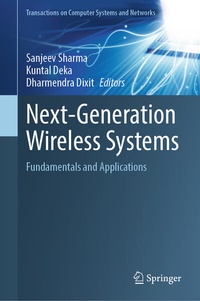
Next-Generation Wireless Systems
Description

The book examines various performance analysis metrics related to next-generation wireless communication technologies and their potential use cases. It presents the material in straightforward language to facilitate easy comprehension and ensure that readers gain a deep understanding of the topics covered. Additionally, the book delves into the role of deep learning and machine learning in designing smart wireless systems. A wide array of subjects is explored, including technical advancements, potential applications, and practical use cases. The book highlights the possible impact of these technologies on various industries, such as healthcare, transportation, and education, and discusses real-world scenarios and case studies to provide practical insights into their implementation. With a future-oriented perspective, the book considers the potential of emerging wireless communication technologies, including 6G, and their anticipated influence on society and the economy. It offers readers an outlook on the latest developments and trends in wireless communication technologies, helping them stay ahead of the curve and prepare for what lies ahead. This volume serves as a valuable resource for researchers, engineers, students, and professionals in the field of wireless communication, as well as policymakers and regulators interested in the advancement of wireless technologies.
More details
Other editions
Additional editions
Persons
Sanjeev Sharma received his B. Tech, M. Tech, and Ph.D. degrees in Electrical Engineering from Shri Govindram Seksaria Institute of Technology and Science (SGSITS Indore), the Indian Institute of Technology (IIT) Guwahati, and the Indian Institute of Technology Indore in 2008, 2010, and 2018, respectively. He worked as a Postdoctoral Fellow in the Department of Electrical and Computer Systems Engineering at Monash University in Melbourne, Australia. Currently, he is an Assistant Professor in the Electronics Engineering Department at IIT (BHU) Varanasi. His research interests include signal processing for wireless communications and networking, as well as the mathematical modeling, simulation, design, and analysis of wireless systems. He has published approximately 90 papers in journals and conferences related to wireless communication.
Kuntal Deka received his B.E. and Ph.D. degrees from Assam Engineering College Guwahati and the Indian Institute of Technology (IIT) Guwahati in 2008 and 2016, respectively, both in Electrical Engineering. He served as an Assistant Professor in the Department of Electronics and Communications Engineering at the Indian Institute of Information Technology (IIIT) Guwahati from 2015 to 2018. He was an Assistant Professor at the School of Electrical Sciences at IIT Goa from 2018 to 2021. Currently , he is an assistant professor in the department of EEE, IIT Guwahati. His areas of expertise include error-correcting codes, information theory, and multiple access and modulation techniques for modern wireless communication standards. He has published about 65 papers in reputable journals and conferences.
Dharmendra Dixit earned his B.Tech, M.Tech, and Ph.D. degrees in Electronics and Communication Engineering from Madan Mohan Malaviya University of Technology Gorakhpur, IIT Guwahati, and IIT Bhubaneswar in 2007, 2009, and 2020, respectively. He has held academic positions at renowned institutions, including Rajkiya Engineering College Sonbhadra, LNM-IIT Jaipur, and Jaypee University of Engineering and Technology, Guna, Madhya Pradesh. Dr. Dixit also served as a Scientist/Engineer-SC at the Indian Space Research Organization (ISRO), SDSC Sriharikota, Andhra Pradesh. He is currently an Assistant Professor in the Department of Electronics and Communication Engineering at MNNIT Allahabad, Prayagraj, India. With over 13 years of teaching and research experience, Dr. Dixit specializes in wireless communication systems, focusing on performance analysis, mathematical modeling, and next-generation technologies. He has published more than 34 research articles in leading journals and conferences, including IEEE and Wiley. Dr. Dixit's expertise and contributions to advanced wireless systems provide valuable insights into the fundamentals and applications of next-generation wireless technologies, as explored in this book.
Content
Introduction to 5G, 6G and Beyond wireless communications.- Intelligent reflecting surface.- Unmanned aerial vehicle (UAV).- Visible light communication (VLC).- Low-complexity Massive MIMO Systems.
