

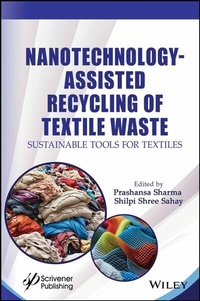
Nanotechnology-Assisted Recycling of Textile Waste
Description

Discover how innovative nanotechnology can turn waste into opportunity, offering insights and strategies to create a greener, more eco-friendly textile industry.
This book investigates nanotechnology-assisted sustainable solutions and their potential to transform waste into opportunity by fostering innovative designs and in-depth knowledge of sustainable waste management and nanotechnology applications.
Divided into four comprehensive parts, comprising 16 chapters, Nanotechnology Assisted Recycling of Textile Waste, provides insights into the potential of nanotechnology in revolutionizing textile recycling and shaping the future of sustainable textiles.
Part I sets the stage with an insightful overview of textile waste and management, exploring the conceptual dimensions and challenges in handling and organizing textile waste. It also describes the innovative realm of textile recycling. In Part II, the spotlight shines on comprehensive, sustainable, and productive recycling of waste using nanotechnology. Here, readers are invited to explore the transformative contributions of nanotechnology in shaping sustainable textile design and characterizing functional properties of novel recycled nano-textiles. Future perspectives of nanotechnology in textile applications, particularly concerning waste recycling, are also examined. Part III explores deeper into the advanced application of recycled and nano-assisted novel textiles generated through waste. From sports textiles to technical textiles, this section explores the diverse applications of recycled waste, bolstered by nano-engineered innovations. Finally, Part IV addresses the critical aspects of quality control and regulatory compliance in the realm of advanced nano-textile materials through an exploration of global legislation, schemes, and standards.
Readers will find in this book:
- research findings and innovative approaches to cope with the challenges and issues of textile waste;
- systematic and scientific knowledge on textile waste recycling techniques using nanotechnology;
- knowledge of complex scientific research findings in a simple and understandable form;
- comprehensive coverage of a broad range of topics, including sustainable textile waste management.
Audience The book will be read by a range of researchers, engineers and students in technical textiles, textile technology and engineering, textile chemistry, fiber science, textile processing technologies and manufacturing, fashion and apparel technology, materials science, environmental science. This book will help designers and clothing manufacturers, and all those in textile and environmental domains, who are engaged in waste management.
More details
Other editions
Additional editions
Persons
Prashansa Sharma, PhD, is an assistant professor in the Department of Home Science, MMV, Banaras Hindu University, Varanasi, Uttar Pradesh, India. With over ten years of experience in both teaching and research, her areas of expertise encompass nano-textiles, green synthesis, and the application of nanotechnology in textiles. She has contributed significantly to her field with numerous research papers, books, and book chapters.
Shilpi Shree Sahay works in the Department of Home Science, Banaras Hindu University, Varanasi, Uttar Pradesh, India. She specializes in clothing and textiles, focusing on nano-textile science and eco-friendly textile finishing. With a master's degree from BHU, her research interests include developing nanoparticles and enhancing textile functionality.
Content
Preface xxi
Part I: Overview of Textile Waste and Management 1
1 Overview of Textile Waste 3
Amisha Singh, Shilpi Shree Sahay and Prashansa Sharma
1.1 Introduction 4
1.2 Textile Waste 6
1.3 Classification of Textile Waste 7
1.4 Pre-Consumer Textile Waste 7
1.5 Post-Consumer Textile Waste 14
1.6 Soft and Hard Waste 16
1.7 Major Reasons for Textile Waste Production 17
1.8 Textile Waste--Associated Environmental Hazards 20
1.9 Future Prospect 24
1.10 Conclusion 25
2 Challenges in Handling and Systematically Organizing Textile Waste 29
A.K. Choudhary and Prashant Kumar
2.1 Introduction 30
2.2 Types of Textile Waste 32
2.3 Textile Waste Management 34
2.4 Major Challenges in Managing Textile Waste 35
2.5 Challenges in Textile Recycling (Solid Waste) 38
2.6 Challenges in Different Methods for Recovering Waste from the Textile Industry 45
3 Overview of Textile Recycling (Solid Waste) 59
Debarati Maity, Akash Borkar, Suvojit Ghosh and Anagha S. Sabnis
3.1 Introduction 61
3.2 Overview of Textile Recycling 63
3.3 Circular Economy 64
3.4 Waste Management 66
3.5 Applications of Recycled Fabrics 73
3.6 Challenges in Fabric Recycling 84
3.7 Technologies and Innovation Involved in Textile Recycling 84
3.8 Conclusions 87
4 Nanoparticle-Facilitated Treatment of Wastewater Containing Textile Dye 97
Anirban Roy and Sampa Chakrabarti
4.1 Introduction 99
4.2 Aim, Objectives, and Scope 103
4.3 Nanoparticle-Based Adsorption Processes for Treatment of Textile Wastewater 103
4.4 Nano-Photocatalysts and Their Application for Treatment of Textile Wastewater 106
4.5 Membrane Processes Involving Nanotechnology for Treatment of Textile Wastewater 112
4.6 Bioremediation Involving Nanomaterials 114
4.7 Ecotoxicological Impact of Using Nanoparticles for Textile Wastewater Treatment 117
4.8 Real-Life Textile Wastewater Treatment Using Nanoparticles 118
4.9 Conclusion 119
5 Innovative Approaches to Recover Waste in the Textile Sector 129
Dipak Kumar Sahu and Goutam Rath
5.1 Introduction 130
5.2 Innovative Approaches for Solid Waste Management 134
5.3 Case Studies of Successful Innovations 143
5.4 Innovative Approaches for Liquid Textile Waste Management 144
5.5 Nanofibers for Dye Separation 152
5.6 Waste Cotton Recycling 153
5.7 Mixed Solid Waste Recycling 154
5.8 Challenges and Prospects 155
5.9 Conclusion 157
Part II: Comprehensive, Sustainable and Productive Recycling of Waste Using Nanotechnology 171
6 Role of Nanotechnology in Recycled Textiles 173
Muhammad Jahanzaib, Shambhavi Sharma and Duckshin Park
6.1 Introduction 174
6.2 Textile Waste Reuse or Recycle 176
6.3 Challenges in Textile Recycling 180
6.4 Nanotechnology in Textiles 182
6.5 The Circular Economy and Nanotechnology: The Case of Recycled Textile Waste 188
6.6 Environmental Hazards Associated with Nanomaterials in the Textile Industry 192
6.7 Nanomaterials From Textile Industry and Health Effects 195
6.8 Industrial Applications of Recycled Textiles 197
6.9 Conclusion 198
7 Contribution of Nanotechnology in Shaping Sustainable Textile Design and Future Fashion Trends 207
Shilpi Shree Sahay, Prashansa Sharma and Amisha Singh
7.1 Introduction 209
7.2 Sustainable Design Principles 211
7.3 Promoting Conscious Fashion Choices 213
7.4 Sustainable Practices in Textile Production 214
7.5 Role of Technological Advancements in Achieving Sustainability 216
7.6 Technological Innovations in Material Production 219
7.7 Nanotechnology in Fabric Production 223
7.8 Innovations in Nanotechnology Transforming Textile Sector 225
7.9 Nanotextile Market Trend 228
7.10 Emerging Technologies and Future Trend 229
7.11 Conclusion 230
8 Understanding and Characterization of Functional Properties of Novel Recycled Nano-Textile 235
Chet Ram Meena
8.1 Introduction 236
8.2 Current and Future Trends in Novel Nano-Textiles 237
8.3 Nanotechnology (NT) 239
8.4 Nanomaterials (NMs) 240
8.5 Synthesis of Nanomaterials (NMs) 244
8.6 Characterization of Nanomaterials 246
8.7 Applications of Nanotechnology 253
8.8 Novel Nano-Textile 258
8.9 Environmental and Health Concerns Connected with Nanomaterials 259
8.10 Overpowering the Threats Connected with Nanomaterials 261
8.11 Conclusion 262
9 Future Perspective of Nanotechnology in Relation to Textile Applications Using Textile Waste 265
Ruchi Kholiya, Shefali Massey and Mansi Hans
9.1 Introduction 266
9.2 Nanotechnology and Its Emergence 267
9.3 What is Textile Waste? 272
9.4 Potential of Nanotechnology in the Utilization of Textile Waste 275
9.5 Environmental, Health, and Safety Concerns of Nanotechnology 278
9.6 Conclusion 279
Part III: Advanced Application of Recycled and Nano-Assisted Novel Textile Generated Through Waste 285
10 Utilizing Textile Waste in the Production of Nanotechnology-Based Sports Textiles 287
Janmay Singh Hada
10.1 Introduction 289
10.2 Integration of Textile Waste and Nanotechnology 291
10.3 Sport Textiles 292
10.4 Nanotechnology and Nanomaterials in Sport Textiles 293
10.5 Textile Waste 299
10.6 Health and Safety Measures 301
10.7 Present Scenario 302
10.8 Composites 304
10.9 Nanotechnology is Applied to Enable Self-Cleaning Properties in Textile Waste 305
10.10 Innovations 305
10.11 Conclusion 306
11 Functional Textiles from Agro-Industrial Waste 311
Shubham Joshi, Neelu Kambo and Saurabh Dubey
11.1 Introduction 312
11.2 Socio-Economic Perspective 315
11.3 Agro-Industrial Waste 316
11.4 Extraction and Formulation of Natural Compounds 323
11.5 Functional Properties of Agro-Industrial Waste-Based Formulations 329
11.6 Future and Challenges 344
11.7 Conclusion 345
12 Potential Application of Recycled Waste in Technical Textiles 351
Blesson Tom Mathew, Advitiya Kumar and Archana Samanta
12.1 Introduction 352
12.2 Overview of Technical Textiles 353
12.3 Textile Waste: Sources and Challenges 354
12.4 Recycling Technologies 356
12.5 Benefits of Using Recycled Waste in Technical Textiles 357
12.6 Application of Recycled Waste in Technical Textiles 358
12.7 Environmental and Economic Impact 370
12.8 Conclusion 371
13 Nano-Engineered Protective Textiles Using Recycled Wastes 379
Rupayan Roy and Pravin P. Chavan
13.1 Introduction 380
13.2 Recycled Waste Materials for Protective Textiles 385
13.3 Nano-Engineering in Protective Textiles 387
13.4 Characterization of Nano-Engineered Protective Textiles Using Recycled Wastes 389
13.5 Applications of Nano-Engineered Protective Textiles Using Recycled Wastes 391
13.6 Future Prospects and Challenges 393
14 Advanced Application of Recycled Textile Generated from Waste in Military Application Using Nanotechnology 403
Rohit Rai and Prodyut Dhar
14.1 Introduction 404
14.2 Types and Sources of Waste 408
14.3 Fiber Waste Recycling Procedures 408
14.4 Approaches in Fiber Recycling 410
14.5 Textile Modification with Nanotechnology for Military Applications 414
14.6 Defense Applications of Nanotechnology-Based Textiles 420
14.7 Utilization of Sustainable Nanotextiles for Military Applications 426
14.8 Conclusions 429
Part IV: Quality Control and Regulatory Aspects of Advanced Nano Textile Material with Respect to Industries 435
15 Global Legislation, Schemes and Standards to Control Environmental Concern for Textile-Generated Waste 437
Shambhavi Sharma, Muhammad Jahanzaib, Jooyeon Lee and Duckshin Park
15.1 Introduction 439
15.2 Textile Industry and Environmental Impact 439
15.3 Global Legislation for Textile Waste Management 441
15.4 International Schemes and Initiatives 443
15.5 Standards and Certifications 445
15.6 Challenges and Limitations 447
15.7 Benefits and Impacts of Legislation and Standards 449
15.8 Case Studies 451
15.9 Future Prospects and Recommendations 453
15.10 Conclusion 455
16 Prevailing Eco-Parameters and Protocols for Nanotechnology in the Textile Industry 461
Sanduru Sai Keerthana, Vivek Dave and Prashansa Sharma
16.1 Introduction 462
16.2 Environmental Implications of Nanotechnology 463
16.3 Industrial Use of Nanotechnology in Textiles 467
16.4 A Brief Note on Textile Recycling 469
16.5 An Overview of the Industrial Process in Textile Industry 470
16.6 Textile Waste and Its Environmental Problems 471
16.7 Pollution Output 474
16.8 Restricted Substances 477
16.9 Protocols for Industrial Use of Nanotechnology 481
16.10 Nanotechnology-Based Textiles and Nano-Safety Concerns 482
16.11 Regulation Methods for Nanomaterials 483
16.12 Principles for the Safe Handling of Nanomaterials 485
16.13 Risk Management and Assurance in Quality for Nano-Coated Textile Products 486
16.14 Good Practices and Test Guidelines 487
16.15 Applications for Nanotextiles 488
16.16 Conclusion 490
References 491
Index 497
1
Overview of Textile Waste
Amisha Singh, Shilpi Shree Sahay and Prashansa Sharma*
Department of Home Science (Clothing and Textile), MMV, Banaras Hindu University, Varanasi, U.P., India
Abstract
The textile sector is one of the oldest sectors. After food, clothing comes as the next primary human necessity. Rapid population growth encourages the textile sector to boost production to meet the demand for clothing and apparel, which leads to a significant amount of textile waste. The resulting waste is handled via landfilling or incineration procedures, both of which have a detrimental environmental impact. A significant volume of textile effluent is produced through wet processing because it uses a lot of water and chemicals. When textile waste is dumped on the ground or in water sources, it contaminates both the land and the water bodies. The improper disposal of textile waste leads to soil and water pollution.
By using effective waste management techniques, it is possible to reduce environmental contamination and thus establish a circular economy by turning waste into valuable goods. The present paper provides a thorough description of the various types and categories of textile waste and effluents, as well as the sources that produce them. This paper also discusses the major causes of textile waste and also highlights the impact of textile waste on the environment and human health. This study examines diverse textile processing steps along with a wide range of pollutants produced during textile processing and their toxic effects on weavers, employees, and the environment (air pollution, soil pollution, water, and noise pollution).
Keywords: Textiles, waste, fiber, production, pollution, environmental hazard, clothing
List of Abbreviations
CAGR Compound annual growth rate CO2 Carbon dioxide PET Polyethylene terephthalate BOD Biochemical oxygen demand COD Chemical oxygen demand PVA Polyvinyl alcohol VOCs Volatile organic compounds TDS Total dissolved solids GHG Greenhouse gases CMW COVID-19 medical waste PPE Personal protective equipment OEF Organization environmental footprint PEF Product environmental footprint REACH Registration, evaluation, authorization, and restriction of chemical 5R Refuse, reduce, reuse, recycle, and recover
1.1 Introduction
Fabrics and fibers have been integral to human existence since ancient time, serving as the fundamental elements of clothing. Today, textiles play diverse roles from shielding the body against weather conditions to symbolizing social status and expressing individual style all while keeping pace with evolving trends. With market values of almost USD 1.3 trillion and employment opportunities for over 300 million people along the whole value chain, the textile industry is one of the largest and oldest industries in existence [1]. The dominant industry for clothing and apparel is the textile sector, which is regarded as a key sector for consumer goods. Over the past few decades, fast population expansion, rising global incomes, and improved living standards have all enabled an increase in both clothing manufacturing and demand. The average yearly consumption of textiles has increased by two times in the last two decades, from 7 to 13 kg per person, and reached the maximum amount of 100 million tons worldwide [2].
In the present era, Clothes are designed and produced for rapid trend transitions via depreciation, early disposal, and discard, which facilitates fast income, instead of considering how design and production might accommodate consumer needs and lead toward sustainability. By 2025, the textile industry's demand for textile fibers is anticipated to grow, by around 400%, to reach 130 million tons, with an annual growth rate of 4.3% [3].
Between 2025 and 2026, the Indian textile and apparel market is forecasted to expand by a Compound annual growth rate (CAGR) of 10%, reaching over US$190 billion. India holds a 4% share in the global textile and clothing trade, and it is the leading producer of cotton worldwide. In the 2021-2022 cotton season, approximately 362.18 lakh bales were harvested, with an anticipated domestic consumption of 338 lakh bales. By 2030, India's cotton production is expected to rise to 7.2 million tons (around 43 million bales of 170 kg each) due to increasing consumer demand. [4] As can be shown from statistics, as demand grew, the manufacturing sector developed, and mechanized manufacturing techniques acquired the place of manual labor incentive systems. This enabled to manufacture textiles at affordable prices along with higher productivity and a wide range of variety. This has led to an excessive stock of economical, mass-produced products that tend to low quality as well as a significant amount of textile fiber waste, having restricted end uses.
One of the most intricate and harmful industries is the textile sector. This is challenging because it entails a very extensive and diverse procedure, including raw material production, fabrication of textiles, apparel development, transportation, and waste disposal. It is polluting because a significant amount of waste is generated while manufacturing and consuming it. The processing and manufacturing procedure of textile materials such as the harvesting, extraction; agriculture; process to make fiber, fiber to yarn, and yarn to fabric; wet-processing of fiber or fabric; blow room; carding; draw frame; combing; roving frame; ring frame; spinning process sequences; weaving/knitting, dyeing/printing, and finishing steps; and transportation are additionally required an excessive number of natural resources and non-renewable resources. Aspects related to the environmental impact of fiber production and the subsequent disposal activities have also become more prominent as the demand for fabrics has increased. Several recent studies highlighted the threat and hazard the textile industry generates due to the use of large volumes of industrially dangerous and toxic chemicals during the manufacturing process and the discharge of pollutants during the lifecycle of a textile product in aquatic systems and the atmospheric micro-system. The textiles industry emits over 1.2 billion tons of greenhouse gas (GHG) emissions (more than all of the emissions from international flights and maritime shipping combined). Sixty-three percent of textile fibers are composed of petrochemicals, whose manufacture and disposal result in significant carbon dioxide (CO2) emissions [5]. One of the top three industries for water waste is the textile industry, which severely degrades freshwater supplies. For the production of one pair of jeans and one single t-shirt, respectively, approximately 8,500 and 2,600 liters of water are needed [6]. The mean lifespan of a piece of fabric is approximately 3 years, and more than one million tons of textile materials are discarded annually, the majority of which comes from domestic sources. About 3% of the total volume of residential waste is made up of textiles. Currently, about 80%-90% of textile waste produced is no longer biodegradable because it consists of polyester, which contains PET (polyethylene terephthalate). Compared to natural fibers, synthetic materials are non-eco-friendly and non-biodegradable. Developing nations produce more than 60% of the world's apparel. The world's leading producer of apparel today, accounting for over 32% of global exports, is Asia. The global supply is generated by arranging raw materials and finished products in shipping containers and then transported by rail and vehicles. The health and well-being of people living in coastal and rural regions around the world are commencing to be impacted by marine shipping pollution, which has expanded dramatically over the preceding 20 years. Because there is insufficient information and details available regarding the quality of the discarded textiles, it is difficult to determine whether they can be recycled, transformed, reduced, and recovered or should simply be disposed of and discarded as waste materials. Therefore, it becomes essential to inquire into how textile waste is managed in the most environment-friendly manner [7].
Waste
Waste is defined as any material or goods that has reached the end of its shelf life. They are considered a challenge because they degrade and diminish precious resources, the environment, and human health; occupy landfill space; and increase the expense of using current landfills and building new ones.
1.2 Textile Waste
Textiles perform a variety of purposes and are constructed from a variety of fiber types, blended in a range of ratios. Three classes-apparel, home furnishings, and industrial-can be used for classifying the applications of fiber. Growing product consumption is an indication of rising waste production globally, which prompted greater social responsibility and...
