

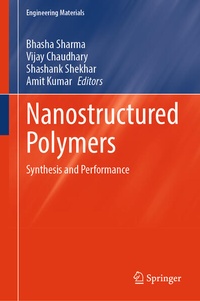
Nanostructured Polymers
Description

This book presents the development of new/novel class of materials-nano polymers and nano polymer advanced composites for future studies in this emerging and attractive field. It discusses the translation of technology from research to practice, considering aspects related to industrialization of preparation and aspects of regulatory development thus becoming an essential read for polymer and materials scientists, materials engineers, biochemists as well as environmental chemists. This book presents nano polymer-based materials from sourcing, synthesis, and modification of nano polymers to materials formation and applications, i.e, the efficiency of nano polymers as a reinforcing phase in various polymer nanocomposites, and the potential of nano polymers as an ideal polymer matrix phase in nanocomposites, and their advanced applications is highlighted.
More details
Other editions
Additional editions
Persons
Dr Bhasha Sharma is working as visiting faculty at DDU College, University of Delhi, India
Dr. Vijay Chaudhary is currently working as an assistant professor in the Department of Mechanical Engineering at Amity University Uttar Pradesh, Noida. He obtained his Ph.D. in Mechanical Engineering from the Netaji Subhas University of Technology, University of Delhi. His research area of interest lies in processing and characterization of polymer composites, tribological analysis of fiber-based polymer composites, water absorption of fiber-based polymer composites, and surface modification techniques related to polymer composite materials.
Dr. Shashank Shekhar is currently an assistant professor at Department of Chemistry, Sri Aurobindo College at the University of Delhi. He obtained his Ph.D. in Chemistry from the University of Delhi. Dr. Shekhar has been working on biopolymers and Schiff base metal complexes as part of his research interests.
Dr. Amit Kumar is working as a Professor in the Department of Chemistry, University of Delhi, India.
Content
Chapter 1. Synthetic Nano Polymer Design: Fundamentals, Materials, and Strategies.- Chapter 2. Bio Nano Polymer Design: Fundamentals, Materials, and Strategies.- Chapter 3. Emerging Nano Polymer Technologies for Synthesis and Characterization of Polymer Nanoparticles.- Chapter 4. Layer-by-Layer Functionalization of Nano Polymers.- Chapter 5. Introduction of Nanostructure into Shape Memory Polymers: From Materials to Applications.- Chapter 6. Engineered Nano Polymer-Based Hydrogels.- Chapter 7. Surface Morphology, Structural, and Interfacial Features of Polymers at Nanoscale.- Chapter 8. Polymer Functionalized Nano Polymers and Their Behavior: Standard Reinforcement Methods, Mechanism, Compatibilization, and Influence in Properties.- Chapter 9. Tunable Shape and Size of Nano Polymers and Their Effect on Properties.- Chapter 10. Protein and Lipid Nanomaterials Based Functional Constructs.- Chapter 11. Polysaccharide Nanomaterial Based Functional Constructs.- Chapter 12. Nanoengineering of Polymer Particles for Traversing Bio-Nano Interactions.- Chapter 13. Nano Polymers for 3D and 4D Printing Applications.- Chapter 14. Nano Polymers Towards Advanced Energy Storage Devices.- Chapter 15. Nano Polymers Applications in Medical Imaging, Diagnostics, Drug Delivery, Cell Activity Regulation, Sensors, and Therapy.- Chapter 16. Nano Polymers Applications in Food and Beverage Industries.- Chapter 17. Nano Polymers-Based Agro Nano-Chemicals.- Chapter 18. Recent Advances and Prospects of Nano Polymers in Environmental Remediation.
