

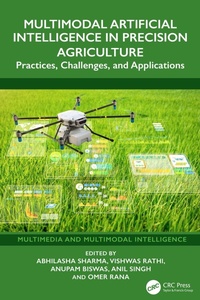
Multimodal Artificial Intelligence in Precision Agriculture
Practices, Challenges, and Applications
1st Edition
Published on 9. April 2026
336 pages
978-1-040-58483-5 (ISBN)
Description

This book highlights the integration of cloud, edge, and network computing for sustainable farming and future trends in smart farming including the role of UAVs, 5G, and advanced artificial intelligence. It covers the use of real-time environmental data for forecasting and tracking agricultural products and livestock health monitoring.
Offers a detailed exploration of the integration of Internet of Things, artificial intelligence, and multimodal intelligence in precision agriculture, covering a wide range of applications from crop management to livestock monitoring.
Identifies and discusses the challenges of using artificial intelligence and multimodal data in agriculture, providing solutions and techniques to overcome these obstacles. * Discusses advanced technologies like multispectral and hyperspectral imaging, Internet of Things sensors, and data fusion techniques.
Highlights emerging trends and future directions in smart farming, including UAVs, 5G, cloud-edge continuum integration, and federated learning.
Includes case studies and practical examples demonstrating successful applications of multimodal artificial intelligence in precision farming.
The text is primarily written for senior undergraduates, graduate students, and academic researchers in electrical engineering, electronics and communications engineering, computer science and engineering, agricultural engineering, and information technology.
Offers a detailed exploration of the integration of Internet of Things, artificial intelligence, and multimodal intelligence in precision agriculture, covering a wide range of applications from crop management to livestock monitoring.
Identifies and discusses the challenges of using artificial intelligence and multimodal data in agriculture, providing solutions and techniques to overcome these obstacles. * Discusses advanced technologies like multispectral and hyperspectral imaging, Internet of Things sensors, and data fusion techniques.
Highlights emerging trends and future directions in smart farming, including UAVs, 5G, cloud-edge continuum integration, and federated learning.
Includes case studies and practical examples demonstrating successful applications of multimodal artificial intelligence in precision farming.
The text is primarily written for senior undergraduates, graduate students, and academic researchers in electrical engineering, electronics and communications engineering, computer science and engineering, agricultural engineering, and information technology.
More details
Series
Edition
1. Auflage
Language
English
Place of publication
London
United Kingdom
Publishing group
Taylor & Francis Ltd
Target group
College/higher education
Professional and scholarly
Illustrations
45 Tables, black and white; 65 Line drawings, black and white; 19 Halftones, black and white; 84 Illustrations, black and white
File size
15,71 MB
ISBN-13
978-1-040-58483-5 (9781040584835)
Copyright in bibliographic data and cover images is held by Nielsen Book Services Limited or by the publishers or by their respective licensors: all rights reserved.
Schweitzer Classification
Other editions
Additional editions
Abhilasha Sharma | Vishwas Rathi | Anupam Biswas
Multimodal Artificial Intelligence in Precision Agriculture
Practices, Challenges, and Applications
Book
05/2026
1st Edition
CRC Press
€164.50
Shipment within 15-20 days
Persons
Abhilasha Sharma is currently working as an assistant professor, in the Department of Computer Engineering, at National institute of Technology, Kurukshetra, India. She has published research papers and articles in high-impact journals and international conferences of repute including Computer Networks, Computer Communications, wireless personal communication etc. She has taught 3 postgraduate courses including machine learning, Cloud Computing and Security, and deep learning. Her research interests include cyber physical systems, wireless networks, vehicular communication, and software-defined networks.
Vishwas Rathi is currently as an assistant professor, in the Department of Computer Engineering, at the National Institute of Technology, Kurukshetra, India. He has authored research papers in renowned venues such as IEEE Transactions on Computational Imaging, IEEE Signal Processing Letters, Signal Processing: Image Communication, and IEEE International Conference on Image Processing Challenges and Workshops. His research interests encompass image processing, computational imaging and forensics, multispectral imaging systems, and applied deep learning.
Anupam Biswas is presently working as an assistant professor, in the Department of Computer Science and Engineering, at the National Institute of Technology Silchar, Assam, India. He has published over 100 research papers in prestigious international journals, conferences, and book chapters, including IEEE Transactions on Fuzzy Systems, IEEE Transactions on Social Computing, Elsevier Information Fusion, Elsevier Information Sciences, and Expert Systems with Applications, among others. His research interests include machine learning, deep learning, evolutionary computation, social networks, and information retrieval.
Anil Singh is presently working as an assistant professor, in the Department of Electronics and Communications Engineering, at Thapar Institute of Engineering and Technology, Patiala, India. He has also been a postdoctoral researcher at the Department of Computing, Umea University, Sweden. He has authored research papers and articles in high-impact journals and internationally reputed conferences, including IEEE Transactions on Services Computing, Software: Practice and Experience, Cluster Computing, IEEE/ACM International Conference on Utility and Cloud Computing, among others. He has also taught around 8 postgraduate courses, such as cloud infrastructure and services, agile software methodology, advanced computer architecture, advance data structures, among others. His research interests include cloud-edge-fog systems, edge artificial intelligence, energy efficiency, and distributed computing resource management.
Omer Rana is a Dean of International for the Physical Sciences and Engineering College, and a Professor of Performance Engineering with Cardiff University, Cardiff, U.K. He has authored over 700 peer-reviewed papers and articles in high-impact journals and internationally reputed conferences, including IEEE Cloud Computing, IEEE Transactions on Services Computing, Software: Practice and Experience, ACM computing surveys, ACM Transactions on Internet Technology, Cluster Computing, IEEE/ACM International Conference on Utility and Cloud Computing, among others. His current research interests include problem solving environments for computational science and commercial computing, data analysis and management for large-scale computing, and scalability in high performance agent systems.
Vishwas Rathi is currently as an assistant professor, in the Department of Computer Engineering, at the National Institute of Technology, Kurukshetra, India. He has authored research papers in renowned venues such as IEEE Transactions on Computational Imaging, IEEE Signal Processing Letters, Signal Processing: Image Communication, and IEEE International Conference on Image Processing Challenges and Workshops. His research interests encompass image processing, computational imaging and forensics, multispectral imaging systems, and applied deep learning.
Anupam Biswas is presently working as an assistant professor, in the Department of Computer Science and Engineering, at the National Institute of Technology Silchar, Assam, India. He has published over 100 research papers in prestigious international journals, conferences, and book chapters, including IEEE Transactions on Fuzzy Systems, IEEE Transactions on Social Computing, Elsevier Information Fusion, Elsevier Information Sciences, and Expert Systems with Applications, among others. His research interests include machine learning, deep learning, evolutionary computation, social networks, and information retrieval.
Anil Singh is presently working as an assistant professor, in the Department of Electronics and Communications Engineering, at Thapar Institute of Engineering and Technology, Patiala, India. He has also been a postdoctoral researcher at the Department of Computing, Umea University, Sweden. He has authored research papers and articles in high-impact journals and internationally reputed conferences, including IEEE Transactions on Services Computing, Software: Practice and Experience, Cluster Computing, IEEE/ACM International Conference on Utility and Cloud Computing, among others. He has also taught around 8 postgraduate courses, such as cloud infrastructure and services, agile software methodology, advanced computer architecture, advance data structures, among others. His research interests include cloud-edge-fog systems, edge artificial intelligence, energy efficiency, and distributed computing resource management.
Omer Rana is a Dean of International for the Physical Sciences and Engineering College, and a Professor of Performance Engineering with Cardiff University, Cardiff, U.K. He has authored over 700 peer-reviewed papers and articles in high-impact journals and internationally reputed conferences, including IEEE Cloud Computing, IEEE Transactions on Services Computing, Software: Practice and Experience, ACM computing surveys, ACM Transactions on Internet Technology, Cluster Computing, IEEE/ACM International Conference on Utility and Cloud Computing, among others. His current research interests include problem solving environments for computational science and commercial computing, data analysis and management for large-scale computing, and scalability in high performance agent systems.
Content
1. Introduction. 2. Use of Data Fusion Techniques for Optimizing Agricultural Practices. 3. Use of Multimedia Technologies/ Multimodal Intelligence for Crop Monitoring and Management. 4. Implementation of Machine Learning and Deep Learning Techniques for Disease Detection and Classification. 5. Analysis of Soil Properties using Internet of Things Sensors and Multimodal Data Analytics. 6. Employing Integrated Data to Study the Impact of Climate Change on Agriculture. 7. Using Multimodal Data to Monitor Environmental Conditions and their Effects on Crop Production. 8. Use of Historical Data and Multimedia Inputs to Model and Forecast Crop Yields. 9. Utilization of Real-time Environmental Data for Crop Harvest Forecasting and Prediction. 10. Utilizing Sensor Data for Tracking and Tracing Agricultural Products from Farm to Market. 11. Using Multimedia and Audio Sensor Data for Livestock Health Monitoring. 12. Developing Mobile and Web Applications to Provide Farmers Recommendations for Efficient Farming Practices. 13. Future Trends in Multimedia and Multimodal Intelligence for Smart Farming. 14. The Importance of Integrating Federated Learning in Contemporary Farming Practices. 15. Precision Agriculture Utilizing Emerging Edge, Cloud and Network Computing. 16. Challenges and Future Trends w.r.t. Integration of Edge and Cloud Computing in Precision Agriculture. 17. Conclusion.
