

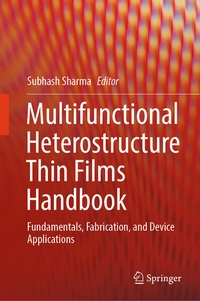
Multifunctional Heterostructure Thin Films Handbook
Description

This book provides a comprehensive guide to heterostructure thin films and multifunctional nanomaterials, highlighting how the stacking of dissimilar materials enables interface-driven properties that surpass those achievable in bulk systems. It covers fundamental concepts such as band alignment, strain and charge coupling, and built-in fields, alongside advanced synthesis techniques including pulsed laser deposition, atomic layer deposition, molecular beam epitaxy, and chemical/physical vapor deposition. The volume emphasizes state-of-the-art characterization methods, ranging from structural and compositional analyses to electrical, optical, and in-situ approaches, as well as AI-assisted multimodal techniques to probe interfaces and defects. Functional phenomena, including ferroelectricity, magnetoelectric coupling, spintronic effects, thermoelectric and piezoelectric responses, are closely tied to device applications such as non-volatile memories, sensors, actuators, solar cells, and flexible/wearable electronics. Case studies on multiferroic, van der Waals, and hybrid organic-inorganic systems illustrate the power of interface engineering. Chapters on inorganic perovskite solar cells, thin-film sensors, and PAAO-based plasmonic metamaterials demonstrate scalable, application-driven innovations. Concluding perspectives explore AI-assisted optimization, quantum and topological heterostructures, and strategies for scalable, energy-efficient device integration, offering a roadmap for future research in multifunctional thin films.
Multifunctional Heterostructure Thin Films Handbook: Fundamentals, Fabrication, and Device Applications serves as a valuable resource for researchers, engineers, and graduate students working at the forefront of materials science, nanotechnology, and the development of next-generation devices.
More details
Other editions
Additional editions
Person
Dr. Subhash Sharma is a Researcher at the Center for Nanoscience and Nanotechnology (CNyN) of the National Autonomous University of Mexico (UNAM). Before joining UNAM, he held a postdoctoral fellowship in the Department of Physics at the Institute of Science, Banaras Hindu University (BHU), under the National Postdoctoral Fellowship (NPDF) program. He earned his Ph.D. in Physics from the Jaypee Institute of Information Technology (JIIT), Noida, India, in 2016. Dr. Sharma's research focuses on the structural, dielectric, and magnetic properties of multiferroic ceramics and thin-film heterostructures. His broader research interests include developing multifunctional nanomaterials for green energy applications, heterostructure thin films (via RF magnetron sputtering & PLD) for energy storage and memory devices, and perovskite-based materials for photovoltaic technologies. He has authored over 100 research papers in reputed international journals and holds an h-index of 21. He has delivered more than 15 invited talks at international conferences and has served as a Guest Editor for special issues in recognized scientific journals, reflecting his research excellence and leadership in the field.
Content
Introduction to Thin Films and Heterostructures.- Thin Film Fabrication Techniques.- Advanced Characterization Techniques for Thin Films.- Magnetic Thin Films for Spintronics.- Ferroelectric Thin Films: Fundamentals and Applications.- Magnetoelectric Coupling in Thin Films.- Multiferroic Thin Films for Device Applications.- Spintronic Devices Based on Heterostructure Thin Films.- Thin Film Sensors: Applications in Environmental and Biological Detection.- Energy Harvesting Using Thin Film Devices.- Integration of Heterostructure Thin Films in Flexible and Wearable Devices.- Future Trends in Thin Film Device Applications.
