

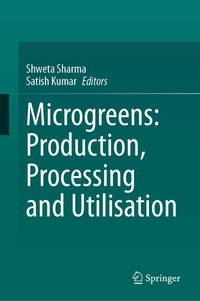
Microgreens: Production, Processing and Utilisation
Description

This book provides a comprehensive overview on production processing and utilization of microgreens in light of their popularity among health-conscious consumers, along with detailed information on the nutritional and functional importance of microgreens. The text promotes an understand of the basic concepts of microgreens cultivation, post harvest handling, processing techniques and value chain operations including growing, processing (harvesting, post-harvest handling and pest and disease management) and shelf life management. The basic aspects of microgreens as functional foods and their utilization such as culinary uses, salad dressings, product development and other potential food applications are covered in full.
Microgreens: Production, Processing and Utilisation studies current market trends and opportunities for the microgreen industry. The book provides information about developments in the field of microgreens as functional food in the last decade. Microgreens contain a variety of phytonutrients in concentrations usually higher than sprouts and baby greens and require less growing space with 15-20 days of growth period and thus has emerged as potential superfoods with numerous health benefits in the last decade.
More details
Other editions
Additional editions
Persons
Shweta Sharma is an Assistant Professor at the MS Swaminathan School of Agriculture, Faculty of Agriculture at Shoolini University of Biotechnology and Management Sciences
Satish Kumar is an Assistant Professor in the Department of Food Science and Technology at Dr. Yashwant Singh Parmar University of Horticulture and Forestry
Content
Microgreens, sprouts and baby greens: Understanding the basics.- Microgreens- Emergence as super food for well being.- Microgreens for food and nutritional security: diverse varieties and functional significance.- Advancements in microgreen cultivation: Soil based and soil less cultivation.- Integrated Insect Pest and disease management in microgreens.- Harvesting, post-harvest handling and minimal processing of microgreens.- Interventions for shelf-life extension and quality retention.- Brassicaceae Microgreens: Health Benefits and Food Versatility.- Amaranthaceae Microgreens: Nutrient-Dense Microgreens.- Amaryllidaceae Microgreens: Flavorful and Nutritious superfood.- Microgreens of Apiaceae family: Aromatic and Nutrient-Packed Greens.- Asteraceae Microgreens: Diverse Flavors and Health Advantages.- Microgreens: Value addition opportunities.- Genetic approaches for nutritional and functional improvement of microgreens.- Stress induced functional enhancement of microgreens.- Microgreens: Opportunities and applications as space food.
