

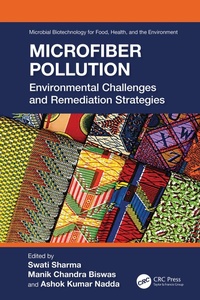
Microfiber Pollution
Environmental Challenges and Remediation Strategies
1st Edition
Published on 28. November 2024
338 pages
978-1-040-23063-3 (ISBN)
Description

Microfibers, synthetic fibers like polyester and nylon, are emerging contaminants widely distributed in air, water, and soil, posing significant ecological risks. The textile industry, driven by fast fashion trends, is a major source of microfiber pollution in both aquatic and terrestrial environments. These fibers degrade air quality, especially indoors, where they shed from textiles and contribute to respiratory issues and have potential carcinogenic effects due to associated dyes and pollutants. The widespread impact on human health and ecosystems has spurred interest in sustainable textiles and efforts to reduce microfiber pollution. Microfiber Pollution: Environmental Challenges and Remediation Strategies examines the global sources, environmental impacts, and remediation strategies for microfibers, aiming to educate consumers and encourage industry shifts towards eco-friendly alternatives.
Provides an in-depth examination of global microfiber sources, detailing their distribution in air, water, and soil, and highlighting the environmental and aquatic impacts.
Explores advanced methods for detecting and characterizing microfibers, enhancing understanding of how these pollutants propagate into oceans and affect marine habitats.
Discusses the potential threats of microfibers to aquatic species, human health, and the food chain.
Reviews current remediation technologies and sustainability trends in the textile industry, offering insights into future challenges and motivating both consumers and industries to adopt eco-friendly practices.
Provides an in-depth examination of global microfiber sources, detailing their distribution in air, water, and soil, and highlighting the environmental and aquatic impacts.
Explores advanced methods for detecting and characterizing microfibers, enhancing understanding of how these pollutants propagate into oceans and affect marine habitats.
Discusses the potential threats of microfibers to aquatic species, human health, and the food chain.
Reviews current remediation technologies and sustainability trends in the textile industry, offering insights into future challenges and motivating both consumers and industries to adopt eco-friendly practices.
More details
Series
Edition
1. Auflage
Language
English
Place of publication
London
United Kingdom
Publishing group
Taylor & Francis Ltd
Target group
Professional and scholarly
Illustrations
34 Tables, black and white; 36 Line drawings, black and white; 7 Halftones, black and white; 43 Illustrations, black and white
ISBN-13
978-1-040-23063-3 (9781040230633)
Copyright in bibliographic data and cover images is held by Nielsen Book Services Limited or by the publishers or by their respective licensors: all rights reserved.
Schweitzer Classification
Other editions
Additional editions
Swati Sharma | Manik Chandra Biswas | Ashok Kumar Nadda
Microfiber Pollution
Environmental Challenges and Remediation Strategies
Book
approx. 06/2026
1st Edition
CRC Press
€69.00
Not yet published
Swati Sharma | Manik Chandra Biswas | Ashok Kumar Nadda
Microfiber Pollution
Environmental Challenges and Remediation Strategies
Book
11/2024
1st Edition
CRC Press
€132.90
Shipment within 10-20 days
Persons
Swati Sharma is working as an assistant professor in the University Institute of Biotechnology, Chandigarh University, Mohali, Punjab India. Dr. Sharma has completed her PhD from the University Malaysia Pahang, Malaysia. She worked as a visiting researcher in the College of Life and Environmental Sciences at Konkuk University, Seoul, South Korea. Dr. Sharma has completed her master's (M.Sc.) from Dr. Yashwant Singh Parmar University of Horticulture and Forestry, Nauni Solan H.P., India. She has also worked as program co-coordinator at Himalayan Action Research Center Dehradun and senior research fellow at India Agricultural Research Institute. Presently, Dr. Sharma's research is in the field of biopolymers, waste management, bioplastics, hydrogels, keratin, nanofibers, sponges, beads and nanoparticles, and polymers with antioxidant and anti-cancerous activities. Dr. Swati has published more than 35 research papers in various internationally reputed journals, 15 books, and a couple of book chapters.
Manik C. Biswas is a polymer and materials engineering expert with 10+ years of research and industrial experience seeking to innovate real-world textile and polymeric products in a multidisciplinary way yet individually, with expertise in polymer chemistry, fiber spinning techniques, wet processing techniques, nanomaterials synthesis, surface modification via functionalisation, and grafting and polymer reinforcement. Dr. Biswas utilises his unique knowledge of applied chemistry, chemical engineering, polymers, and fibers to guide innovations in green chemistry as well as their adoption by industry and government. He finished his PhD in fiber and polymer science from Wilson College of Textiles, North Carolina State University, USA, and is working as a materials engineer in the packaging industry focusing on materials solutions and sustainability. Dr. Biswas also finished his master's in materials science and engineering from Tuskegee University, Alabama, USA. He also another master's degree in applied chemistry and chemical engineering from University of Dhaka, Bangladesh, where he finished his B.Sc. Dr. Biswas has filed a U.S. patent and has published 25 research articles in various internationally esteemed journals and more than 6 book chapters.
Ashok Kumar Nadda is working as an assistant professor in the Department of Biotechnology and Bioinformatics, Jaypee University of Information Technology, Waknaghat, Solan, Himachal Pradesh, India. He has completed his Ph.D. in Biotechnology from Department of Biotechnology, Himachal Pradesh University, Summer Hill, Shimla, India. He worked as a post-doctoral fellow in State Key Laboratory of Agricultural Microbiology, Huazhong Agricultural University, Wuhan, China. He also worked as a brain pool researcher/assistant professor at Konkuk University, Seoul, South Korea. Dr. Ashok has a keen interest in carbon utilisation, enzyme immobilisation, biomaterials, biopolymers, nanobiotechnology, biocatalysis, waste management, biomass degradation, biofuel synthesis, and biotransformations. Dr. Ashok has published more than 150 research papers in various internationally reputed journals, 34 books, and 57 book chapters and holds a couple of patents.
Manik C. Biswas is a polymer and materials engineering expert with 10+ years of research and industrial experience seeking to innovate real-world textile and polymeric products in a multidisciplinary way yet individually, with expertise in polymer chemistry, fiber spinning techniques, wet processing techniques, nanomaterials synthesis, surface modification via functionalisation, and grafting and polymer reinforcement. Dr. Biswas utilises his unique knowledge of applied chemistry, chemical engineering, polymers, and fibers to guide innovations in green chemistry as well as their adoption by industry and government. He finished his PhD in fiber and polymer science from Wilson College of Textiles, North Carolina State University, USA, and is working as a materials engineer in the packaging industry focusing on materials solutions and sustainability. Dr. Biswas also finished his master's in materials science and engineering from Tuskegee University, Alabama, USA. He also another master's degree in applied chemistry and chemical engineering from University of Dhaka, Bangladesh, where he finished his B.Sc. Dr. Biswas has filed a U.S. patent and has published 25 research articles in various internationally esteemed journals and more than 6 book chapters.
Ashok Kumar Nadda is working as an assistant professor in the Department of Biotechnology and Bioinformatics, Jaypee University of Information Technology, Waknaghat, Solan, Himachal Pradesh, India. He has completed his Ph.D. in Biotechnology from Department of Biotechnology, Himachal Pradesh University, Summer Hill, Shimla, India. He worked as a post-doctoral fellow in State Key Laboratory of Agricultural Microbiology, Huazhong Agricultural University, Wuhan, China. He also worked as a brain pool researcher/assistant professor at Konkuk University, Seoul, South Korea. Dr. Ashok has a keen interest in carbon utilisation, enzyme immobilisation, biomaterials, biopolymers, nanobiotechnology, biocatalysis, waste management, biomass degradation, biofuel synthesis, and biotransformations. Dr. Ashok has published more than 150 research papers in various internationally reputed journals, 34 books, and 57 book chapters and holds a couple of patents.
Content
Introduction to Microfiber Pollution. Sources and Ubiquity of Microfibers.
Fate of Microplastics and Microfibers.
Detection and Characterization Techniques for Microfiber in Wastewater.
Effect of Microfiber Pollutants in Freshwater Ecosystems.
Marine Microfiber Pollution: Prevalence and Effect.
Soil Pollution by Microfibers: Harmful Effects.
Infiltration of Microfibers in Marine Habitats and Food Chain.
Microfiber Surface Acting as a Potential Niche for Proliferation of Microbial Community.
Microfibers as Carcinogenic and Neurodegenerative Agents.
Microfibers Accumulation in Aquatic Organisms.
Use of Biodegradable Fibers over Synthetic Fibers.
Advance Technologies to Reduce Marine Microfiber Pollution.
Role of Textile Industries in Microfiber Pollution.
Future Perspectives.
Role of Plastics and Packaging Industry.
Fate of Microplastics and Microfibers.
Detection and Characterization Techniques for Microfiber in Wastewater.
Effect of Microfiber Pollutants in Freshwater Ecosystems.
Marine Microfiber Pollution: Prevalence and Effect.
Soil Pollution by Microfibers: Harmful Effects.
Infiltration of Microfibers in Marine Habitats and Food Chain.
Microfiber Surface Acting as a Potential Niche for Proliferation of Microbial Community.
Microfibers as Carcinogenic and Neurodegenerative Agents.
Microfibers Accumulation in Aquatic Organisms.
Use of Biodegradable Fibers over Synthetic Fibers.
Advance Technologies to Reduce Marine Microfiber Pollution.
Role of Textile Industries in Microfiber Pollution.
Future Perspectives.
Role of Plastics and Packaging Industry.
