

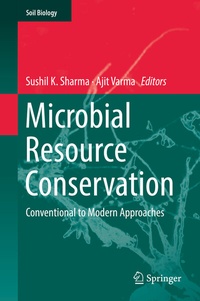
Microbial Resource Conservation
Description

Microorganisms are the silent and unseen majority of life on Earth, and are characterized by a high degree of genetic and metabolic diversity. It is well documented that no branch of science or society is unaffected by microbial interventions. Researchers have documented microorganisms from such extreme and unique environments as deserts and hydrothermal vents, and with specific traits that are currently being exploited in agriculture, industry, medicine and biotechnological applications. Such great potential can only be found in microorganisms. The aim of this book - the first entirely devoted to the conservation of microorganisms, and to regulatory mechanisms for access and benefits sharing as per Biological Diversity (BD) Act 2002 - is to promote awareness of our world's microbial wealth, and to introduce readers to strategies and methodologies for the conservation of microorganisms, which could ultimately save human life on Earth.
More details
Other editions
Additional editions
Persons
Prof Dr Ajit Varma: Ajit Varma has completed his PhD at the age of 25 years from Allahabad University and Former Professor, School of Life Sciences, Jawaharlal Nehru University, India. Presently, he is the Distinguished Scientist & Professor of Eminence of AmityInstitute of Microbial Technology; Pro-Vice Chancellor, Ritnand Balved Education Foundation, and Vice Chairman, Amity Science, Technology & Innovation Foundation Amity University Uttar Pradesh, India. He has published more than 314 papers. Ajit Varma is the Fellow of Alexander-von-Humboldt Society, Germany, elected Fellow of National Academy Agricultural Sciences and Fellow of Microbiology Society of India.
Content
1. Microbial Genetic Resources: Status, Conservation, Access and Benefit Sharing (ABS) Regulations.- 2. Concept of Microbial Preservation: Past, Present and Future.- 3. Establishment and Management of Culture Collections of Microorganisms (mBRC): An Overview.- 4. Specialized Microbial Resource Centres: A Driving Force of the Growing Bioeconomy.- 5. Agricultural Microbial Genetic Resources: Application and Preservation at Microbial Resource Centres (mBRCs).- 6. Rhizobia: Culture Collections, Identification and Methods of Preservation.- 7. Biobank for Conservation of Arbuscular Mycorrhizal (AM) Fungi.- 8. Conservation of Fungi: A Review on Conventional Approaches.- 9. Veterinary Type Cultures and their Preservation: Status and Challenges.- 10. Biodiversity Conservation of Phages and Microbial Populations.- 11. Modern Immunochemical Approaches in Microbiology.- 12. Conservation and Application of Microalgae for Biofuel Production.- 13. Desert Truffles in Saudi Arabia: Diversity, Ecology, and Conservation.- 14. Maintenance, Conservation and Regulation of Microbial Resources for Defense Applications.- 15. Diversity, Ecology and Conservation of Fungal and Bacterial Endophytes.- 16. Archaea: Ecology, Application and Conservation.
