

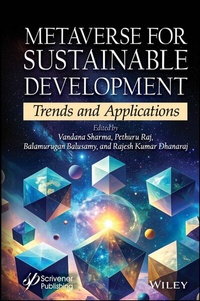
Metaverse for Sustainable Development
Description

Unlock the future of technology and sustainable development by purchasing Metaverse for Sustainable Development: Trends and Applications, a comprehensive guide that delves into immersive application building, groundbreaking innovations, and the transformative potential of the metaverse across various industries.
Metaverse for Sustainable Development: Trends and Applications explains the fine details of metaverse application building, demonstrating how integrated platforms in association with a suite of tools come in handy for enabling application construction. The metaverse is the next big thing influenced by virtual and augmented reality paradigms. This user experience will be more immersive and mesmerizing, empowering innovative, disruptive, and transformative technologies to create a spectacular platform for visualizing and realizing business-critical and people-centric metaverse systems. This book explores various metaverse models for healthcare information systems, including the latest technologies, such as the Brain-Computer Interface. Through real-world data and case studies, readers will gain a comprehensive understanding of the metaverse's potential for the Internet of Things, blockchain, artificial intelligence, 5G, and 3D modelling for creating and sustaining immersive virtual worlds.
Metaverse for Sustainable Development: Trends and Applications is a vital resource for understanding the end-to-end implementation of metaverse technologies.
More details
Other editions
Additional editions
Persons
Vandana Sharma, PhD is an associate professor at CHRIST University. She has published over 50 research papers in international journals and conferences, and contributed as a keynote speaker, session chair, reviewer, and Technical Program Committee (TPC) member for international journals and conferences. Her primary areas of interest include artificial intelligence, blockchain technology, and the Internet of Things.
Pethuru Raj, PhD is the Chief Architect and Vice President at Reliance Jio Platforms Ltd. with over 22 years of IT industry experience. He has over 120 publications, including six books and numerous book chapters and journal articles. His research focuses on the Internet of Things, artificial intelligence, model optimization techniques, blockchain, and digital twins.
Balamurugan Balusamy, PhD is an Associate Dean of Students at Shiv Nadar University with over 12 years of experience. He has published over 200 papers in international journals and edited and authored over 80 books. Additionally, he has given over 195 talks at international conferences and symposia. His contributions focus on engineering education, blockchain, and data sciences.
Rajesh Kumar Dhanaraj, PhD is a professor at Symbiosis International University. He has authored and edited over 45 books, and published 21 atents and over 90 articles and papers in in international journals and conferences. His research interests include machine learning, cyber-physical systems, and wireless sensor networks.
Content
Preface xxi
1 Demystifying the Metaverse Era: The Enabling Technologies and Industry Use Cases 1
Pethuru Raj, N. Gayathri and Vandana Sharma
1.1 Introduction 1
1.2 The Trends and Transitions in the Digital Era 3
1.3 Delineating Metaverse 6
1.4 The Metaverse Application Domains 27
1.5 Conclusion 32
2 Future Trends of Roadmap to Metaverse Technology 37
Jagjit Singh Dhatterwal, Kuldeep Singh Kaswan, Vandana Sharma and Balamurugan Balusamy
2.1 Introduction 38
2.2 Concepts of Metaverse 45
2.3 Metaverse 45
2.4 IT Hardware Parts (Physical Devices and Sensors) 48
2.5 Metaverse in Medical Domain 53
3 Amalgamation of IoT, Blockchain, Artificial Intelligence for Metaverse 59
Kuldeep Singh Kaswan, Jagjit Singh Dhatterwal, Reenu Batra and Vandana Sharma
3.1 Introduction 60
3.2 Understanding the Core Technologies 63
3.3 Synergy Between IoT, Blockchain, and AI 66
3.4 Applications in the Metaverse 70
3.5 Case Studies 73
3.6 Challenges and Solutions 75
3.7 Future Prospects 78
3.8 Conclusion 80
4 Metaverse Technology Architecture and Distributed Applications: Open Issues and Challenges 85
Pankaj Rahi, Budesh Kanwer, Monika Dandotiya, Reena Agnihotri and Mayur D. Jakhete
4.1 Introduction 86
4.2 Problems in Applying AR/VR in Healthcare 89
4.3 The Architecture and Use of Metaverse Technology 90
4.4 Applications 92
4.5 Benefits of Metaverse Technology in Improving the Quality of Services (QoS) 95
4.6 Limitations of Metaverse Technology Interfaces 97
4.7 Advantages of Metaverse 100
4.8 The Negatives of the Metaverse 101
4.9 Convergence Technologies, Open Issues, and Challenges of Metaverse 104
4.10 Conclusion 108
4.11 Future Work 109
5 Tools and Applications for Creation of MetaHuman 113
Vijay K., Eashaan Manohar, Sowmia K. R. and Ravikumar S.
5.1 Introduction 114
5.2 Evolution of MetaHumans 114
5.3 Metahuman Modeling 115
5.4 Functional Layer 116
5.5 Behavior Layer 117
5.6 Structural Layer 117
5.7 Challenges in Metahuman Creation 118
5.8 Phases of Creating Metahumans 118
5.9 Software Tools in Metahuman Creation 124
5.10 Platforms for MetaHuman Use 132
5.11 Conclusion 136
6 Exploring the Blockchain-Enabled Metaverse: A Comparative Study of Leading Platforms 139
Upinder Kaur and Vandana Sharma
6.1 Introduction 140
6.2 Metaverse in Depth 141
6.3 Introduction to Blockchain 145
6.4 Comparative Analysis of Blockchain Integration in Metaverse Platforms 148
6.5 Application Domains 154
6.6 Decentralization and Governance 156
6.7 Virtual Economy and Currency 157
6.8 User Experience and Accessibility 157
6.9 Security and Privacy 158
6.10 Ecosystem Development 159
6.11 Interoperability and Standards 159
6.12 Case Study: Virtual Career Fair Using Metaverse and Blockchain 160
6.13 Open Issues and Challenges in the Metaverse 162
6.14 Conclusion 164
7 Exploiting Smart Communication System Applications and Imagined Speech for Metaverse Fuzzy Conditions 171
Yogeesh N. and P. William
7.1 Introduction 172
7.2 Smart Communication System Applications and Their Relevance to Metaverse Fuzzy Conditions 175
7.3 Exploiting Smart Communication System Applications and Imagined Speech for Metaverse Fuzzy Conditions 184
7.4 Case Studies 190
7.5 Limitations and Challenges 194
7.6 Future Directions and Conclusion 196
8 Brain Computer Interface of an Immersive Virtual Metaverse Envisioned for Brain Healthcare 201
Pankaj Rahi, Abolfazl Mehbodniya, Julian L. Webber and Sayed Sayeed Ahmad
8.1 Introduction 202
8.2 System Overview 205
8.3 Brain Signaling Concepts 208
8.4 Brain-Computer Interface Architecture 211
8.5 Neuropsychological Signals Applied in BCI Applications 212
8.6 Humanoid BCI Research 214
8.7 Psychological Task Classification for Brain-Computer Interface Solicitations 223
8.8 BCI and Its Applications 225
8.9 Present and Futuristic Aspects 227
8.10 Conclusion 227
9 The Role of Metaverse in Education-Framework, Applications, Future Scope, and Importance of Metaverse in Virtual Learning Environment 233
Shubham Verma, Amit Gupta and Abhishek Prabhakar
9.1 Introduction 234
9.2 Advancements, Explanations, and Characteristics of the Metaverse 235
9.3 Collection of Technologies 237
9.4 Gap Analysis in the Real and Virtual Environment 237
9.5 Technologies Enhancement in Digital Era 237
9.6 Online Persona 237
9.7 Immersive and Multisensory Experience 238
9.8 Decentralized and Editable Content 238
9.9 Concept, Architectural View, and Characteristics of the Metaverse in Education 238
9.10 Architectural Representations Based on Metaverse in Education 239
9.11 High-Speed Communication and Networks 240
9.12 Computing Technologies 240
9.13 Technological Analysis 240
9.14 Modeling Within Metaverse 241
9.15 Variety of Technology Interaction with Metaverse 241
9.16 NPC-Non-Player Character 241
9.17 Metaverse Education Through Learning 242
9.18 Learning Resource 242
9.19 Learning Logging 243
9.20 Learning Analysis 243
9.21 Learning Authentication 243
9.22 Features of Metaverse in Education 244
9.23 Learners' Participation in Class Based on Time and Location 245
9.24 Learner Identity 245
9.25 Social Communication of Learners in Classroom 246
9.26 Learning Scene 246
9.27 Learning Resource 246
9.28 Learning Activity 247
9.29 Learning Interaction 247
9.30 Learning Objective 248
9.31 Future Potential Applications of the Metaverse in Education 248
9.32 The Metaverse Assists Blended Learning 249
9.33 The Metaverse Assists Virtual Experiment Learning 250
9.34 Metaverse Education: What is Next for Virtual Learning? 251
9.35 Understanding Metaverse Education 251
9.36 Metaverse Education: Opportunities 252
9.37 Enhanced Inclusion, Diversity, and Equity (DE&I) 252
9.38 Relatable to Modern Students (Digital Natives) 253
9.39 Can Be Combined with Mirror Worlds for Immersive Learning 254
9.40 Competitive Advancements of the Metaverse in Education 254
9.41 Technology and Equipment 254
9.42 Privacy and Data Security 255
9.43 Ethics and Morality 255
9.44 Addiction 256
9.45 Identity and Social Interaction 256
9.46 Potential Metaverse Education Research Areas 256
9.47 Conclusions 260
10 Concept Development and System Standards for Metaverse 263
Vijay K., Ravikumar S., Prithi Samuel and Eashaan Manohar
10.1 Introduction 264
10.2 What Does Metaverse Mean? 266
10.3 Concept Development for the Metaverse 267
10.4 Advantages of AI in Metaverse 276
10.5 How is Blockchain Related to Metaverse? 280
10.6 System Standards for the Metaverse 281
10.7 Research Challenges and Perspectives 284
10.8 Conclusion 287
11 Open-Source Tools, Platforms, and Environment for Building Metaverse 291
Himani Maheshwari, Umesh Chandra and Dharminder Yadav
11.1 Introduction 291
11.2 Open-Source Tools and Other Metaverse Platforms 294
11.3 Conclusion 305
12 Strategies and Procedures for the Development of Virtual Worlds Utilizing the Metaverse 307
Ridhima Sharma, Timcy Sachdeva and Prerna Ajmani
12.1 Introduction 307
12.2 Technical Process 308
12.3 Creative Approaches and Procedures 309
12.4 The Innovative Component 312
12.5 The Aspect of Society 312
12.6 Regarding the Economy 313
12.7 Component of Ethics 313
12.8 The Capabilities of the Technology of the Metaverse 315
12.9 Virtual Reality (VR) and Augmented Reality (AR) Technologies 316
12.10 Platform Compatibility Across a Wide Range of Platforms 318
12.11 Possible Outcomes 321
12.12 Conclusion 322
13 Case Studies and Use Cases for Metaverse-Driven Industries and Service Sectors 327
Vijay K., Sowmia K. R., Eashaan Manohar, K. Jayashree and Ravikumar S.
13.1 Introduction 328
13.2 Facilitating a Virtual Test Drive for Automotive Industry 328
13.3 Example: Uber is a Multi-Sided Platform Business Model 329
13.4 Virtual Showrooms for the Retail and eCommerce Sector 329
13.5 Seven Industries Transformed by Metaverse 330
13.6 What are the Metaverse Use Cases and Applications? 339
13.7 Conclusion 354
14 Fuzzy Logic in Metaverse Technology Roadmap: Adaptive Future Trends 359
Yogeesh N.
14.1 Introduction 360
14.2 Fuzzy Taxonomy for Metaverse Technologies 361
14.3 Fuzzy-Driven Technology Roadmap 363
14.4 Fuzzy Integration of Emerging Technologies 365
14.5 Case Studies 368
14.6 Future Perspectives 374
14.7 Conclusion 377
References 380
About the Editors 381
Index 383
1
Demystifying the Metaverse Era: The Enabling Technologies and Industry Use Cases
Pethuru Raj1, N. Gayathri2 and Vandana Sharma3*
1 Edge AI Division, Reliance Jio Platforms Ltd., Bangalore, India
2 Department of CSE, GITAM University, Bangalore, India
3 Department of Computer Science, Christ University, Bengaluru, India
Abstract
Metaverse can be called a 3D shared virtual space that is hyper realistic, immersive, instinctive, and interactive. Through metaverse, people try to visualize life in the manner that do not exist in the real world. The potential and promising digital technologies turn out to be a huge enabler of the metaverse dream. This chapter is to delineate the various versatile metaverse applications, implementation technologies, and use cases (individual as well as industrial).
Keywords: Metaverse, augmented reality, artificial intelligence, virtual reality
1.1 Introduction
Metaverse [1] is representing the next-generation universe, which will be mesmerizingly multi-dimensional, multi-purpose, and multifaceted. Users can enter into a metaverse environment through a specialized VR headset (this is very expensive at this point of time). In the future, this costly and bulky gear can become a software library to be pre-installed in our smartphones. Through a small additional hardware module, experimenting and experiencing the projected metaverse can be fully facilitated. So, the metaverse represents a kind of extended virtual world. Here in this shared virtual world, every participant can have his own augmented digital "body" (avatar) that he or she can easily customize. Also, the participant can have a home filled up with a growing collection of preferred artifacts, etc. He or she can visit hundreds of places and spaces virtually. He can communicate with various users in the imaginary world, accomplish some complicated works collaboratively, play games intuitively with intensity, spend time usefully in learning and sharing what is learned, etc. In short, whatever we do in our everyday surroundings (house, motels or any public place, etc.) can be comfortably replicated in a virtual environment. The metaverse idea is definitely blooming because it brings forth a dazzling array of individual and industrial use cases [2]. For an example, experts point out that the metaverse can reduce our travel needs across the globe. Instead, we can enjoy and experience different dream locations across the world with all the comfort at our homes. On the other side, we can have our physical places and products getting augmented substantially through augmented reality (AR) gears. In a 3D environment, visualization and communication between various things happen in a smooth manner. We can quickly switch between activities and locations by making a simple gesture. In the digital world, everything is connected and readily available and accessible to understand its unique capabilities.
1.1.1 Metaverse Technologies and Tools
With more such pulsating and peculiar use cases emerging and evolving, building and releasing metaverse applications formally leveraging an end-to-end technology stack is gaining the momentum in the recent past. Fortunately, there are several development and deployment platforms and frameworks for producing and delivering new-generation metaverse offerings. However, building such applications is very tricky yet trendsetting. The mission of establishing and sustaining the metaverse is radically simplified through the power of a bevy of digital technologies. In this section, we are to discuss the most indispensable technologies that can speed up the dawn of the metaverse era.
- Augmented reality
- Virtual reality dealing with metaverse
- AI for metaverse
- Natural language processing
- Blockchain technology
- The Internet of Things (IoT)-digitized entities, connected devices, drones, robots, etc.
- Data fabric and mesh
- 5G and 6G communication
- Digital twins
- Edge and cloud-native computing
- Service mesh
- Serverless processing
- Event-driven architecture (EDA) and event mesh
- Augmented and virtual reality (AR/VR) for Metaverse
- Cybersecurity
1.2 The Trends and Transitions in the Digital Era
- The web is tending toward Web 3.0.
- The universe is heading toward Metaverse.
1.2.1 About Web 3.0
Rather than using central database, in Web 3.0, applications use a decentralized environment. Communities will be developed as a decentralized autonomous organization (DAO). Web 3.0 will also make use of AI toward producing intelligent and adaptive applications. HTML will still continue to be a foundational layer with Web 3.0, but how it connects to data sources and where those data sources reside are possibly different.
- Decentralized-Web 3.0 applications will be architected and developed in a decentralized fashion. In a decentralized setup, there is no central control.
- Blockchain-enabled-This is clearly the enabler for the origin of decentralized services. Blockchain can also create a decentralized database, which is an immutable ledger of transactions and activities. Such an enablement helps in providing authenticity in an increasingly decentralized world which is accountable.
- Cryptocurrency-based-Its usage will become a crucial feature of Web 3.0 services.
- Autonomous and AI-enabled-Automation is a characteristic of Web 3.0, and it will be supported by AI algorithms and techniques.
As indicated above, Web 3.0 is the next evolution of the Internet paradigm [3]. This represents the evolution of how users are able to create and control their identities, digital content, and services. The digital creators can make money by leveraging the popular blockchain technology in a highly secure manner. The aspect of non-fungible tokens (NFTs) is a popular one for the blockchain technology. NFTs turn out to be a shining example of owning, securing and selling digital arts and assets with the aid of the powerful blockchain method. NFTs make it possible for items to exist uniquely in the increasingly digital and connected world. In the current web environment, digital data and content can be cut, copied and pasted by anyone at will, but certain digital items are very important and memorable and hence it is mandatory to ensure their ownership and manipulation. Therefore, noteworthy digital arts are being formally tokenized and secured through the inherent strength of blockchain.
Web 3.0 is blossoming as an effective tool for decentralization. Web 3.0 is being built on the blockchain protocol, which is decentralized management of financial data and further governance of the same. This protocol does not mandate for hosting and management of digital content and services in a centralized location. Actually, the real power lies with the creator. In the current Web 2.0, everything is centralized and controlled. Digital creators do not have the full power. Instead, Web 2.0 service providers gain all the power of managing digital content and services. For example, Twitter can remove our account and content anytime without our approval because the operating control lies with Twitter.
Previously, the semantic web was termed as Web 3.0. The Internet paradigm started with Web 1.0 (simple web) and then moved over to social Web 2.0 and the world is tending toward Web 3.0 (semantic web) with much maturity and sustained growth of digital technology, but as it turns out, the projected semantic web is not exactly as Web 3.0. The semantic web seems acquiring a special significance because it has the inherent potential to enable many web pages can be brought together to be correlated using a semantic protocol. Such an arrangement helps users to extract highly beneficial relationships hidden between web pages. A comprehensive search is possible when the idea of semantic web matures with the technologies and tools which are promising. Semantically correct content and services will be identified and supplied for any search query. All web pages can be indexed based on their relevance and affinity. Answering for complex questions will be a correct and comprehensive affair.
The current web pages and portals provide minimal experiences only, but Web 3.0 will be three-dimensional; thereby, users can get an immersive experience in the web world as in the real world. Increasingly, our everyday and industrial environments are being stuffed and sandwiched with scores of multifaceted sensors, actuators and other edge technologies. Therefore, people will get a kind of interactive experience due to the triggers originating from the environment sensors. Gestures, voice commands, and other movements will guarantee a distinct experience. In simple terms, Web 3.0 is the decentralized Internet succulently built on the blockchain technology. The economic value of Web 3.0 exponentially grows. Web 3.0 can host NFTs, applications and their data in a decentralized, publicly discoverable, network-accessible, highly usable and secure manner. Web 3.0 applications, tokens, and data on blockchain layer are being seen as a game-changer.
Blockchain [4] and Web 3.0 data can get analyzed through the leverage of AI algorithms and models to extract actionable insights. In the Web 3.0 world, not only making sense out of data but also making money is to thrive soon. Experts are pondering the ways and means of integrating Web 3.0 and blockchain together to put a stimulating and sparkling foundation. With the...
