

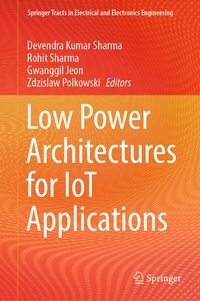
Low Power Architectures for IoT Applications
Description

This book provides comprehensive coverage of different aspects of low-power circuit synthesis for IoT applications at various levels of the design hierarchy, starting from the layout level to the system level. For a seamless understanding of the subject, the basics of MOS circuits have been introduced at the transistor, gate and circuit level, followed by various low-power design methodologies, such as supply voltage scaling, switched capacitance minimization techniques, and leakage power minimization approaches. The contents of this book are useful to students, researchers, as well as practicing engineers. Low-power architectures refer to the latest development in computer microchips which are created by integrating hundreds of thousands of transistors on one chip for different IoT applications. Emerging research in this area has the potential to uncover further applications for IoT in addition to system advancements.
More details
Other editions
Additional editions
Persons
Devendra Kumar Sharma received his B.E. degree in Electronics Engineering from Motilal Nehru National Institute of Technology, Allahabad, in 1989, his M.E. degree from Indian Institute of Technology Roorkee, Roorkee, in 1992, and his Ph.D. degree from National Institute of Technology, Kurukshetra, India, in 2016. He is a Professor and Dean of SRM Institute of Science and Technology, Delhi-NCR Campus, Ghaziabad, India. Dr. Sharma has authored many papers in several international journals and conferences of repute. His research interests include VLSI interconnects, electronic circuits, digital design, testing, and signal processing.
Rohit Sharma is currently an Associate Professor and Head of the Department of Electronics and Communication Engineering, SRM Institute of Science and Technology, Delhi-NCRCampus, Ghaziabad, India. He is an Editorial Board Member and Reviewer of more than 12 international journals and conferences. He serves as Book Editor for 16 different titles His research interests are data networks, data security, data mining, environment and pollution trend analysis, Big Data, IoT, etc.
Prof. Gwanggil Jeon received the B.S., M.S., and Ph.D. (summa cum laude) degrees from the Department of Electronics and Computer Engineering, Hanyang University, Seoul, Korea, in 2003, 2005, and 2008, respectively. He is currently a Full Professor at Incheon National University, Incheon, Korea. He has published more than 65 papers in journals and 25 conference proceedings. He served as a Member of the Technical Program Committee at many international conferences in Poland, India, China, Iran, Romania, and Bulgaria. His area of interest includes IT in Business, IoT in Business, and Education Technology.
Zdzislaw Polkowski is a Professor of UJW at the Faculty of Technical Sciences and Rector's Representative for the International Cooperation and Erasmus+ Program at the Jan Wyzykowski University Polkowice. Since 2019, he is also Adjunct Professor in the Department of Business Intelligence in Management, at Wroclaw University of Economics and Business, Poland. He is the Former Dean of the Technical Sciences Faculty during the period 2009-2012 at UZZM in Lubin. He holds a Ph.D. degree in Computer Science and Management from the Wroclaw University of Technology, a postgraduate degree in Microcomputer Systems in Management from the University of Economics in Wroclaw and a postgraduate degree in IT in Education from Economics University in Katowice. He obtained his engineering degree in Computer Systems in Industry from the Technical University of Zielona Gora. He has published more than 65 papers in journals and 25 conference proceedings, including more than 19 papers in journals indexed in the Web of Science, Scopus, and IEEE. He served as a Member of the Technical Program Committee at many international conferences in Poland, India, China, Iran, Romania and Bulgaria. To date, he has delivered 20 invited talks at different international conferences across various countries. He is also a Member of the Board of Studies and an Expert Member of the doctoral research committee at many universities in India. He is also a Member of the editorial board of several journals and served as Reviewer in a wide range of international journals. His area of interest includes IT in Business, IoT in Business and Education Technology.
