

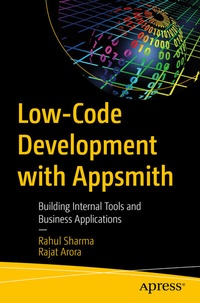
Low-Code Development with Appsmith
Description

This book will show you how to harness the power of Appsmith, an open-source low-code platform with a large set of integration tools and an active community.
The book begins with an introduction to Appsmith and its features. As you explore the platform, you will learn about widgets, UI Canvas, and data stores, among other things. Authors Rahul Sharma and Rajat Arora then show you how to build customizations and navigation workflows, as well as how to handle error handling, debugging, and troubleshooting with Appsmith. You will also learn efficient monitoring and authentication for deploying production-ready systems. Low-Code Development with AppSmith provides examples, realistic scenarios, and explanations of the tools you'll need to build successful low-code apps, helping you gain practical skills.
Upon completing this book, you will be able to use Appsmith to build low-code solutions that suit your business requirements.
What You Will Learn
- Understand low-code development and the factors driving its adoption
- Solve your business's most pressing issues with Appsmith
- Gain an understanding of the key concepts of app development, such as data management, APIs, troubleshooting, and debugging
- Model different design patterns for low-code development
Who This Book Is For
Anyone interested in designing technical solutions with minimal programming. This book assumes a basic understanding of object-oriented programming and JavaScript.More details
Other editions
Additional editions
Persons
Rahul Sharma is an architect with18 years of experience developing Java/J2EE and Python applications. He has worked in a variety of organizations ranging from enterprises to startups. He has experience with various architectures, including monolith, distributed, Big data, and streaming.
Rajat Arora is a hands-on programmer with over ten years of experience building software in the fintech domain. He has worked with both monolith and microservices-based architectures using .NET and Java technology stacks. He is currently working as an Engineering Manager.
