

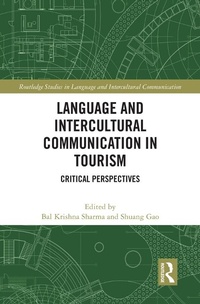
Language and Intercultural Communication in Tourism
Critical Perspectives
1st Edition
Published on 25. November 2021
282 pages
978-1-000-46801-4 (ISBN)
Description

This collection critically examines tourism as a site of intercultural communication, drawing on the analytical tools afforded by the discipline toward better understanding contemporary tourism discourses and the broader societal structures of power and ideologies in which they are situated.
The volume interrogates culture and interculturality in tourism in detailed analyses of discursive details in tourism interactions and focuses on the notion of culture as a process or phenomenon engaged in or enacted on by individuals. Drawing on discourse analytic and ethnographic approaches, the book brings together perspectives from the lived experiences of residents, hosts and ethnographers to explore the extent to which linguistic and cultural differences are constructed, identities negotiated, and power relations maintained and perpetuated in tourism encounters. The volume draws on insights from those working across a range of geographic contexts and explores the interplay of these issues in English as well as other languages and language varieties used in tourism interactions.
With its focus on critical approaches to understanding language and culture, this book will appeal to students and scholars in intercultural communication, applied linguistics, sociolinguistics, linguistic anthropology, discourse analysis, and tourism studies.
The volume interrogates culture and interculturality in tourism in detailed analyses of discursive details in tourism interactions and focuses on the notion of culture as a process or phenomenon engaged in or enacted on by individuals. Drawing on discourse analytic and ethnographic approaches, the book brings together perspectives from the lived experiences of residents, hosts and ethnographers to explore the extent to which linguistic and cultural differences are constructed, identities negotiated, and power relations maintained and perpetuated in tourism encounters. The volume draws on insights from those working across a range of geographic contexts and explores the interplay of these issues in English as well as other languages and language varieties used in tourism interactions.
With its focus on critical approaches to understanding language and culture, this book will appeal to students and scholars in intercultural communication, applied linguistics, sociolinguistics, linguistic anthropology, discourse analysis, and tourism studies.
More details
Series
Edition
1. Auflage
Language
English
Place of publication
London
United Kingdom
Publishing group
Taylor & Francis Ltd
Target group
College/higher education
Illustrations
1 Tables, black and white; 8 Line drawings, black and white; 39 Halftones, black and white; 47 Illustrations, black and white
ISBN-13
978-1-000-46801-4 (9781000468014)
Copyright in bibliographic data and cover images is held by Nielsen Book Services Limited or by the publishers or by their respective licensors: all rights reserved.
Schweitzer Classification
Other editions
Additional editions
Bal Krishna Sharma | Shuang Gao
Language and Intercultural Communication in Tourism
Critical Perspectives
Book
09/2023
1st Edition
Routledge
€63.60
Shipment within 10-20 days
Bal Krishna Sharma | Shuang Gao
Language and Intercultural Communication in Tourism
Critical Perspectives
Book
11/2021
1st Edition
Routledge
€206.70
Shipment within 15-20 days
Language and Intercultural Communication in Tourism
Critical Perspectives
Book
10/2021
Routledge
Unfortunately, price unknown
Article exhausted; check different version
Persons
Bal Krishna Sharma is Assistant Professor of Applied Linguistics at the University of Idaho, USA.
Shuang Gao is Lecturer in Applied Linguistics in the Department of English at the University of Liverpool, UK.
Shuang Gao is Lecturer in Applied Linguistics in the Department of English at the University of Liverpool, UK.
Content
Table of Contents
Chapter 1. Introduction: The problem of interculturality in tourism (Shuang Gao and Bal Krishna Sharma)
Part 1. Metadiscourses of interculturality in tourism
Chapter 2. The Other food: Ambivalence and (in)authenticity in the representation of Chinese food and foodways at tourist cooking schools (Shuang Gao)
Chapter 3. Imaging Chinese in touristic intercultural communication (Xiaoxiao Chen)
Chapter 4. Interculturality and stereotypes in tourism instructional discourse (Bal Krishna Sharma)
Part 2. Interculturality in the promotion of tourist destinations
Chapter 5. "Fun place and hospitable people": (Post)colonial gaze towards the Philippines on webpages for Japanese learners of English (Jayson Parba and Tomoaki Morikawa)
Chapter 6. Finding Queen Emma at the International Market Place: The intercultural semiotics of commodified cultural heritage tourism (Kristen Urada, Lin Chen, Kathleen Griffin, Michaela Nuesser, and Christina Higgins)
Chapter 7. Culinary types: Culture in the typographic landscape of the Eastern Food Bazaar in Cape Town (Gilles Baro)
Part 3. Interculturality and identity in tourism encounters
Chapter 8. Getting down to business: Intercultural communication and the utilitarian discourse system in an urban tourist destination in France (Adam Wilson)
Chapter 9. Ecocultural identity and intercultural communication in wildlife ecotourism: Stance-taking towards sea turtles in Hawai'i (Gavin Lamb)
Chapter 10. Emergent stance in walking tour discourse in Nara: The intersubjective construction of interculturality (Hiroko Takanashi)
Chapter 11. Touring linguistic borderland: Communicating the 'cultural divide' in bilingual guided tours (Larissa Semiramis Schedel)
Discussion commentary: Why we didn't see things and why we should have: Critical considerations on tourism and intercultural communication (Alexandre Duchene)
Chapter 1. Introduction: The problem of interculturality in tourism (Shuang Gao and Bal Krishna Sharma)
Part 1. Metadiscourses of interculturality in tourism
Chapter 2. The Other food: Ambivalence and (in)authenticity in the representation of Chinese food and foodways at tourist cooking schools (Shuang Gao)
Chapter 3. Imaging Chinese in touristic intercultural communication (Xiaoxiao Chen)
Chapter 4. Interculturality and stereotypes in tourism instructional discourse (Bal Krishna Sharma)
Part 2. Interculturality in the promotion of tourist destinations
Chapter 5. "Fun place and hospitable people": (Post)colonial gaze towards the Philippines on webpages for Japanese learners of English (Jayson Parba and Tomoaki Morikawa)
Chapter 6. Finding Queen Emma at the International Market Place: The intercultural semiotics of commodified cultural heritage tourism (Kristen Urada, Lin Chen, Kathleen Griffin, Michaela Nuesser, and Christina Higgins)
Chapter 7. Culinary types: Culture in the typographic landscape of the Eastern Food Bazaar in Cape Town (Gilles Baro)
Part 3. Interculturality and identity in tourism encounters
Chapter 8. Getting down to business: Intercultural communication and the utilitarian discourse system in an urban tourist destination in France (Adam Wilson)
Chapter 9. Ecocultural identity and intercultural communication in wildlife ecotourism: Stance-taking towards sea turtles in Hawai'i (Gavin Lamb)
Chapter 10. Emergent stance in walking tour discourse in Nara: The intersubjective construction of interculturality (Hiroko Takanashi)
Chapter 11. Touring linguistic borderland: Communicating the 'cultural divide' in bilingual guided tours (Larissa Semiramis Schedel)
Discussion commentary: Why we didn't see things and why we should have: Critical considerations on tourism and intercultural communication (Alexandre Duchene)
